Monday, April 25, 2022

The Woman You Know And Have Never Met


Alice Ranck Hettle

You know this woman, although unless you attended New Albany High School between 1952 and 1986, it is unlikely you ever met her.  If, on the other hand, you were one of my students in Missouri, Texas, or Indiana, you have.  In fact, if you have ever encountered one of Alice Ranck's students...teachers, doctors, lawyers, athletes, business people, moms, dads, coaches, and more...you have in some way come to know her.

Dedication for Dedication


I have written about this extraordinary Latin teacher before, and now I need to post an addendum.  On Sunday, April 24th, 2022, the New Albany High School media center was formally dedicated as the Alice Ranck Hettle Media Center.  It seemed only fitting that a space we used to call a library be dedicated to a teacher whose dedication both to academics and her students was and perhaps always will remain unparalleled.


Although she retired more than thirty-five years ago to marry a man she had met in the 8th grade, none of us could ever call her Mrs. Hettle.  She was always "Miss Ranck" or "Miss Alice" to her students, the latter appellation undoubtedly derived from her own habit of addressing us as "Mr." or "Miss" and then our first name.  I was always "Mr. Steve" to her.

After her passing in 2019, a group of her former students began to plan a suitable and permanent way to honor this woman who had so profoundly influenced so many lives.  The choice of the library/media center was obvious, as was the choice for a quotation on the plaque that now adorns the wall to the right of the picture above.


Seneca was a Stoic philosopher who lived from 4 B.C. to A.D. 65, and in Epistle LXXVI he wrote, "Tamdiu discendum est quamdiu nescias."  "You must keep learning as long as there is something you do not know."  Had Seneca not said it first, Miss Ranck surely would have said it herself, for she would often stop class to impart some bit of wisdom, prefaced by her trademark statement, "This is more important than any Latin I will teach you."  It is for that reason more than her clear presentation of the subjunctive mood or the ablative absolute that so many people were present for this dedication.

Across the Decades


Steven Prince, Latin Teacher, NAHS

The emcee of the ceremony, current New Albany High School Latin teacher Steve Prince, asked people to stand as he called out the decades, and people rose who had been students of Miss Ranck in the 1960s, 1970s, and 1980s.  The youngest among us had last sat in a classroom with Miss Ranck thirty-five years ago, the eldest more sixty.  What could possibly draw people from as far away as Houston, Texas?  What could have compelled people with physical infirmities for whom motion was clearly a challenge to visit a southern Indiana high school on a Sunday afternoon?  The answer is simple.  We were there for Miss Ranck.

When she was inducted into the NAHS Hall of Fame several years ago, Miss Ranck said, "It is our responsibility as educators to provide a sound education based on ethical principles.  Innate within every human being is first the desire to be noticed and to be loved, then comes the need to be taught to learn how to learn.  It is the role of the teacher to notice and yes, to love the student so much that he is ready to learn, and in turn develop all of his potential.  What better way for a teen-ager to learn to live honorably and well than to read from the literary masterpieces of Cicero."

After school board member Elizabeth Galligan read a poignant piece to acknowledge and commemorate the life of this extraordinary teacher, person after person took the microphone to share a "Miss Ranck" story.  Had Steve Prince not drawn this portion to a close, we could have been there all night listening to stories about this woman, whose first year of teaching was at Spartanburg High School in Lynn, Indiana, during the 1945-1946 school year, we could have been there all night.


That's My Teacher


I have friends in many noble professions, yet I do not think there is a calling that produces the excited statement, whether by a child or a senior citizen, quite like, "That's my teacher!"  

My calculus teacher, Jim Dickman

As guests began filling the atrium for the ceremony, I spotted across the room the man who had been my calculus teacher my senior year, Mr. Jim Dickman.  I quickly grabbed my daughter and asked her to take a picture of the two of us.  Mr. Dickman had also been a student of Miss Ranck, and although he is now retired and I am in the second phase of my own career, I was still excited to see "my teacher."

L to R:  Steve Perkins, Tim Harbison, Steve Prince

Many of Miss Ranck's students went on to become teachers and college professors, but only three that we know of became Latin teachers.  Tim Harbison, Steve Prince, and I share a special bond in that, but as all teachers know, there is something about the student-teacher relationship that is unlike any other.  The eminent polymath George Steiner wrote of this in Lessons of the Masters, a book that should be required reading for all teachers and that I explored in another post.  Those who have experienced such a special connection with a teacher can recognize the reason why in Miss Ranck's words above.  Before it is an academic relationship, it is a relationship based in love.

A Personal Note


To date I have taught more than 2,200 students, and while I have been blessed by a great many extraordinary teachers, a topic I have written about in "Why I Love Teaching, Part 1," it would not be too much to say that I would not have taught any of them had it not been for Miss Ranck.  As I described in the post titled "Infinite Space," God spoke to me when one day in 1986 she made an offhand reference to Antioch as the first place where anyone was ever called a Christian.  The call I felt on my life that day in Room C317 has led me to a life I have been blessed beyond measure to lead.  For this reason, I was grateful when Steve Prince took a few of us on a tour of the school and I was able to see that room once again.


Some things have change since I sat in that room years ago, learning from textbooks like Latin For Americans and Our Latin Heritage.  The door is in a new location, and there used to be windows that looked out across the football field.  For me, however, it was sacred ground, for it was there that I learned from Miss Ranck, heard the voice of God, and was inspired by the calling to which I have given my life.


Wednesday, April 20, 2022

A Brief Post on Mistakes


Errare humanum est.  To err is human.  This is proved in the frequent misattribution of this quotation to the Roman philosopher Seneca.  It seems the kind of thing he might have said, but we have no evidence that he actually said it.  But is that a really big deal?  If making mistakes is human, then perhaps we should just learn to live with them.

When Mistakes Matter


At some point in my Latin classes, we talk about how the Latin texts they read in their books came into existence.  We have no autographs from any ancient author, which is to say, we have no manuscripts written in their own hand.  We possess copies of works by people like Homer and Plato and Cicero and Vergil, but we do not have even one scrap of papyrus in their handwriting.  Copies were made even in their day, and then copies of those copies were made, after which copies of copies of copies were made, and so on down through the ages.  If you have ever copied something, however, you know that it is easy for your eyes to skip words, to write the same word twice, or to make other errors in transcription.

When I was a graduate assistant in Classics at The University of Texas, I was grading a set of etymology exams for a certain professor and noticed that a large number of the students had incorrectly defined a particular word.  Even stranger was that they had all misdefined it in the same way.  The word was "anthropocentric," and these students had defined it as an adjective related to the belief that "man is the center of the unwise."  I have often told my own students that if an answer does not make sense, it is probably wrong, but this professor had obviously not given such advice.  Eventually I figured out what had happened.  Apparently a student with illegible penmanship had shared his notes with the class, and although he had written "universe," the word looked like "unwise," and that was what the students had memorized for the test.

This kind of thing happened all the time in the transcription of ancient texts across the centuries, especially when those doing the copying did not know the language they were transcribing.  As a result, scholars have poured much work into establishing authoritative versions of texts by comparing the various manuscripts and applying philological rules to resolve discrepancies.  For more on this, see Max Hardy's excellent article in the online journal Antigone.

A Calligraphic Goof


I encountered this scribal problem firsthand recently after putting on our dry erase board the Verse of the Week for our Latin III class.  A student had come to see me before school, and as we talked, my eye wandered over to the board, and suddenly I saw the error, but even that I corrected incorrectly.  In the picture above you can see the Latin of 1 Peter 3:15.  The first word in the next-to-last line is posenti, which is not a Latin word at all.  I began to think about the verse and, not having memorized it in Latin, assumed that I miswritten petenti, figuring that since "e" and "o" are similar, my brain had simply taken one for the other.  Furthermore, because there are two instances of the long "s" in satisfactionem immediately above, I had mistakenly used the long "s" instead of "t."  My mental emendation had the benefit of keeping the sense of the verse, but when I actually looked at the Vulgate, I found that not only had I misspelled a word, but my intended correction was wrong as well.  The actual word in that verse is poscenti, and I had left out the letter "c."


The corrected version

I quickly changed the word on the board, and all was well, but it was an interesting reminder of the kind of thing that happened countless times as scribes copied the works of antiquity.  It is also a reminder of the debt of gratitude we owe classical philologists who have produced reliable texts that we can be quite confident express what the ancient authors wrote.

Wednesday, April 6, 2022

Vowels and Baptism

It can be caused by viruses, bacteria, and parasites.  Lactose, fructose, and artificial sweeteners can cause it as well.  It can even be associated with diseases such as ulcerative colitis, and despite its relatively simple treatment, there is some debate over how to spell it, or at least there was recently among some of my friends.

When Wordsmiths Text

In a text thread of three other friends and me, one of us had shared a screenshot from a news update on a certain illness, one of the symptoms of which included the condition described above.  What bothered someone on the thread was that the word was spelled "diarrhoea" instead of the more familiar "diarrhea."  One of my friends quipped, "I'm sure Steve will give us a full etymological report, replete with Latin roots -- whether we want it or not!"  Since I am the obliging type, sent them a diagram tracing the roots of the word to the original Greek noun "diarrhoia," and began unpacking the matter at hand.

You will notice that the Greek noun ends with iota alpha (ia in the transliteration).  That iota often comes into English as "e," as in "Phoinix" becoming "Phoenix."  Same thing with Phoibos -> Phoebus, as in Apollo.  There is a tendency in English to collapse diphthongs into single vowels.  The spelling you see is legitimate and is closer to a transliteration from the Greek.  This is why "caelestis," the Latin word for "heavenly," comes into English as "celestial."  The "ae" diphthong has collapsed into the single vowel "e."

[Referring back to the original issue of why someone might spell "diarrhea" with an "o," I added the following.]  Richmond Lattimore did this kind of thing in his translations of Homer.  He wanted to convey a sense of the Greek, so he used transliterations of names, e.g. Achilleus (Achilles), Hektor (Hector), Achaians (Achaeans), etc.

After introducing Richmond Latimore into the discussion, I thought I would share with my friends the translation of the New Testament that this renowned translator of Homer's Iliad and Odyssey had produced, and it was then that our conversation took an important turn.


From Vowels to Baptism

As I searched for a link to Lattimore's New Testament, I ran across the story of his baptism in 1983, just a year before his death.  The story was told more than twenty years later by Rev. Andrew Mead in a sermon on Sunday, January 16, 2005.  The message is short, and I urge you to follow this link and read it now.

I remember excitedly discovering Lattimore's translation of the New Testament nearly thirty years ago, and I was drawn, as I always am when picking up any translation, to the preface.  This preface did not, as one might expect in a Bible, give historical or theological or other specifically biblical information.  It did, however, as one would expect in a translation of Homer or Vergil, present stylistic information and a discussion of the translator's method and underlying theory of translation.  This was a scholar's work.  It was the work of a poet, and it never occurred to me that there might have been something more going on for Lattimore himself.  Yet there clearly was, as Lattimore revealed to Rev. Mead, to whom he had just admitted his desire for Christian baptism at the age of 73.  Mead shares in his sermon that he pressed Lattimore on what had apparently been Lattimore's known difficulties with the faith.

"Dr. Lattimore [though he preferred it, it was difficult for me to call him Dick], I thought you had reservations about the Christian faith and the Church."  "I did," he replied.  "But you don't any longer?"  "No, not any longer."  "Please then may I ask you, when did they go away?"  He was silent for a space; then, again with that smile and twinkling eyes, he answered, "Somewhere in Saint Luke."

The Closeness of Reading

Translation involves the close reading of a text.  Even someone with a cursory knowledge of another language can skim a text in that language and glean information, but translation is something entirely different.  Is the verb in the indicative or subjunctive mood?  To what does this relative pronoun refer?  Answering questions like these is essential to making an accurate translation, but when it comes to the biblical text, this close reading leads to another kind of closeness, one that Lattimore clearly experienced.  When we slow down and ponder a biblical text, when we look at it from multiple angles and ruminate on it, as it were, at the atomic level, we are drawn closer to the One Who is the author, or more simply, to The One Who Is.

There is a difference between to hen,” The One, of Plotinus, and “ho ōn,” The One Who Is.  It is the latter that we see surrounding the head of Jesus in icons and that we find in Revelation 4:8.  A close reading of these two Greek phrases reveals an impersonal quality to the former and a personal aspect to the latter, and therein lies all the difference.  God is not an idea, but a person.  To be precise, He is three persons eternally existing as one deity, and it would seem that this is Whom the renowned translator Richmond Lattimore encountered when reading closely the biblical text.  It is not necessary, of course, to read Hebrew or Greek or Latin to encounter God in the Bible.  What is necessary is a slow, careful reading, one that does more than skim a text to glean information.  Lattimore said that his reservations about the Christian faith were allayed "somewhere in Saint Luke."  What an exciting proposition to think that you, too, may encounter  ho ōn,” The One Who Is, as you read the Bible today!


Friday, April 1, 2022

Words Matter

Michael Biehn as Johnny Ringo in Tombstone

The 1993 film Tombstone opens with a scene of violence as members of the ruthless gang known as the Cowboys invade a wedding party.  The priest hurls words of Scripture at them in Spanish, and one of the gang translates, albeit loosely, for their leader, Curly Bill Brosius.  Fearsome gunslinger Johnny Ringo, however, knows better what was said.


Cowboy:  Patron, he say, uh, someone will come to revenge for him.  Something like a, a... sick horse who comes to sit with him.  He talk crazy.

Ringo:  That's not what he said, ya ignorant wretch.  Your Spanish is worse than your English.


Later, as the Cowboys help themselves to food from the wedding banquet, Curly Bill revisits the topic.


Curly Bill:  Hey, Johnny, what'd that Mexican mean..."a sick horse is gonna get us," huh?

Ringo:  He's quoting the Bible.  Revelations.  "Behold, a pale horse.  The man who sat on him was Death.  And hell followed with him."

Words matter.  Translators bear an enormous responsibility, one that is almost impossible to fulfill perfectly, and this is the reason the Italian expression traduttore, traditore exists.  The translator is in one aspect or another nearly always a traitor.

Consider the story of the woman caught in adultery that is told in John, chapter 8.  When the Pharisees bring the woman to Jesus, they cite the law of Moses for what should happen to her, and both the original Greek and the Latin of the Vulgate are quite clear.

ἐν δὲ τῶ νόμῳ ἡμῖν μωϊσῆς ἐνετείλατο τὰς τοιαύτας λιθάζειν.
In lege autem Moyses mandavit nobis huiusmodi lapidare.
In the law Moses commanded us to stone women of this sort.

The key words here are τὰς τοιαύτας in the Greek and huismodi in the Latin.  They both indicate categories or types.  The Pharisees are applying the general to the specific.  In general, women caught in adultery are to be stoned.  This particular woman was caught in adultery, and the consequence is clear.

Most English translations of the Bible get this right, but one, the New Living Translation, misses the mark.  It translates John 8:5 to say, "The law of Moses says to stone her."  As we just saw, the implication of the law is precisely that, and so, on one hand the NLT scholars were justified in this translation, yet they have also proved the truth of the Italian expression traduttore, traditore, for they have betrayed a key aspect of this verse.  The Pharisees see the woman merely as a category, but Jesus sees her as something else, something more.  He sees her as a person.


Fr. Mark Toups in The Ascension Lenten Companion has this to say about what happened that day just east of Jerusalem.

They stand behind her, the scribes and the Pharisees, each of them teeming with righteousness.  They bend down, looking around, hunting for the perfect rock to hurl so that they can crush her to death.

They do not see a woman.  They do not see a person.  They see a category.  To them she is a category, a thing with a label:  "an adulteress."  They are ready to stone her, to kill her, because they want to remove the category.

Jesus does not see a category; he sees a woman.  Jesus sees a person.  Jesus sees this particular person.  To Jesus she is not a category:  "adulteress."  No, she is a person.  She is a person who has made an egregious mistake, but she is a person who can be forgiven.  (p. 135)

By rushing on to the implication of the law for this particular moment, the NLT passes too quickly over what is really going on here, but if we stop for a moment, we see a profound lesson for ourselves.  How often do we in the shrill age of screeching social media merely see people as the categories into which they seem to fit?  It is easy to rail against Debbie the Democrat or Rob the Republican, Harry the Hollywood Elite or Charlotte the CEO, especially from the anonymity of a social media screen name, but what do we actually know of Debbie or Rob or Harry or Charlotte the human beings created in the image of God who have the same opportunity to accept redemption through Jesus Christ as any other man or woman?  Of course, Jesus was right in Matthew 7 when He said that we can know people by their fruits, which is to say, by their words and actions, but what does that mean?  Does it mean that we can use what people say and do to assign them to categories that we can then proceed to pillory, reject, or dismiss?  Or does it mean that we can use those fruits to see when people are not walking with Christ so that we can reach out to them as the salt and light Jesus has called us to be?

This gospel story convicts me, for I, like most people these days, can get caught up in the bloodless blood sport of sitting around with like-minded friends to skewer with wicked wit groups of people whose words and deeds seem out of alignment with what we think is right.  We should not turn a blind eye to sin, nor should we excuse sinful behavior, but we must be careful not see people merely as categories and rather as Jesus saw them, as He has seen each of us, as friends in need of His grace. 


Monday, March 28, 2022

Pen and Ink

In what might be the project with the greatest potential for mess, our Latin III students explore the world of Medieval calligraphy and text production as they learn to write in Carolingian Minuscule.  As I have described in another post, our Latin students are not strangers to working with ancient writing materials, and with this project they move from antiquity to the era of Charlemagne (747-814).  After spending much of the year reading the oratory and philosophy of Cicero, the philosophy of Seneca, and parts of the Bible, including the full Epistle to Titus, the students take a break from strictly linguistic work and enter the artistic aspect of presenting words in writing.

They begin by learning to dip pens in ink and write with metal nibs.  To be sure, the scribes in Charlemagne's time cut their pens from quills and made their own ink, but we can take advantage of a few modern conveniences!  I pour the ink into small, plastic cups, and the first step is for the students to become familiar writing a Speedball C-3 nib.

There is, of course, the challenge of learning to write with a square nib as opposed to the round point of the typical ballpoint or gel pen of today.  In addition, the students have to become comfortable with how much pressure to use.  Too much produces a blob or river of ink on the paper, but too little leaves a thin, scratchy trail.  There is also the issue of how often to dip the pen into ink.  Depending on how the nib is formed or has changed with use, some students can write a line or two before needing to dip again, yet others must get more ink after just a word or two.  For this reason, they first just doodle.  They write their names or draw shapes and lines to get the feel of the pens.

From there they begin to learn how to form the letters in what we know as Carolingian Minuscule.  This is a relatively simple script to learn, and once the students have broken down the basic strokes needed to make the letters, they practice by writing the alphabet multiple times.  The next level of practice comes from copying a simple and familiar Latin text, perhaps something from their first year of study that they remember fondly.  Once they have achieved a reasonable level of comfort, it is time for the real project to begin.

They are invited to choose a passage from Cicero, Seneca, or the Bible that we have read and that has particular meaning for them and then copy it in Carolingian Minuscule.  To add a bit of ambiance, we listen to the monks of Santo Domingo de Silos and their ethereal, Gregorian chant along the way.  Using markers, colored pencils, or even crayons, the students decorate the page in the style of the illuminated manuscripts that we have examined and submit a short paper that explores why they chose the text they did, what challenges they faced in learning to write in this style of Medieval calligraphy, and what insights they have gained into the production of texts in the Middle Ages.  It is no surprise that what they produce, both in the art of their manuscripts and in their written reflections, is quite beautiful.  Take a moment and enjoy this short video of their work and excerpts of what they shared.


Monks spent their whole lives copying the Bible letter by letter in painstaking detail so that the word of God could be read to people around the world.  I also never realized how much each page and really each letter is like its own little work of art.  -- Sophia


I've seen some illuminated texts in person, and the pages were massive.  I can't imagine how long it would take to fill one of those pages with text and images when even the small page that I did, with markers instead of paint to boot, took me hours to complete.  I wonder whether they felt the need to get every page exactly perfect, in which case they must have done many drafts and sketches of pages to ensure that they were achieving exactly the images they wanted, or whether they painted spontaneously without any guides or detailed planning, which sounds terrifying.  -- Marian


I struggled to keep the pen at the 45-degree angle that would lead to writing perfection, and when I did get back on track with the pen, my pen would run out of ink and the loop would start all over again.  Another minor problem I faced was with letter similarity, as I would often begin a letter, and my brain would make it a different letter, as the case with c and e.  -- Nathan


This whole experience left me with a much larger appreciation for the monks, or anyone, who copied and produced these manuscripts.  It took me about two class periods, almost three hours, to write four sentences.  I cannot imagine how long it would take to write even one book of the Bible. -- Sophie


While I was learning to write in Carolingian Minuscule, I found myself getting frustrated because of how long it would take me to write just one word.  After practicing the alphabet, I did find it a bit easier and I noticed I was writing faster.  After completing the calligraphy portion of this project, I was very glad I took as much time as I did and I was impressed with how good my writing looked.  -- Heidi


It took me around 60 minutes just to write less than two sentences, as compared to completing most of this paper in minutes.  From that difficulty I can also see that someone would have really cared about what they are copying compared to how people can copy something down on a computer without even thinking about it.  -- Otto


After a couple of sentences my hand was hurting.  I cannot imagine having to do this all day.  It was a cool experience and I had never tried calligraphy before or used real ink when writing.  I enjoyed it a lot and I have a much greater appreciation for scribes and monks.  -- Erin

Monday, February 14, 2022

Too Fond

Philosophy books to grade

It has been a long, long time since I was in Kindergarten, putting a big, red F on a quiz I had made for my grandmother.  Back then, I thought that was what teaching was all about, but then I grew up.  Now, grading is one of my least favorite parts of my job as a teacher, as it is for many if not most teachers.  I do not enjoy the tedium of it, but there is another reason grading is a particular challenge for me.  It takes too long.  Now, you may be thinking, "Just assign less work, smart guy, or create assignments that are easier to grade."  That solution, however, misses the root cause of my problem.  Grading takes a long time for me because I am too fond.

A King and His Priest

In the 1964 film Becket, an adaptation of the 1959 Jean Anouillh play Becket or the Honour of God, King Henry II (Peter O'Toole) falls out with his onetime friend Thomas Becket (Richard Burton), whom he had helped make the Archbishop of Canterbury.  In one of the most famous, although undoubtedly not the first, instances of plausible deniability, Henry muses among his noblemen, "Will no one rid me of this meddlesome priest?"  The nobles take this as a command from their sovereign and head out to murder Becket in the cathedral.  Yet it is what Henry says immediately after his provocative query that has always struck me as the heart of this story.  Listen closely in the following clip.


Henry is torn between his need to establish his authority and his deep feeling of friendship with Becket.  In his words, he is too fond.  What on earth could be the comparison between this sort of anguish and the challenge to a teacher grading an assignment?  It is just this.  Like Henry, I am torn by the need to do something, namely, to assign a grade, and the feelings of admiration and inspiration that threaten to overwhelm me as I read what students have written.  I am too fond. 

Student Philosophers


In a recent post I wrote of a project that involved my Latin III students.  They had read selections from the writings of the Stoic philosopher Seneca, and upon completion they had to take their reading a step further.  Seneca had written his philosophy in the form of letters to a friend, and these students were asked to write a philosophical epistle of their own.  Additionally, they had to reflect on which of Seneca's epistles had meant the most to them, which had caused them to look at something in a new way or even for the first time, and which contained ideas they were likely to apply in their own lives.  Everything that follows is student authored.  Take the time to read what they wrote, even the longer passages, and as you do, pause to admire what teenaged students can do.  Oh, and have a kind thought for me.  I must do the mundane work of entering grades for their work, but I would far rather sit in fondest wonder as I ponder their words, or better yet, run through the streets, shouting, "Look at these students!  Aren't they amazing?"  


Philosophia Mea


The following are excerpts from what these students wrote, in imitation of Seneca, in the form of a philosophical epistle.

A lot of times you go through life thinking you need someone's permission to do something so simple.  You might think you need permission from yourself.  You probably think that you need to have your life all sorted out or have everything marked off your to-do list before you do something you want.  But go ahead and give yourself the grace to enjoy life a little bit.

To My Dearest (Future!) Daughter,
          Being a girl isn't easy.  Women are so quick to judge other women, just based on what they see externally.  I want you to know that you are perfect just the way you are.  The only opinion about you that matters is your own.  There will be times where you doubt yourself, where you lack self-confidence, where you may have a poor body-image, or where you make mistakes.  But these adversities are all just a part of life that everyone faces at least once.  I myself have struggled with all of these.  My sweet daughter, always remember that "You are braver than you believe, stronger than you seem, and smarter than you think."  Just being you is more than enough, and I will always love and be proud of you!
          With Endless Love,
                                   Mom

Do not live an outward life.  I urge you, my friend, to build a life that can be self-contained.  Do not depend on other people or things, which pass or change with time, but create a place within your soul where you may retreat to find peace and contentment.  I do not say that you must withdraw from the world; on the contrary, you must find joy in as many things as possible.  Suffering, it seems, waits for us everywhere.  Indeed, it is impossible to live a fully joyful life; there is no one, I tell you, who can be joyful in every moment, but you must strive to do so.  The man who ceases in his walking to listen more closely to a bird or look more closely at a flower is a man who lives a full life.  You must be predisposed to contentment.  The man who relies on other people or remarkable events for his daily happiness is like the man who walks out to an island at low tide and does not know how to swim.  He is at the mercy of the tides and can never be certain of his safety or free to travel where he wishes.  Therefore, dearest friend, carry your joy with you everywhere you go, and do not leave it at the mercy of the world.

Be wary of jealousy.  To combat this you must strive for the virtue of gratitude.  But how do you do this?  Aristotle taught virtue is the mean between two vices, so gratitude is the mean between jealousy, which is wanting someone's good thing or fortune for your own, and anhedonia, not wanting good for yourself.  A great way to counter jealousy is to break yourself of your attachments to possessions since they will never truly bring you happiness; human relationship brings true happiness.

I advise you not to allow life's potential stresses to tear you down.  Parcel the tasks so you can better manage them, and you will find that they truly weren't as stressful as you thought them to be.  If you claim not to have time for breaks, know that you are responsible for your own time management, and you should not allow others to take your time away with things that will not allow you to grow your mind.


The Most Meaningful of Seneca's Epistles

Epistle 20 was especially interesting.  One particularly meaningful sentence was, "I advise you this:  that you not be miserable before the time, since those things at which you paled in fear (as if about to happen), perhaps may never come, for they certainly have not come yet."  This was extremely eye-opening, since I often will stress about things that are completely out of my control.  Worrying is just making my life harder and causing me extra harm.

I found epistle thirty-eight very meaningful since in it, Seneca states to use effective words rather than many words.  I found this statement inspiring since I am a pretty introverted person and sometimes get annoyed with myself or others get annoyed with me for not talking a lot when in a social setting.  I think it is very important to state that which has value and meaning rather than just a bund of meaningless words.

I found epistle eighty-eight very meaningful due to Seneca's emphasis on the idea that titles and degrees and other things which are considered "important" in our modern society are not really that important.  What is important is that you are a good person.  I found this epistle especially touching since I am not really wanting to go to college and so many people have told me that I am ruining my life by doing that and am not being smart.

Epistle LII was meaningful to me because as a teenager, I try to look for someone to be an example.  It can be discouraging when it seems like you an't find anyone, but this epistle reminded me that my options aren't limited to those that I know personally.  Ones that came before me can be examples too.

Epistle 38 was meaningful to me because I find myself rambling a lot and many of the words I say are unnecessary.  Seneca says to use few words with greater meaning and this is something I need to work on.


Which Epistle Prompted You To Consider Something New?


In Epistle 44, Seneca talks about how philosophy is above no one.  This is an idea that I have never thought about before.  I have always been intimidated by the idea of philosophical thinking, because I work better in more black-and-white ways of thinking.  I enjoyed the part where Seneca said that philosophy did not receive Plato as a noble man, but Plato was made noble through philosophy.

The idea in epistle 2 about retaining something from what you read to protect the plagues of life is a new concept to me.  I have always know that readings is supposed to teach you a lesson that you can use in your life but I had never thought about it as building a defense against plagues of evil. This concept makes me want to read more so that I can have the best defenses possible.

I believe that Seneca's thoughts on teaching and learning helped me to see those things in a new light.  Seneca talks about really digesting material and truly understanding it as well as focusing on the actual useful and practical things that can help me to be a better person as well as bettering others.

The idea that made me think in a different way was the idea that you lose credibility if you are not willing to act on your words.  I am now going to think my words through and try to back them up with my actions.


Which Piece of Seneca's Advice Might You Apply In Your Life?


The idea that time is the one thing that we are truly in control of is one thing that was discussed in Epistle 1.  He talked about how time is extremely "slippery," as well as how easy it is for us to let other people take our valuable time away from us.  Personally, I have always prided myself on being decent at time management with my school work; however, I have always put that above everything else in my life.  While this has benefited me from an academic standpoint, life is more than school.

One idea I would likely put into practice is the idea discussed in epistle XXVIII, where Seneca suggests that a person should not change their 'climate,' but they should change their spirit.  An example of this is that sometimes I do not want to do my homework.  Even though I know I must do it in order to get good grades, I sometimes feel like giving up on it.  However, instead of thinking about how boring the homework itself is, I like to think about how I will feel once I am done and have gotten a good grade.  This is an example of a person changing their spirit.

One idea that I would put into practice is the idea, in letter seventy-six, of always learning.  Seneca says that learning must go on as long as you do not know something or as long as you live.  I think this one is important to practice in my life because people need to keep learning and growing as much as they can.

An idea I am most likely to put into practice is from epistle 71.  In this epistle Seneca states that you must plan for your whole life rather than just parts of your life.  we must think more of the end goal rather than just one step at a time.  I think about where I am considering going to college.  I must also consider what I will do after college and where it will take me.  What career will I choose?  I must think more of the future rather than just tomorrow.

I would put into practice the ideas of epistle 33.  I have consistently memorized content for tests throughout middle and high school, and forgot all information directly after it is over.  Sometimes, I don't even know or understand the content, rather I memorize the fact for rehearsal on the test.  I need to start fully understanding the content and truly putting it in memory before I have the ability to rehearse it.

Wednesday, February 9, 2022

Imagination, Education, and Faith

Corpus Hypercubus, Salvador Dali, 1954


Imagine a square on a piece of paper.  Now, imagine stretching that square upward from the surface of the paper.  You would have a cube, right?  Try, if you can, to imagine expanding that cube into four spatial dimensions.  You can't really do it, because we our brains only think in three spatial dimensions (length, width, height), but if you could, you would be imagining a tesseract or a hypercube.  Dali painted one of his crucifixion works showing Christ on a hypercube.  Pretty imaginative, huh?

The Wonder of Imagination


In an age in which I can pull from my pocket a device that allows me both to see and hear a friend halfway around the world as we converse in real time, we may be losing our sense of amazement at imagination itself.  What was, not too many years ago, the province of science fiction is now mundane science.  We can certainly imagine amazing things, and we do on a regular basis, both in the design of products and in our entertainment, but then again, it is not that hard to do so.  We have split the atom and walked on the moon.  We have taken images of far-flung space and helped a 3,000 -year-old mummy speak.  Should it be surprising that we have imagined the Marvel universe onto the silver screen?  To see how amazing human imagination truly is, consider some of what we imagined when we didn't have technological marvels on every corner.

In Book IV of his Metamorphoses, the Roman poet Ovid told the story of Venus and Mars.  It was an adulterous affair between the goddess of love and the god of war, and to get revenge, Vulcan, the husband of Venus and blacksmith of the gods, crafted a net of bronze in which to trap them.  Ovid wrote that the strands of the net lumina fallere possent.  They could deceive the human eye.  The net was so finely woven that it would move with the slightest touch and was unlike anything that a weaver or even a spider could spin.  Ovid, writing at the beginning of the first century A.D., imagined this adulterer's trap at a time when it could not have been produced in reality.  There were many excellent craftsman of that day, to be sure, but none that could have crafted what Ovid conceived in his mind.

Or take Lucian of Samosata, the second century A.D. satirist who wrote what some consider the first science fiction novel, A True Story, with its wild plot describing travel to the moon and interstellar war.  Lucian died sometime around 180 A.D., which is a long time before Neil Armstrong or Star Wars.  Such a tale from a time when there was no electricity or telescopes is, well, quite imaginative, and knowing the circumstances in which it was written, we likely experience a little wonder, if not jaw-dropping amazement, at the very act of Lucian's imagination.

The Necessity of Imagination

Imagination is a critical and foundational component of literacy, something I was discussing recently with a former student now at a major university preparing to become an English teacher.  As our Zoom conversation wound its way through many ideas, I recalled the story of one my of homeroom students years ago as he took our statewide assessment.  One part of the test asked the students to write to a prompt that said something like, "You and your class went on trip to a dairy farm.  Write about what happened on that trip."  This young man raised his hand, and when I went to his desk, quietly said, "I didn't go on that trip."  I replied that this was pretend, that he should imagine what it would have been like and to write about that.  He accepted the advice, and as I walked away, I noticed the ankle bracelet that this sophomore was required to wear while on house arrest.

Since he was in my homeroom, which only met once a week, I did not know him well, and I never learned all of his circumstances, but I was shaken deeply that day, and the ripples of that interaction are with me still.  I did not know what had warranted his house arrest, but I did know that he lacked a skill necessary for learning, imagination.  Whether that had anything to do with his legal trouble, I could not say, but it was heartbreaking to think that a high school sophomore did not recognize an imaginative assignment for what it was or, worse still, lacked the capacity to fulfill it.


The Treachery of Images, René Magritte, 1929

Imagination is at the heart of metaphor, and it is possible to see all language as metaphoric.  When I look at an object sitting on my desk and tell a friend, "That is my stapler," I have made a comparison, a reference.  I have uttered the two syllable word "stapler," perhaps even written its five consonants and two vowels on a piece of paper, and have asked my friend to connect those sounds and letters with the object on my desk and think of them as the same.  It is, when you think about it, an extraordinary act of imagination to think that seven distinct shapes on a piece of paper are the same as a metal and plastic, rectangular device capable of puncturing an object with a slender bit of metal and then bending that metal so that what has been punctured by it cannot readily escape from it.  It takes even greater imagination to suppose that an act of exhalation and vocal cord-vibration is equivalent to that metal and plastic, rectangular device.  If such imagination is required for the identification of a simple office item, how much do we need to understand math or physics or poetry?

Imagination's Raw Materials

Much goes into the making of imagination, both in terms of the material by which imagination works and the working of that material into what we call imagination.  In a similar way, a painting is the product both of physical elements such as paint, brushes, and canvas, along with the training and practice and work of the painter.  What, then, are the materials and the working that go into the formation of imagination?  The answers, of course, far exceed what can be explored here, but there are some basics that can be considered.

Experience, along with the realization that things can be other than they are, is one of the key elements of imagination.  When once I have experienced a coffee cup and have come to understand that its shaped may be varied, I can imagine a cup that will ride without spilling in my car, and so is born the travel mug.  One of the best ways for me to expand rapidly my experience of the world is through reading.  My grandmother used to say that she could go anywhere in a book, and she was right.  Faster than in a Star Trek transporter, I can be whisked by a book to any place in the universe and at any point in history, and this is one of the reasons why reading is crucial, especially in early childhood.  Maryanne Wolf, whose background is in neuroscience and psycholinguistics, has written much about this, and the point is quite simple.  Children need to be read to when they are young and need as much experience with reading as they can get once they are able to read for themselves.  I will never forget when one of my students asked if I had read Seamus Heaney's then new translation of Beowulf.  When I said that I had not, he offered to bring it to me when his dad had finished reading it.  As excited as I was to see the new Beowulf, I was more struck by the comment about his father's reading habits.  Reading was clearly a part of this family's life, not only engaged in with and for the children, but by the adults as well, thus modeling the look of literacy for the younger members.

If reading is a source of experience, one of the necessary ingredients for imagination, how is that experience kneaded and worked into imagination itself?  In no small part this happens through imaginative play among children.  When my son was little, we ran around the backyard in endless re-enactments of the Trojan War.  He was always the victorious Achilles, and I the doomed Hector, and there can be no doubt that the imaginative play of his youth, which included adventures with toy knights and kingdoms built of Legos, shaped the imagination that he now uses as an industrial design major.  Whether it is retelling a story through a classroom play complete with cardboard props and costumes cobbled together from the rummage sale to drawing pictures of a favorite story in a notebook, this sort of creative and recreative work is essential for developing the skill of imagining.

Imagining God

St. Anselm (1033-1109) is famous for putting forth his ontological proof for the existence of God.  In Proslogion 2 he says that God is aliquid quo maius nihil cogitari potest, that than which no greater can be imagined.  He is the very limit of our imagination because He is the source of our imagination, and it certainly takes imagination on our part even to attempt to get our minds around how John described the Incarnation in his gospel when he wrote that the Word was God and the Word became flesh and lived among us.  Our word "imagination" is derived from the Latin word imago, which we find in Colossians 1:15 where Jesus is described as the imago Dei, the image of God.  Just a few lines later in verse 19 we read that all the fullness of God dwelled in Him.  Once again, Jesus, Who is God, is the very limit of our imagination.  He is the fullness of God.  He is that than which no greater can be imagined.

Imagination is necessary not only for attempting to grasp theological concepts, but for the living out of our faith as well.  We live in the world of already-but-not-yet.  Christ is already victorious over all things, and yet we await His return and the renewal of all things.  This is why His description in Revelation 4:8 as the One Who was, Who is, and Who is to come, while seemingly illogical, makes sense, but it does take a stretching of our imagination to get there.  What does it mean, then, to live in such a reality?  We are everyday imagining new ways of doing just that.

Why We Read


Much more can be and has been written about imagination, but I want to close by revisiting the idea of reading.  Not only do books quickly broaden our experiences, the raw material of our imagination, but they allow us to see how others imagine.  For most of human history, people have learned skills through apprenticing, by seeing how others have done something, and this applies well to developing our imagination.  When we see how master authors, both of fiction and nonfiction, have imagined the tale they have to tell, we see yet another way for us to imagine our own tale, a way that we can follow or that will inspire us to imagine something new yet again.

Thursday, February 3, 2022

Leadership Lessons

Title Page of Samuel Clarke's Latin Iliad (published 1729)

What does it say about an organization or business, a school or a church, a team or a group, when its best people start leaving?  

My second-year Latin students have been reading selections from Samuel Clarke's 1720 Latin translation of the Iliad.  They had previously learned some of the rudiments of Greek and had just finished reading parts of Julius Caesar's account of his war in Gaul.  By diving into a Latin translation of the Iliad, a war poem originally written in Greek, they were able to bring both of those strands together.  Among the many themes and ideas that can be drawn from this roaring adventure story are lessons in leadership.  In fact, the entire epic could be read as a case study in leadership styles, but one key thing leapt out recently as we discussed the argument between Agamemnon and Achilles in Book 1.

Upon learning that the plague in the Greek camp outside Troy had been caused by Agamemnon's capture of a Trojan girl who was the daughter of a priest of Apollo, Agamemnon was persuaded to return her to her father.  He demanded, however, that one of the other Greek soldiers replace his lost war prize with one of their own captured Trojan women.  Achilles found this intolerable, arguing that each warrior had won his spoils of war fairly and should not be forced to give up anything.  Set aside for a moment the moral issue of taking human slaves as war prizes and notice what happened next.  When Agamemnon retaliated against Achilles and his defense of the soldiers' spoils by threatening to taking Achilles's own slave woman, Achilles replied,

Nunc itaque abeo in Phthiam: quoniam multo melius est,
Domum ire cum navibus rostratis....

Now, therefore, I leave for Phthia, since it is much better
To go home with my beaked ships....

Achilles was far and away the greatest of the Greek warriors in the Trojan War.  No warrior worthy of the name would leave the fight, but here was Achilles himself willing to pack up and head for home.  It was a question Agamemnon would have to deal with over the course of the Iliad, but it brings up a point that my students and I discussed.  When good, qualified people start to leave, leadership needs to start asking the hard questions of itself.

The most recent in an endless series of articles about teachers leaving education is one in The Wall Street Journal, which talks about companies that are snatching up educators who are, like Achilles, leaving the fight.  Unfortunately, the article makes only one brief reference to "dealing with challenging...administrators" as a cause for the teacher exodus, yet I would argue that it is one of the primary reasons for it.  Several years ago I wrote a piece titled "Bad Administrators Are Killing Education," and little has changed.

To give you an idea of how the leaders of an organization set the tone and influence their employees, consider the following email from my current principal to his staff regarding the cancellation of school for inclement weather.  After laying out the details and discussing what we needed to do with our students, he concluded, "Last, but not least, enjoy your time at home.  God must have thought we needed a break."

You do not need to be a person of any faith at all to recognize the generous humanity in his comment.  And what did that inspire in me?  It made me want to share that generosity of spirit with my students, so when I messaged them about assignments to be completed during our time away from school, I added, "Most importantly, call to mind these words from Roman poet Horace in Ode I.9.1-6.

Vides ut alta stet nive candidum
Soracte nec iam sustineant onus
silvae laborantes geluque
flumina constiterint acuto?

Dissolve frigus ligna super foco
large reponens...

Do you see how Mt. Soracte stands gleaming
With deep snow and the struggling forests
Do not sustain their burden and
The rivers are frozen with sharp ice?

Melt the cold as you place upon the hearth
A large stack of wood...

As I work on other school matters during this snow day and drink a cup of Earl Grey, I cannot help but think that if Agamemnon had been more like my principal, Achilles would have stayed.  I am quite certain that if more building and district level leaders in education followed his model, we would not be facing quite so sharp a crisis in education.


Tuesday, February 1, 2022

Jesus and Seneca


Several years ago, the fifth-year Latin students at the school where I was teaching wanted to read some Roman philosophy, so I suggested Seneca, the 1st century A.D. Stoic.  After they had read some of his works, they insisted that I include him in one of my classes.  They thought his ideas and advice were sound and would be particularly well suited to teenagers.  Since they were teens themselves, I took their word on this last point, pulled together selections from Seneca's 124 philosophical epistles, and put them together in a small volume that would allow students to read some of his best works, record their translations on the pages with the Latin text, and have space to write their own philosophical musings.

My current Latin III students at Guerin Catholic High School have recently been reading and discussing Seneca, and one of them made an interesting connection with something Jesus had said.


Guerin Latin students discussing their translations of Seneca

We also have a Verse of the Week, a Latin verse from the Bible, that we read and discuss each week, and the verse for this particular week was Matthew 6:34, "Nolite ergo solliciti esse in crastinum.  Crastinus enim dies sollicitus erit sibi ipsi:  sufficit diei malitia sua."  "So don't worry about tomorrow, for tomorrow will bring its own worries.  Today's trouble is enough for today."  I commented that this seemed like the kind of thing Seneca would say, and Erin immediately replied, "It's like what he said in Epistle 13 about not worrying because things may not actually happen."  She was referring to the passage in which Seneca had written, "Illud tibi praecipio, ne sis miser ante tempus, cum illa quae velut imminentia expavisti fortasse numquam ventura sint, certe non venerint."  "I advise you this, that you not be miserable before the time, since those things at which you paled in fear as if imminent perhaps may never come, for they certainly have not come yet."

I wish I could write that I expounded upon this meaningfully, that I drew forth from this student's observation further profound insight, but I didn't.  I fumbled some sort of affirming comment and moved on because her keen insight had simply blown me away.  This high school student had made a connection between something Jesus had said and something Seneca had written as effortlessly as other people cite sports statistics or quote song lyrics.  Do not let anyone tell you that young minds are incapable of some of the sharpest and deepest thought.  Do not let anyone say that we must come down to some imagined inferior level when working with them.  That is nonsense.  High school students are more than capable of rich, meaningful engagement with the greatest art, music, poetry, philosophy, and science that we have created.  We do them and the world a disservice, whether by pandering to them with silliness or by burdening them with great quantities of work in misguided attempts to instill rigor into the curriculum.  What is needed is straightforward, deep, and deeply human interaction with the discoveries and achievements of the past as we guide our children to the fullest use of their gifts.

Tuesday, January 25, 2022

Julius Caesar and (Not So) Modern Education


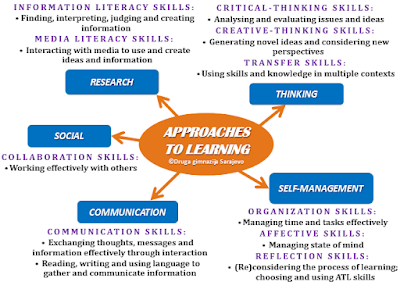
The school where I currently teach Latin is an IB World School, as was the one where I spent the most recent 23 years of my career.  You can read more about the International Baccalaureate program on our website, but the aspect of IB on which I want to focus is called ATL, Approaches To Learning.  One handy graphic lays out the ATLs like this.


An argument can be made, quite easily in fact, that these approaches to learning, while displayed here in somewhat new packaging, have in fact formed the basis of good teaching and learning for a long, long time.  Because that is true, I have found that a project I have for many years assigned to Latin II students fulfills this model of instruction quite nicely.  Or perhaps I should say that this model matches well with a meaningful project my students have regularly pursued.

After spending quite a bit of time reading in Latin the war writings of Julius Caesar in his campaigns against Gaul, the students choose partners (social) to work together to explore more deeply some aspect of the ancient Roman military.  They must pick an issue or problem the Roman army of the 1st century B.C. would have had to address and then find out how the Romans actually handled it (research, communication).  They must work together (social) to analyze (thinking) how well the Romans handled it given the resources available to them, and they must devise an alternative solution (thinking), one not necessarily better, but at least different, that the Romans could have employed, again given only the resources available to them.  They have time both in and out of class to complete this, and I frequently use guiding questions to help them maintain their focus (self-management).  Finally, they must present their findings and alternative solutions to the class (communication).  The fun part, of course, is in their sharing of items they have made to illustrate their work, but more on that below.

Several years ago I co-hosted a podcast with Michigan Teacher of the Year Gary Abud, Jr.  In one of our episodes, we spoke with Dr. Bernard Barcio, himself an Indiana Teacher of the Year and a 44-year veteran of high school and university classrooms.  He talked about his decades-long project of guiding students in the construction of catapults, an effort that gained annual attention in the national news and that has been chronicled with archival video here.  As we discussed in that podcast, such an approach to education grew to take on the name "project-based learning," although when Dr. Barcio began it back in the 1960s, it carried no such appellation.  It was merely good teaching.

I am pleased, of course, if something I do in the classroom checks the boxes of the IB approach to learning.  We are, after all, an IB World School.  Yet what I, and I think the International Baccalaureate Organization itself, would argue is that this approach is simply about helping students make the most of their learning, regardless of what name the approach goes by.

What follows are pictures from this year's Caesar projects by the Latin II students at Guerin Catholic High School.  


On group recreated testudo,  the tortoise shell formation of the Roman army.

Another group baked buccellatum, the hardtack eaten by soldiers. Yes, with jaw-breaking effort, I ate one!

One group crafted a Roman gladius from wood.

Some may wonder why, in the age of electronic technology, my students create old-fashioned posters of the information.  Some of my other projects do indeed ask students to present using electronic technology, but this project allows me to display student work in the hallway.  Not only does this affirm the value of their work, but it allows other students to see the kinds of things we do in our classes, perhaps giving them something to look forward to when they reach Latin II.


In the end, this project helps students develop multiple skills while exploring topics of their choosing relevant to our class.  It ticks off the boxes of modern education theory, but in fact it is simply the kind of thing that teachers have long used to help students make the most of their learning.  When it comes to successful strategies, I think Caesar would have like this one.