Elisha Ballantine was a professor of mathematics, modern languages, and ancient Greek at Indiana University and was its acting president in 1884.
I have countless times passed the plaque that honors him in the building that bears his name, but was struck when I saw it again on a recent visit. He was a professor of mathematics and Greek. In today's age of specialization, this would be an oddity to say the least. A professor of Greek and Latin, of course. A professor of mathematics and computer science, quite possibly. But mathematics and Greek?
This put me in mind of a former teacher at New Albany High School, my alma mater. You have no doubt heard of Edwin Hubble and the telescope that bears his name, but did you know that he taught high school physics, mathematics, and Spanish...yes, Spanish...in 1913? He also coached the boys' basketball team.
And speaking of sports, these men reminded me of famed golfer Bobby Jones. In 1922 he earned his B.S. in Mechanical Engineering, in 1924 his A.B. in English literature, and after only three semesters of law school begun in 1926 passed the Georgia bar exam and practiced law in Atlanta.
Mathematics and Greek. Spanish and physics. Engineering and literature. There was a time when people pursued a variety of studies. This not to say that everyone of a bygone era was a polymath, but I do find a certain kinship with those academic souls of yesteryear. The world is vast, history is long, creation is complex, and humans have both discovered and contributed much to the unfolding wonder of it all.
When we make education nothing more than training for gainful employment, we miss a great deal. In fact, we miss almost everything. Yes, a stick in a forest can help make the fire that keeps me warm through the night, but the forest itself, with its symphony of sounds and the towering columns of its arboreal cathedral that seem to support its stellar dome, is worth beholding in its own right. And while it is true that the quiet contemplation of the evening nature scene now in your head could inspire you toward an act of creativity, the composition of a poem, perhaps, or a work of painting or photography, there is something more to be gained from the experience. Simply put, it nourishes the soul.
So it is with true education. It may equip students for a task or an occupation. It may provide them with the skills necessary to produce any manner of art, both for service and for art's sake itself. At its core, however, it need serve no other purpose than fulfilling the human desire to know.
Tuesday, September 6, 2016
Monday, August 29, 2016
I Don't Want An Education
In the classic 1960 film Spartacus, the famous gladiator-turned-freedom-fighter (Kirk Douglas) enjoys a rare evening of peace with his beloved Varinia (Jean Simmons). As they recline in a meadowland indulge in the soft conversation of lovers, their talk turns to knowledge of the wide world.
Spartacus: I know nothing. Nothing! And I want to know. I want to... I want to know.
Varinia: Know what?
Spartacus: Everything. Why a star falls and a bird doesn't. Where the sun goes at night. Why the moon changes shape. I want to know know where the wind comes from.
I was at an overnight planning session for the Indiana Junior Classical League recently at Indiana University, and as I often do when visiting my alma mater, I took a walk around campus during the early morning before our meeting resumed. I followed a path different from my usual course and ended up by Rawles Hall, home of the mathematics department, went in, and found a poster for an upcoming lecture. Apart from definite articles and conjunctions, there was almost no word on that poster that I had either seen before or understood.
As I drifted back past more familiar buildings, I recalled the words of Spartacus and thought as I have so many times about all that I do not know. And like him, I want to know. I want to have a deeper understanding of mathematics so that I can truly grasp the famous words of Galileo that "mathematics is the alphabet with which God wrote the universe." I want to understand the language of numbers and mathematics and how they describe the universe. And speaking of the universe, I want know how forces work and interact with other and with matter, forces like the electromagnetic force and gravity and the strong and weak nuclear forces. I want to explore the human sciences and understand the workings of the mind and consciousness and how to know which fonts and colors and arrangements of graphic information are best for reaching certain audiences to communicate certain things and I want to know how we know such things.
Like most people, I raced through my education. Spelling for fifteen minutes, math for half an hour, followed by reading and lunch and then social studies, P.E., and science. That was a day in elementary school. In junior high and high school, the pace quickened. Math...bell ring ... move down conveyor belt ... English ... bell ... conveyor belt ... Latinbellconveyorlunchconveyorchoirbellconveyorchemistrybellconveyorhistorybell. And why? It was mostly to memorize this or that, prove yourself through tests and projects, and then get some more. With such training how could I have approached undergraduate studies any differently? I remember once during my freshman year sitting in a class thinking I should be back in the dorm room completing some assignment. The absurdity hit me like a thunderclap. Listening to a professor who was an expert in the subject was the reason I was in college, not mindlessly completing homework.
We speak of getting an education, as if it were any other commodity capable of being acquired. I already have too much stuff in my life. I do not need something more. I do not need an education. What I need is to do something. I need and want to learn. Learning is an inquisitive activity. It is an enterprise of curiosity, mystery, and adventure. It is non-linear and for heaven's sake it is not fast. It is not frantic and harried and driven. Learning is deep and therefore slow. As Andrew Marvell mused, had we but world enough and time I would go back to the university, seek out instructors in matters I wished to learn, and not allow myself to run in a terrified attempt to outpace the inexorable charge of the educational machine bearing down upon me.
So what can teachers do, chained as they are inside the belly of the beast and forced to turn the cranks to make it go? We can tantalize our students with tastes of the true, the good, and the beautiful. We can make them thirsty with grains of the curious and mysterious. We can take them to the edge of awe and wonder and inspire them with the possibility of one day being freed from education so that they can truly learn.
Spartacus: I know nothing. Nothing! And I want to know. I want to... I want to know.
Varinia: Know what?
Spartacus: Everything. Why a star falls and a bird doesn't. Where the sun goes at night. Why the moon changes shape. I want to know know where the wind comes from.
I was at an overnight planning session for the Indiana Junior Classical League recently at Indiana University, and as I often do when visiting my alma mater, I took a walk around campus during the early morning before our meeting resumed. I followed a path different from my usual course and ended up by Rawles Hall, home of the mathematics department, went in, and found a poster for an upcoming lecture. Apart from definite articles and conjunctions, there was almost no word on that poster that I had either seen before or understood.
As I drifted back past more familiar buildings, I recalled the words of Spartacus and thought as I have so many times about all that I do not know. And like him, I want to know. I want to have a deeper understanding of mathematics so that I can truly grasp the famous words of Galileo that "mathematics is the alphabet with which God wrote the universe." I want to understand the language of numbers and mathematics and how they describe the universe. And speaking of the universe, I want know how forces work and interact with other and with matter, forces like the electromagnetic force and gravity and the strong and weak nuclear forces. I want to explore the human sciences and understand the workings of the mind and consciousness and how to know which fonts and colors and arrangements of graphic information are best for reaching certain audiences to communicate certain things and I want to know how we know such things.
Like most people, I raced through my education. Spelling for fifteen minutes, math for half an hour, followed by reading and lunch and then social studies, P.E., and science. That was a day in elementary school. In junior high and high school, the pace quickened. Math...bell ring ... move down conveyor belt ... English ... bell ... conveyor belt ... Latinbellconveyorlunchconveyorchoirbellconveyorchemistrybellconveyorhistorybell. And why? It was mostly to memorize this or that, prove yourself through tests and projects, and then get some more. With such training how could I have approached undergraduate studies any differently? I remember once during my freshman year sitting in a class thinking I should be back in the dorm room completing some assignment. The absurdity hit me like a thunderclap. Listening to a professor who was an expert in the subject was the reason I was in college, not mindlessly completing homework.
We speak of getting an education, as if it were any other commodity capable of being acquired. I already have too much stuff in my life. I do not need something more. I do not need an education. What I need is to do something. I need and want to learn. Learning is an inquisitive activity. It is an enterprise of curiosity, mystery, and adventure. It is non-linear and for heaven's sake it is not fast. It is not frantic and harried and driven. Learning is deep and therefore slow. As Andrew Marvell mused, had we but world enough and time I would go back to the university, seek out instructors in matters I wished to learn, and not allow myself to run in a terrified attempt to outpace the inexorable charge of the educational machine bearing down upon me.
So what can teachers do, chained as they are inside the belly of the beast and forced to turn the cranks to make it go? We can tantalize our students with tastes of the true, the good, and the beautiful. We can make them thirsty with grains of the curious and mysterious. We can take them to the edge of awe and wonder and inspire them with the possibility of one day being freed from education so that they can truly learn.
Thursday, August 18, 2016
Teacher Ethics
I asked a colleague of mine why he thought I had never told him to stop punching a student in the face. He correctly observed that this would have been unnecessary, since he was not in the habit of punching students in the face. By similar logic, my wife has never told me to sit down and consume vast quantities of pizza as if I were still seventeen. I do that just fine on my own. She does, however, have to tell me that I need to rest or get more exercise because I am not naturally inclined to take care of myself in those ways.
We tell people what they do not likely know and we refrain from speaking what we assume is common knowledge.
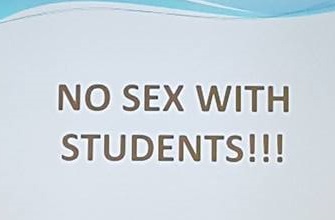
What does it say, then, when newly hired teachers must be told not to sleep with their boss, have sex with students, or show up to work hammered or high?
The pictures throughout this post were taken of a PowerPoint presentation at the ethics training for newly hired teachers. I will not name the state or district, but they were shared by a good friend and highly respected colleague who teaches there.
Should a teacher really need to be told that "the 'night before' must end early enough for you to sober up before reporting to work?" Should a teacher really need to be told "no flirting with students?" Should a teacher really need to be told not to cuss out a student or colleague?
Make no mistake, all these violations of professionalism, law, and common decency have occurred in schools. Nevertheless, one of two situations must be true in the district that offered this training to newly hired teachers. Either it was necessary to do so or it was not.
If it was not necessary, then it was exceedingly insulting to professional adults. Sadly, it would not have been the first time in the history of education that well-educated, professional adults were treated as if they were children.
Yet, even more sadly, this probably was necessary. It was probably necessary to tell adults charged with helping develop the intellectual gifts of children not to have sex with them. It was probably necessary to tell adults who should be modeling the best of what the human race has achieved, which should be the core of their curriculum, not to come to work inebriated. It was probably necessary to tell adults who are the custodians of the words that have been spoken to bring light into darkness and to conjure forth the ideas and devices that have saved countless lives and allowed the human race to explore the eternity set within its heart not to use two-cent vulgarities best suited for the bathroom wall.
Yet such things ought not to be. For the vast majority of those who would claim the name "teacher," the highest intellectual and moral standards should prevail. There will always be the exceptions, of course, but these can and should be dealt with individually. If we have arrived at a point where the best we have coming into the profession truly need such training, then we must ask ourselves some hard questions.
First, have we so destroyed the profession of teaching through crippling legislation, tyrannical or ridiculous local leadership, and media vitriol that few decent people will enter it? Schools of education and licensing departments suggest so (here, here, and here).
Yet even if we were no longer able to attract the most accomplished, creative, and intellectual among us into the realm of teaching our children, would we be truly unable to draw people with a basic moral sense? This would be a far greater problem. The schoolhouse is not the monastery, to be sure, and there should be no requirement for sainthood to accompany the teaching license. Yet we must all ask ourselves what sort of culture we are developing if people who enter the field of education need a PowerPoint presentation to tell them the information in these slides.
Wednesday, August 3, 2016
Celebrity Teachers
I am not the celebrity hound that my dear friend and colleague Marcene is. She has pictures with everyone from Red West to Dee Snider of Twisted Sister fame. Nevertheless, I was as geeked up as the next guy when my son and I got to meet Michael Sweet, lead singer and guitarist for the hair-band Stryper.
I recently attended the National Junior Classical League Convention, which was hosted this year by my own state, Indiana, at my alma mater, Indiana University. While there with over fifteen hundred Latin students, teachers, and professors from around the country for a week of competitions, learning, and fun related to the languages and cultures of ancient Greece and Rome, my wife, also a Latin teacher, and I had the opportunity to visit with professors from our undergrad days.
On the first day of the convention, Matt Christ, department chair of Classical Studies at IU, spoke to us before one of the assemblies. As we talked about Classics at the university, I could not help thinking, "I'm talking to the department chair!" A few days later he dined with us at a banquet for all the teachers, and as our talk meandered through Classics at the university and secondary levels, I was again struck by the opportunity I was enjoying.
| My wife, Melissa, and I with Matt |
Mid-week of the convention, I met my good friend Tim Long for breakfast. Tim is a professor emeritus of Classics at IU, and far more than just being my Greek professor, he gave me sage advice on many matters when I was an undergrad and has remained a good friend whom I often consult whenever Classical questions arise. When I left the breakfast table after two hours of conversation, it was as if I had just sat down.
| Tim and I with the first winner of the scholarship our high school Latin Club has in his name |
That afternoon my wife, Melissa, and I had the chance to relive a memory. We sat in Ballantine Hall, where we had so many classes as undergrads, and listened as Ellie Leach presented her work on the mythological paintings in Roman houses. We had been her students in multiple classes, and to have the chance to sit under her instruction again, in the classroom building where it all began for us, was a tremendous thrill.
Then that evening I received an email from Derek Vint. Derek has been the office manager and fiscal officer of the Classical Studies department for many years. We made it a point to visit him the following day, and when I asked how long he had been there, he said that this September would mark 40 years. Derek was always the one who assisted us with our class scheduling, and as he gestured to open chairs so we could sit and chat and turned on his window air conditioner for our comfort, we knew we had come home. (We did not get a picture with Derek because I was partly in costume for a presentation as a Roman centurion and did not have my camera with me.)
Finally, on the last day of the convention, Betty Rose Nagle had us over for pie. Betty Rose taught the first and last classes I took as an undergraduate, the first being on Cicero and the last on Ovid. We remain Facebook friends, and she is often a person I reach out to with my many questions. We spent the morning on her porch, eating wickedly good key lime pie that she had made, and discussing her work with 18th century German-authored Latin texts on human skulls and various other Classics related topics that made me never want to leave. When we did, however, she imparted a box full of books that are already in my classroom.
The relationship between teachers and students never ends, and like the biggest rock and roll fan, I was giddy with excitement in each of these encounters with these friends in education who have had such an effect on my life and what I do. And why shouldn't we be excited to interact with our teachers? They worked with us in our formative years in loco parentis, and the places where we learned with them bear the name alma mater, nourishing mother. Our teachers and professors are more significant parts of our lives than most celebrities ever will be. The next time you have a chance, pay one of them a visit. It will mean the world to both you.
Wednesday, December 2, 2015
What Do I Want To Know?
What do you see in these pictures? Do you see school projects that are too simple for today's world that seeks to develop critical thinking skills? Do you see evidence of teaching methods that are outdated? Are you inspired or left flat?


I see something rather more, and yes, I am inspired. My first year Latin students keep a section in their notebooks titled QNC, which stands for Quod Noscere Cupio, or What I Want To Learn. Most days they have the opportunity to jot down something that they would like to know based on what we have discussed in class. At different times throughout the semester they will present one of their questions to the class, including a discussion of what inspired the question and the answer or answers they have discovered on their own.
"Okay," you say. "That's great for helping students take ownership of their own learning, but, um, posters? Why not something a little more tech savvy and hip for the 21st century?"
I can't display a PowerPoint in the hallway and I want other students, non-Latin students, to see what my students are thinking about and discussing. I want them to be intrigued by the diversity of topics. Look at those pictures again. There is considerable variety displayed, including questions that I would not have thought to ask. Yes, I know that not everything is grammatically correct or spelled correctly even in the English. Some of my students are not native English speakers, so I can live with that. What is important is that my students develop the belief that Room A526 is a place to ask questions and explore big ideas.
That belief begins in Latin I and finds some of its best expression in Latin IV, our A.P. class. Recently one of my students asked a highly perceptive question about one of the characters in Vergil's Aeneid. He asked why Mercury could appear in full divinity to Aeneas in Book IV, but Venus had disguised herself for a similar appearance in Book I. Another student chimed in that Iris, another divine messenger like Mercury, had appeared undisguised to Turnus in Book IX, a fact she recalled from her own research for a presentation she had given in our class a few weeks before. She wondered whether the lack of disguise were a feature common to divine messengers.
I ended up posting the question and the direction of our class discussion on Facebook, tagging Latin colleagues and Classicists from universities around the country. The comments exploded as scholars began discussing the matter, and when the academic frenzy had abated, I printed out the entire FB discussion, three pages, and took it to my students for further exploration, pointing out that none of it would have taken place had they not asked the questions they did.
It's true that our QNC projects in Latin I are a bit simple. They may even be old fashioned with regard to their presentation. Yet they help develop a culture of inquisitiveness that is vital to our exploration of matters that matter in the philosophy, history, and poetry of the Romans. If a simple first-year poster will lead a student to ask a probing question in his study of Vergil, I am more than pleased.
I see something rather more, and yes, I am inspired. My first year Latin students keep a section in their notebooks titled QNC, which stands for Quod Noscere Cupio, or What I Want To Learn. Most days they have the opportunity to jot down something that they would like to know based on what we have discussed in class. At different times throughout the semester they will present one of their questions to the class, including a discussion of what inspired the question and the answer or answers they have discovered on their own.
"Okay," you say. "That's great for helping students take ownership of their own learning, but, um, posters? Why not something a little more tech savvy and hip for the 21st century?"
I can't display a PowerPoint in the hallway and I want other students, non-Latin students, to see what my students are thinking about and discussing. I want them to be intrigued by the diversity of topics. Look at those pictures again. There is considerable variety displayed, including questions that I would not have thought to ask. Yes, I know that not everything is grammatically correct or spelled correctly even in the English. Some of my students are not native English speakers, so I can live with that. What is important is that my students develop the belief that Room A526 is a place to ask questions and explore big ideas.
That belief begins in Latin I and finds some of its best expression in Latin IV, our A.P. class. Recently one of my students asked a highly perceptive question about one of the characters in Vergil's Aeneid. He asked why Mercury could appear in full divinity to Aeneas in Book IV, but Venus had disguised herself for a similar appearance in Book I. Another student chimed in that Iris, another divine messenger like Mercury, had appeared undisguised to Turnus in Book IX, a fact she recalled from her own research for a presentation she had given in our class a few weeks before. She wondered whether the lack of disguise were a feature common to divine messengers.
I ended up posting the question and the direction of our class discussion on Facebook, tagging Latin colleagues and Classicists from universities around the country. The comments exploded as scholars began discussing the matter, and when the academic frenzy had abated, I printed out the entire FB discussion, three pages, and took it to my students for further exploration, pointing out that none of it would have taken place had they not asked the questions they did.
It's true that our QNC projects in Latin I are a bit simple. They may even be old fashioned with regard to their presentation. Yet they help develop a culture of inquisitiveness that is vital to our exploration of matters that matter in the philosophy, history, and poetry of the Romans. If a simple first-year poster will lead a student to ask a probing question in his study of Vergil, I am more than pleased.
Monday, November 16, 2015
A Life Well Spent
![]() |
| Marcus Tullius Cicero, 106-43 B.C. |
One translation of Cicero's essay De Senectute, which literally means "On Old Age," has the title On A Life Well Spent. I recently had the opportunity to bring Cicero to life through re-enactment and in so doing to explore some of the depths of this statesman, philosopher, and orator.
I first came to appreciate Cicero in my third-year high school Latin class. I admired his oratorical pyrotechnics, and when I was pursuing my M.A. in Classics, I focused on his execution of the Catilinarian conspirators in 63 B.C.
I am always seeking ways to reduce the gap of two millennia and half a world that separates students from the cultures of ancient Greece and Rome. One way I have done that is through re-enactment. I present multiple personas from the Classical world, about which you can read more at www.romanpersonas.com. One of these personas is Cicero, and I was glad for the recent opportunity to bring this important figure to life for students at the Illinois Junior Classical League convention in Pekin, Illinois. My own former teacher and now dear friend and colleague Marcene Farley had invited me, and it was great fun.
During this half-hour presentation, Cicero rises from the table where is writing his memoirs in Brundisium in 43 B.C. and begins musing about his life. He reflects on growing up in Rome after being born on his grandfather's farm in Arpinum and what it was like to begin his career in the dictatorship of Sulla. He goes on to talk about his consulship, his family, and the dark times that brought about the end of the Republic.
Thursday, November 12, 2015
Cicero, Springsteen, and Common Grace
Expectant mother Amanda Blackburn was murdered at 8:30 a.m. on Tuesday, November 10, as she protected her infant son from a violent home invader. Her husband, Pastor Davey Blackburn, has released a beautiful statement. The Indianapolis Star has details of the crime.
This is but one more instance of senseless violence. One. More. Instance.
The Roman orator Cicero closed one of his earliest speeches with these words:
Nam cum omnibus horis aliquid atrociter fieri videmus aut audimus, etiam qui natura mitissimi sumus adsiduitate molestiarum sensum omnem humanitiatis ex animis amittimus. (Pro Roscio, 154)
"For when at every hour we see or hear some atrocity taking place, even those of us who are by nature most gentle, by growing accustomed to the violence, lose all sense of humanity from our souls."
Yet today in this city that wakes up to the news of one more mother killed, one more unborn baby murdered, we will go about our business. I will teach my classes. Baristas will serve coffee. Doctors will heal, officers will help, and lawn care crews will rid homes of unwanted fall leaves.
How is this possible?
Bruce Springsteen once wondered the same thing in song. After he recounts various mundane tragedies in the verses, he sings in the chorus, "Struck me kinda funny. Seems kinda funny, sir, to me. At the end of every hard earned day people find some reason to believe."
How is this possible?
Some of the students at our school, one of the largest public high schools in Indiana, have faced horrors no one, certainly no child, should ever face. These pictures and words from our English Language Learners currently on display tell part of their story.
How is this possible? How can these children survive such atrocities and not, as Cicero had it, lose all sense of humanity from their souls? Sadly, some do lose their humanity, but most do not. Most, in Springsteen's words, find some reason to believe and to carry on.
I am reminded of the words of Jesus in Matthew 5:45. "For he makes his sun rise on the evil and on the good, and sends rain on the just and on the unjust." (ESV) There is a common grace that allows us to endure. It gives us a reason to believe and, for those who would "rage against the dying of the light" and would not lose all sense of humanity from their souls, to keep going.
As these thoughts were running through my mind while I walked the halls before the start of school, I was reminded of how important it is that I love my students well. I must provide an environment for grace to flourish. I do this in part by treating my students with respect, by enjoying them and the things they do, and by creating a positive atmosphere in my class. I also do it by striving along with them to achieve the greatest rigor in our subject. We work hard because our subject matters and they matter. We correct mistakes. We do not flinch from academic difficulties. We conduct class this way because to do other would be to cheapen the experience and to say that they are not worthy of the best in human endeavor. This would truly be a loss of humanity, and it is something grace will not allow.
This is but one more instance of senseless violence. One. More. Instance.
The Roman orator Cicero closed one of his earliest speeches with these words:
Nam cum omnibus horis aliquid atrociter fieri videmus aut audimus, etiam qui natura mitissimi sumus adsiduitate molestiarum sensum omnem humanitiatis ex animis amittimus. (Pro Roscio, 154)
"For when at every hour we see or hear some atrocity taking place, even those of us who are by nature most gentle, by growing accustomed to the violence, lose all sense of humanity from our souls."
Yet today in this city that wakes up to the news of one more mother killed, one more unborn baby murdered, we will go about our business. I will teach my classes. Baristas will serve coffee. Doctors will heal, officers will help, and lawn care crews will rid homes of unwanted fall leaves.
How is this possible?
Bruce Springsteen once wondered the same thing in song. After he recounts various mundane tragedies in the verses, he sings in the chorus, "Struck me kinda funny. Seems kinda funny, sir, to me. At the end of every hard earned day people find some reason to believe."
How is this possible?
Some of the students at our school, one of the largest public high schools in Indiana, have faced horrors no one, certainly no child, should ever face. These pictures and words from our English Language Learners currently on display tell part of their story.
How is this possible? How can these children survive such atrocities and not, as Cicero had it, lose all sense of humanity from their souls? Sadly, some do lose their humanity, but most do not. Most, in Springsteen's words, find some reason to believe and to carry on.
I am reminded of the words of Jesus in Matthew 5:45. "For he makes his sun rise on the evil and on the good, and sends rain on the just and on the unjust." (ESV) There is a common grace that allows us to endure. It gives us a reason to believe and, for those who would "rage against the dying of the light" and would not lose all sense of humanity from their souls, to keep going.
As these thoughts were running through my mind while I walked the halls before the start of school, I was reminded of how important it is that I love my students well. I must provide an environment for grace to flourish. I do this in part by treating my students with respect, by enjoying them and the things they do, and by creating a positive atmosphere in my class. I also do it by striving along with them to achieve the greatest rigor in our subject. We work hard because our subject matters and they matter. We correct mistakes. We do not flinch from academic difficulties. We conduct class this way because to do other would be to cheapen the experience and to say that they are not worthy of the best in human endeavor. This would truly be a loss of humanity, and it is something grace will not allow.
Wednesday, November 11, 2015
The Shoulders of Education Leadership
A dear friend of mine, Kate Smith, who is an award-winning principal in Australia uses the expression "shoulder-to-shoulder teaching." (Before you continue reading, follow her on Twitter @edukate_S.) She describes going into teachers' classrooms and working with them, teaching alongside them, shoulder-to-shoulder.
Another friend of mine, 2015 Indiana Teacher of the Year Kathy Nimmer, (again, follow her on Twitter @Kathy_Nimmer) once told me about monthly summits in her district in which she meets with central office leaders to share experiences and what she is learning as she travels our state. It is a time in which everyone benefits, and she is valued.
And then there was the experience I had recently with my post-evaluation conference. The person who evaluates me is my department chair, Traci Rodgers (again, you know the drill, follow her @tracirodgers). We quickly moved from talking about the evaluation to discussing the implications of some data I had requested about changes in the demographics of our school and school district. We talked about work our department had done a few years ago in this area, how our student profile has changed in the intervening years, and what some of the implications could be. And as we talked about numbers, we began to talk about people. We talked about actual students and families. We speculated. We mused. We pondered.
When she left, we acknowledged that we had come up with no solution to any problem, no means of handling any certain challenge. Yet we had done one of the most important things two human beings can do. We had thought together. No, you did misread that last sentence. I did write that we had taught together, although we are indeed colleagues in the best sense of that word. We had thought together, and that supreme and supremely human act can only take place when egos and agendas are set aside and two people walk shoulder-to-shoulder looking in the same direction toward what can be.
Another friend of mine, 2015 Indiana Teacher of the Year Kathy Nimmer, (again, follow her on Twitter @Kathy_Nimmer) once told me about monthly summits in her district in which she meets with central office leaders to share experiences and what she is learning as she travels our state. It is a time in which everyone benefits, and she is valued.
And then there was the experience I had recently with my post-evaluation conference. The person who evaluates me is my department chair, Traci Rodgers (again, you know the drill, follow her @tracirodgers). We quickly moved from talking about the evaluation to discussing the implications of some data I had requested about changes in the demographics of our school and school district. We talked about work our department had done a few years ago in this area, how our student profile has changed in the intervening years, and what some of the implications could be. And as we talked about numbers, we began to talk about people. We talked about actual students and families. We speculated. We mused. We pondered.
When she left, we acknowledged that we had come up with no solution to any problem, no means of handling any certain challenge. Yet we had done one of the most important things two human beings can do. We had thought together. No, you did misread that last sentence. I did write that we had taught together, although we are indeed colleagues in the best sense of that word. We had thought together, and that supreme and supremely human act can only take place when egos and agendas are set aside and two people walk shoulder-to-shoulder looking in the same direction toward what can be.
Sunday, November 1, 2015
Self-Indulgent Rock 'n' Roll Post
October just got away from me. Speaking engagements and teaching and podcasting and parenting and life...it just got away from me, so there were no posts in October.
And how do I usher in the month of November? A sizzling piece on edu policy or theory? Nope. This rock 'n' roller at heart needs a bit of a fun break. I promise, though, that education posts will return.
In October the metal band Stryper released their eleventh studio album since blasting onto the scene in 1984. I have been a fan the whole time and am writing this review just so I can be part of the
historical moment that is the re-birth of classic metal. Stryper’s album Fallen proves what talented musicians can do who stay true to their roots, care about their fans, and have
enough creativity not to live on the glory days but to create new ones in
keeping with the times.
The opening track, “Yahweh,” begins like no other Stryper
song. It starts with an acapella choir
sound that turns into a thundering, sonic guitar attack as Michael Sweet begins
the story of Christ’s crucifixion. It is
an epic story, and the music stands up to it.
The entire album has a ten-foot deep, concrete foundation made out of
Robert Sweet’s pounding drums and Tim Gaines’s aggressive bass. On this track they combine to lend the
perfect tone to this tale. And let’s be
serious. If you are going to open your
album with this story and a sound this big, the audience knows it is going to
be a killer album in whole.
From there we get the title track, and one cannot help
thinking of the epic poem Paradise Lost as we get the story of Satan’s fall
from glory told in traditional Stryper guitar attack style. Michael’s high scream opens the tale and
resurfaces in the chorus, which always has me reaching for the volume to turn
it up.
“Pride,” for which the band released their first official video, picks up the dark, heavy sound from “Yahweh” for the
third track, and again we have the pounding rhythm section to open. We are treated to a beautiful melody that
morphs into a gritty scream during the chorus, and those who have never heard
Michael Sweet simply accept his powerful vocals, but those of us who have heard
him for three decades stand in awe at how he has continued to grow.
“Big Screen Lies” is a fun tune with another aggressive,
rhythmic opening. It talks of how
Christianity is portrayed in popular media, something the boys in Stryper know
a little about. It has that
in-your-face, “We’re Not Gonna Take It” it feel of “Loud ‘n’ Clear” off their
debut album. The chorus features
thundering guitars, and the song ends with a gritty, greasy, snarling vocal.
The next track, “Heaven,” would have been at home on the
Sweet & Lynch album Only To Rise.
This is another song of rebellion against what others think is the way
to go. Michael has strong, soaring
vocals without going into the stratosphere.
It is again an in-your-face lyric.
“Love You Like I Do” almost has a Whitesnake feel in the
very opening. It is a call-and-response
song that could be seen as a lyric between a man and a woman, but is more
likely, and more reasonably, a lyric between God and His creation. I could not help thinking of Oz Fox’s wife, Annie Lobert, in this one, as she leads the fight against sexual exploitation of
women. No one will ever see us as God
sees us, certainly not those who see us only as means to an end. And speaking of Oz, his guitar work has been
killer on ever track, and the guitar solo on this song begs to be seen live in
concert.
“All Over Again,” for which the band and their wives have
released the album's second official video, is a country-rock ballad and may be the best of their
career. Let’s face it. A fair portion of their fan base is of a
maturing age. This lyric hits home. It is not a rose-colored glass view of the
past, but one that can honestly say that with the good and the bad, we would
not change a thing, but would do it all over again. It is a big sound, worthy of the cowboy
rocker of the ‘80s and perfectly suited for today.
“After Forever” was the track a lot of people were eager to
hear. It is a cover of Black Sabbath
and, despite that this may get me negative comments, I will go on record as
saying the cover is better. It is sharp,
clean, and aggressive. It is a perfect
fit for Stryper, and the boys carry it off perfectly.
The next song, “Till I Get What I Need,” is a fast,
blistering number that seems directly born from Michael’s autobiography
Honestly. It has the classic Stryper
guitar sound that would have been at home in the ‘80s, yet sounds in no way
dated.
I’m not sure what it is, but I often like the last two or
three tracks of an album the best. Time
and again for a variety of artists, these seem the heaviest. "Let There Be Light" would have gone well on their last album, No More Hell To Pay, and is musically in
that vein. Again we have a strong, epic
sound to the epic story of Genesis.
"The Calling" may be my favorite.
It is a chest-beating, bold, head-thrown-back anthem, with a fast and
aggressive rhythm. It has almost a
classic rock sound at points. Matthew
Arnold, the famous scholar of Homer, said the Greek poet had a fast-moving,
forward-driving feel to his poetry. The
same is true in this song. It grabs you
and drags you along at Mach I.
The final track, “King of Kings,” is another that would have
gone well on the last album. Stryper has
always given us anthems, and this is one that calls to mind the expansive
chorus of “Passion” from the Reborn album.
We have a sonic race at the beginning that slows and hits a slower,
powerful stride in the chorus, forcing us to listen and, if so inclined, to
belt out the lyrics, too.
And speaking of lyrics, I have to say these are some of
Stryper’s best. The stories are epic,
yet the lyrics have a way of speaking directly to us.
If you did a word count, you would see I used “epic” and
“aggressive” more than any other. This
is how I like my music. In one of his
songs, country singer George Strait sang, “I don’t want you under my roof with
your 86 proof watered down ‘til it tastes like tea. You’re gonna pull my string, make it the real
thing for me.” I couldn’t agree more,
and Stryper delivers better than ever.
Some pictures from Michael Sweet's acoustic concert in Bluffton, Indiana, in October. In the third picture you will see my friend Dr. Brad Oliver...teacher, principal, superintendent, professor of education, former state school board member, current Director of Education at The Summit, and most importantly fellow Stryper fan!
Wednesday, September 16, 2015
Top 10 Thoughts On Education
I recently had the opportunity to interview the top ten finalists for 2016 Indiana Teacher of the Year. Watch out, America! These Hoosier educators are among the finest!
Throughout a day of sitting with Indiana's teaching best, I heard many good thoughts that warranted a broader audience. This is what Indiana educators are saying.
This should be on bumper stickers. We all fail. Unfortunately, too many people see failure as merely the opposite of success. Failure is a great learning experience. When we fail well, we fail forward. This is why I am one of the founding fellows of The Failure Institute and why I support my friend Jessica Lahey's book, The Gift of Failure: How the Best Parents Learn To Let Go So Their Children Can Succeed.
Many of us keep in touch with former students, but do we ever ask them what we could have done better? We all need space and time away from something to be able to see it clearly. Once our students have gone on to college or careers, they are in a better place to evaluate their own elementary and secondary education. This is one I had never thought of, but am eager to implement.
Teachers and schools must be evaluated, just as any employee or organization should be evaluated, but such evaluations cannot be significantly informed by student testing. Note that I did not write "should not be," but "cannot be." There are many factors affecting a student's performance on a test that are beyond a teacher's control. It says absolutely nothing about my school or about me if my student fails a test because he or she was unable to think clearly as a result of hunger or worry about an abusive home life.
To be fair, we must also consider what test scores do and do not reveal about students themselves. When a student misses a question, I know only that the student did not answer the question correctly I do not know why he or she did not answer it correctly. The student may have simply forgotten, never known the answer, lacked understanding of the question's wording, had a panic attack, failed to study, or missed seeing that particular question entirely.
If I have to be told when to meet, where to meet, with whom to meet, and what to meet about, then why did you hire me? If college-educated adults cannot be trusted to work independently or in collaboration of their choosing, then the fault, dear Brutus, is not in their substandard work, but in careless hiring practices.
On the flip side, leave teachers to their own devices and they will come up with some of the most amazing ideas. Nobody shares information the way teachers do. We enthusiastically ask each other questions and share our best ideas and activities. If you do not know this is what happens when even two or three teachers gather, then you do not know teachers.
We know this is true regarding students, so why it would it not be true regarding teachers? It has been said that people perish when there is a lack of vision. Never is this more the case than in schools. When school leaders work shoulder-to-shoulder with each other, tapping into each other's talents and both casting and sharing dreams, something happens that is the true result of real education: life. Just as you can tell a plant by the fruit it bears, you can most accurately assess a school by observing its life or, in some sad cases, the lack thereof.
Our profession can always get better. All professions can. Why would we want education to improve? Because it is worth it. Oh, is it worth it! Setting aside all manner of foolishness, we see education for what it truly is. It is a most human endeavor, a shared journey of discovery with young people discovering the mysteries and glories of creation and all that humans have come to know about and added to it. Working with colleagues who understand this, teachers like these top ten finalists and the many others I have enjoyed knowing throughout our state and across our nation, I can honestly proclaim that the calling and life of a teacher are most definitely worth it.
Throughout a day of sitting with Indiana's teaching best, I heard many good thoughts that warranted a broader audience. This is what Indiana educators are saying.
Fail forward, or be a success.
This should be on bumper stickers. We all fail. Unfortunately, too many people see failure as merely the opposite of success. Failure is a great learning experience. When we fail well, we fail forward. This is why I am one of the founding fellows of The Failure Institute and why I support my friend Jessica Lahey's book, The Gift of Failure: How the Best Parents Learn To Let Go So Their Children Can Succeed.
Ask alumni what you could have done better.
Many of us keep in touch with former students, but do we ever ask them what we could have done better? We all need space and time away from something to be able to see it clearly. Once our students have gone on to college or careers, they are in a better place to evaluate their own elementary and secondary education. This is one I had never thought of, but am eager to implement.
Tests should measure students, not teachers and schools.
Teachers and schools must be evaluated, just as any employee or organization should be evaluated, but such evaluations cannot be significantly informed by student testing. Note that I did not write "should not be," but "cannot be." There are many factors affecting a student's performance on a test that are beyond a teacher's control. It says absolutely nothing about my school or about me if my student fails a test because he or she was unable to think clearly as a result of hunger or worry about an abusive home life.
To be fair, we must also consider what test scores do and do not reveal about students themselves. When a student misses a question, I know only that the student did not answer the question correctly I do not know why he or she did not answer it correctly. The student may have simply forgotten, never known the answer, lacked understanding of the question's wording, had a panic attack, failed to study, or missed seeing that particular question entirely.
Teachers need less required collaboration and more trust to work on their own.
If I have to be told when to meet, where to meet, with whom to meet, and what to meet about, then why did you hire me? If college-educated adults cannot be trusted to work independently or in collaboration of their choosing, then the fault, dear Brutus, is not in their substandard work, but in careless hiring practices.
On the flip side, leave teachers to their own devices and they will come up with some of the most amazing ideas. Nobody shares information the way teachers do. We enthusiastically ask each other questions and share our best ideas and activities. If you do not know this is what happens when even two or three teachers gather, then you do not know teachers.
Teachers are effective when they are inspired.
We know this is true regarding students, so why it would it not be true regarding teachers? It has been said that people perish when there is a lack of vision. Never is this more the case than in schools. When school leaders work shoulder-to-shoulder with each other, tapping into each other's talents and both casting and sharing dreams, something happens that is the true result of real education: life. Just as you can tell a plant by the fruit it bears, you can most accurately assess a school by observing its life or, in some sad cases, the lack thereof.
It's worth it.
Our profession can always get better. All professions can. Why would we want education to improve? Because it is worth it. Oh, is it worth it! Setting aside all manner of foolishness, we see education for what it truly is. It is a most human endeavor, a shared journey of discovery with young people discovering the mysteries and glories of creation and all that humans have come to know about and added to it. Working with colleagues who understand this, teachers like these top ten finalists and the many others I have enjoyed knowing throughout our state and across our nation, I can honestly proclaim that the calling and life of a teacher are most definitely worth it.
Subscribe to:
Posts (Atom)