
 I asked a colleague of mine why he thought I had never told him to stop punching a student in the face. He correctly observed that this would have been unnecessary, since he was not in the habit of punching students in the face. By similar logic, my wife has never told me to sit down and consume vast quantities of pizza as if I were still seventeen. I do that just fine on my own. She does, however, have to tell me that I need to rest or get more exercise because I am not naturally inclined to take care of myself in those ways.
We tell people what they do not likely know and we refrain from speaking what we assume is common knowledge.
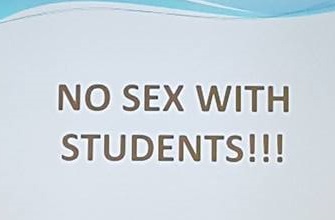
What does it say, then, when newly hired teachers must be told not to sleep with their boss, have sex with students, or show up to work hammered or high?
The pictures throughout this post were taken of a PowerPoint presentation at the ethics training for newly hired teachers. I will not name the state or district, but they were shared by a good friend and highly respected colleague who teaches there.

Should a teacher really need to be told that "the 'night before' must end early enough for you to sober up before reporting to work?" Should a teacher really need to be told "no flirting with students?" Should a teacher really need to be told not to cuss out a student or colleague?

Make no mistake, all these violations of professionalism, law, and common decency have occurred in schools. Nevertheless, one of two situations must be true in the district that offered this training to newly hired teachers. Either it was necessary to do so or it was not.
If it was not necessary, then it was exceedingly insulting to professional adults. Sadly, it would not have been the first time in the history of education that well-educated, professional adults were treated as if they were children.
Yet, even more sadly, this probably was necessary. It was probably necessary to tell adults charged with helping develop the intellectual gifts of children not to have sex with them. It was probably necessary to tell adults who should be modeling the best of what the human race has achieved, which should be the core of their curriculum, not to come to work inebriated. It was probably necessary to tell adults who are the custodians of the words that have been spoken to bring light into darkness and to conjure forth the ideas and devices that have saved countless lives and allowed the human race to explore the eternity set within its heart not to use two-cent vulgarities best suited for the bathroom wall.

Yet such things ought not to be. For the vast majority of those who would claim the name "teacher," the highest intellectual and moral standards should prevail. There will always be the exceptions, of course, but these can and should be dealt with individually. If we have arrived at a point where the best we have coming into the profession truly need such training, then we must ask ourselves some hard questions.
First, have we so destroyed the profession of teaching through crippling legislation, tyrannical or ridiculous local leadership, and media vitriol that few decent people will enter it? Schools of education and licensing departments suggest so (here, here, and here).
Yet even if we were no longer able to attract the most accomplished, creative, and intellectual among us into the realm of teaching our children, would we be truly unable to draw people with a basic moral sense? This would be a far greater problem. The schoolhouse is not the monastery, to be sure, and there should be no requirement for sainthood to accompany the teaching license. Yet we must all ask ourselves what sort of culture we are developing if people who enter the field of education need a PowerPoint presentation to tell them the information in these slides.


