Tuesday, May 5, 2015

Students Want Challenges


After reading the war writings of Julius Caesar in the original Latin and then exploring some Greek philosophy in translation, our Latin II students bring it all together with a project involving Steven Pressfield's The Warrior Ethos.  They must discuss three of the tenets from the book with regard to Caesar, their own current life, and what they plan to do in the future.

In one of his sections, Pressfield talks about why people join the military or want to be soldiers.  For some it is a rite of passage.  They want to challenge themselves. They want to grow.  Emily, one of my freshmen, chose this and applied it to her life at the moment.

Life in high school can seem very stagnant; we follow the same schedule every day and see the same people every day for the majority of the year.  I am craving some of the action, risk, the need to challenge myself, just as this tenet describes of those wishing to join the military.  I need a rite of passage into adulthood that does not involve taking standardized tests.  I want to challenge myself in a different environment than I am used to seeing every day and I want to learn and mature and become a better individual as a result.

There is a move away from high stakes testing for many good reasons.  Some opposed say that this is a move away from academic rigor, yet as my student clearly indicated, this is not the case.  Emily is an intelligent student who it seems has obtained wisdom as well.  In her own words, she wants "to learn and mature and become a better individual."  After fifteen years in which tests have played a far too significant role in life, she has indeed learned something.  She knows what she needs and wants, a proper rite of passage into adulthood that is suitably challenging to provide growth.  She knows that this does not involve testing.

I would argue that our school provides much of what Emily needs.  Ours is a rich curriculum that offers varied opportunities for students to explore their gifts and worlds in which to exercise them.  Yet even we are bound by exams sending the message to students that grades are the most important measure of achievement and the most important of the rites of passage.  We know this is not true and frequently say so, but when our actions do not match our words, students become confused, or worse, believe the message of the exams.  Fortunately some students, like Emily, know that there must be something else.  Hopefully she and others like her are able to explore a world beyond tests as they travel the shared journey of discovery that is true education.

Friday, May 1, 2015

Dear Mr. President


What happens when students from one of the country's newest and most innovative education programs want to take their dreams, hopes, and concerns to the President of the United States?  They make a compelling 12-minute video featuring their peers and established educators.  2014 National Teacher of the Year, Sean McComb, and I had the honor of being part of Raeanne O'Day's and Hannah Iskow's work.  Please share this widely, not because Sean and I are looking for press, but because these creative future teachers are telling and showing our country what education can truly be.

Thursday, April 16, 2015

Chicken Scratches Make It All Clear

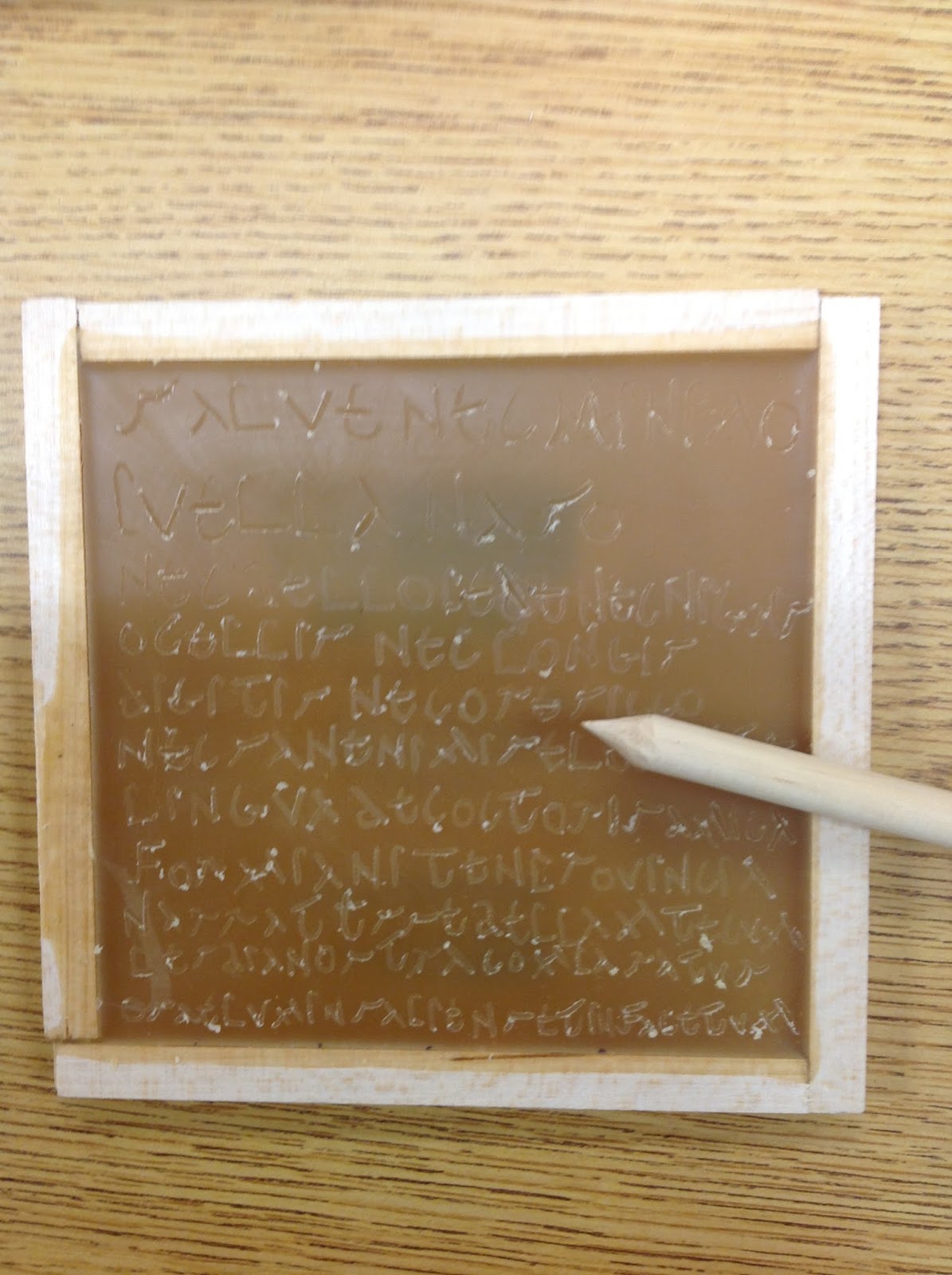
Student-made wax tablet and stylus with writing in Old Roman Cursive

An, opsecro hercle, habent quas gallinae manus?  Nam has quidem gallina scripsit.

By Hercules, I pray you, did the hand of a chicken do this?  Surely a chicken wrote these things.  (Plautus, Pseudolus 29-30)

Even the ancient Romans themselves knew that their handwriting had the appearance of chicken scratches.  In a decidedly low-tech project, the students in our Latin III class, after having read for two years the literature of Caesar, Cicero, Eutropius, Sallust, Horace, and Catullus, have the chance to enter the chicken coop and explore Roman paleography.  They look at the famed Vindolanda tablets and learn to read and write Old Roman Cursive for themselves.  They then make their own writing materials, either a wax tablet and stylus or papyrus sheet and reed pen.  With these instruments they copy a favorite text in Old Roman Cursive.  A key component of the project involves their written reflections, and as always, this year's students had some extraordinary insights.


This project has shown me that today we have it easy.  We can just go to the store around the corner and buy multiple pencils, pens, etc., without even thinking about it.  The Romans had to use elements from the earth to write.  Tony


I had to think about every single movement and swipe I was making....  I was not writing.  I was simply copying shapes that I didn't understand.  Miles


The personalized formation of every letter from every Roman tells a different story, a story incapable of being capture through stone writing alone.  Old Roman cursive is able to capture emotion; large letters may show some anger and thin letters might show delicacy.  Overall, Roman cursive can provide new insight to Roman life.  Ben


The privilege we have in the 21st century to have removed the entire process of making the staples of living often clouds the respect we should have for possessions.  The idea of throwing paper away because something had held a bit through must seem absurd tot h Romans, and it's now a common practice.  This has always led me to believe the Romans led a more disciplined life, as they couldn't afford to waste time remaking papyrus if they made errors.  Meg


This project also caused me to concentrate intently on each and every word of Catullus 101.  As I was writing or drawing rather each and every letter very slowly and repeatedly, I was able to focus on each word, each time presenting me with something new to think about.  The repetition from originally seeing the poem, practicing it in old Roman cursive, and then finally transferring it over in ink to papyrus, caused me to find hidden meanings and techniques used by Catullus.  This made me realize that both poetry and writing are art forms that can represent a culture.  Laura


The handwriting provided something of a link between the work and the person who wrote it.  For example, while reading Catullus, it is all too obvious that he is a person interested in more earthly things, like his affairs with Clodia, or mourning the death of his brother....  But seeing it, and even writing it in Old Roman Cursive made it even more...personal.  Understanding the script of the Ancient Rome has led me to a realized acknowledgment of these poets and writers as people, instead of just names to be associated with this work and that poem.  This experience has developed a more humanizing point of view of normal people who breathed and felt just as we do, instead of being another name in the history book, to be forgotten the very next day.  Becky

Thursday, March 5, 2015

Fifty Minutes

It was a class like any other and because of that it was a class like no other.  My 3rd period is Latin II, and we were finishing our study of Julius Caesar.  The warm-up activity was to translate an English sentence into Latin.  Following that, we read and discussed a passage of Latin poetry related to Caesar.  Ho hum.  Not terribly exciting stuff.

Ah, but you were not there.  The warm-up sentence was the most complex piece the class had ever seen.  It was a compound sentence with two subordinate clauses, one of which contained a passive periphrastic.  Yet the students have been completing prose composition exercises since the beginning of the semester and they were ready.


Using different colors, we analyzed the parts of the sentence first.  We talked about the need to re-word the clause "troops must form a battle line" to read "a battle line must be formed by troops" so we could more easily construct the Latin passive periphrastic.  The students then turned to their notebooks and began the task of composing the Latin.

I walked around the room, and the questions were simply astonishing.  "Why is 'was announced' passive, but 'was announcing' is active?"  "Why does the form of sum need to be an infinitive?"  "How do you get the stem to make the gerundive?"  Again, these may seem rather ho-hum questions, but the earnestness with which they were asked and their specificity spoke volumes.  These average, normal, typical teenagers were not throwing up their hands in despair.  They did not simply check out and put their heads on their desks.  They knew what they needed to know and were able to formulate the right questions to obtain that information.  I am not exaggerating when I say that every single student was actively searching notes, figuring things out, and asking questions.  Many came within two or three minor errors of perfection, and one young lady was just one letter off in one word.

From there we turned to our discussion of a passage from Book IX of Lucan's Pharsalia, an epic poem written in the first century A.D. about a battle between Caesar and Pompey in 48 B.C.  Because our unit is primarily on Caesar's writings and Lucan's poetry is quite challenging, we do not read it in Latin but from a bi-lingual version with Latin and English on facing pages.  The passage we read this day gave Cato's speech to Pompey's men as they were about to face the arduous march back home across the inhospitable region of North Africa.  We talked about Marcus Porcius Cato Uticensis and how his name has stood for two thousand years as the symbol of honesty and uprightness of character.  We talked about Joseph Addison's 1713 play Cato:  A Tragedy and why George Washington had it performed for his men on the eve of Valley Forge.  Students asked questions like, "Why do we think of Caesar as a hero if a man like Cato was against him?"  This, of course, led to a discussion of the complex nature of any person and how it is possible to admire and even imitate some qualities while being opposed to others.  When we read the lines

Must any soldier be assured of danger there's relief,
So taken with life's sweetness, let him seek another chief*

we talked of how success is not always assured, a good grade is not guaranteed, and a job after college is not a given, but that a true leader will always shoot straight and not sugar coat things.  The line "for whether I command or serve, I would not have it known" prompted the observation that the real leader is a servant-leader, serving alongside the rest.

It was fifty minutes of intense, complex grammatical work and intense, complex philosophical/historical discussion.  Conversation with one young man even continued after class, and I think it is safe to say that this ordinary class of young people, some honor students, but many not, proved the truth of Cato's words, "True honor comes more joyful when at higher cost it's won."

*Translations are mine, copyright 2010.


Monday, February 23, 2015

The Logic of Learning

WARNING:  Direct, possibly rude, certainly philosophical language ahead!

If learning has not happened, has teaching taken place?

If the learner hasn't learned, the teacher hasn't taught.

These are variations on one of the most illogical notions to come down the pike.  It may well be, in the words of Bertie Wooster, "the rummiest thing I've heard in a lifetime of rummy things."  Let's dispense with pleasantries and get down to logic.

Definition:  necessary condition -- A necessary condition for some state of affairs S is a condition that must be satisfied for S to obtain.  (http://philosophy.wisc.edu/hausman/341/Skill/nec-suf.htm)

Definition:  sufficient condition -- A sufficient condition for some state of affairs S is a condition that, if satisfied, guarantees that S obtains.  (ibid.)

A simple undergraduate logic or philosophy class introduces these basic terms.  Let me illustrate with an example.

Oxygen is a necessary condition for me to live.  I must have oxygen to breathe.  If I do not have oxygen, I cannot breathe and will die.  Another way to say it is "without which not."  Since without oxygen I would not live, oxygen is a necessary condition for my life.

Oxygen is not a sufficient condition for me to live.  There is plenty of oxygen in the morgue, and we do not see dead people jumping up to do the mambo.  Another way to say it is "with which must."  It is not true that with oxygen in the room a person must live.  Oxygen, therefore, is not a sufficient condition for my life.

The absurdity of statements like, "If the learner hasn't learned, the teacher hasn't taught," is that they are based on the idea that teaching is a sufficient condition for learning, and this is not the case.  Here are a few of the approximately 1,873,244,952 infinite number of reasons why.

1.  Teacher teaches, student gives outward indication of attention, student is thinking about the cute so-and-so two rows over.

2.  Teacher teaches, student gives outward indication of attention, biological factors* cause student not to remember (*including lack of sleep, lack of food, medical issues, etc.).

3.  Teacher teaches, student gives outward indication of attention, social factors* cause student not to remember (*including relational issues at school, abusive conditions at home, etc.).

4.  Teacher teaches*, student refuses to learn (*teaching being taken to include all appropriate methods of classroom management, motivation, etc.)

I think we get the point.  It is entirely possible for a good teacher to teach well and for a student or even multiple students in the class not to learn.  In fact, I will go so far as to say that teaching is not even a necessary condition for all learning (remember the definition above).  If it were, then no one could learn without a teacher teaching, and that is obviously not the case.  No one needs to teach me that I will feel better if I put on a coat before going out in sub zero temperatures.  I can learn that just fine on my own by going out once or twice without one.

It is true, of course, that teachers and teaching are important.  In many, perhaps even most, cases, teachers provide the most efficient means of learning something.  There are even instances where teaching is, in a strictly logical sense of the phrase, a necessary condition for learning.  For example, there is no way I am going to learn quantum mechanics without a teacher teaching me.  Even then, it is no sure bet, but you can take it to the bank that it won't happen without a very patient, kind, patient, knowledgeable, patient, loving, and patient physics teacher.

Yet it is simply not the case that teaching is a sufficient condition for learning.  Does bad teaching make the learning more difficult?  It certainly does.  Can bad teaching stop learning entirely?  Of course it can.  What one cannot do, ever, anywhere, under any circumstances...EVER...is make the logical claim that because a student has not learned teaching has not occurred.  It may be true, mind you.  A student may not have learned because teaching, or good teaching, did not occur, but that is not a conclusion you can logically draw solely from the lack of learning itself.

Thursday, February 19, 2015

Ideas From a 5th Grade Teacher


On May 24, 1980, I jotted down my top ten list of things I wanted to do as a teacher.  It was the end of my 5th grade year, and I did not want to forget the ideas I had formed in Mr. Neal Lang's class at Slate Run Elementary School.  The teaching bug had bitten me early, and Mr. Lang was everything I thought a professional, organized, educational leader should be.  He required us to keep an assignment book in which it was our responsibility to write the homework that he had listed on the board each day for our various subjects.  Even though this was still elementary school, his approach made me feel big and important, no longer a little boy who had to be spoon fed his assignments.

I was recently talking with Sarah Pies, my friend who serves as Educator Effectiveness Specialist and director of the Indiana Teacher of the Year program at the Indiana Department of Education, and told her about the list I had made in 5th grade.  She thought it would be a neat idea for me to blog about it now, so I asked my mom to send it to me, and here we are.

As with many children, going to the doctor made me want to be a doctor, going to the dentist made me want to be a dentist, and the desire to be a teacher when I was in 5th grade was specifically the desire to teach that grade level.  Some of my ideas from thirty-five years ago were clearly related to teaching at the elementary level, such as having sign & return folders for student work, but others have made their way into my current high school Latin classroom.  For example, idea #1 plays out electronically.  I have on my computer at school 8,601 files in 509 folders.  For what it is worth, I do not like having my apps strewn across my iPhone landscape, but keep them all in appropriately labeled folders, too.


While I do not lead my students in physical education every day (idea #10), we occasionally take a "walkabout," in which we walk around the school, pointing out and naming things in Latin.  Why do we do that?  We do it because sometimes students, and teachers, just need to get up and get the blood flowing again.

A no-comic-book policy (idea #3) has morphed into requiring students to put their smart phones away, at least during certain activities.  My list of materials at the beginning of school asks students to bring some kind of writing utensil every day and a colored pen for marking assignments (idea #6).  I do not list homework assignments on the board (idea #2), but put them in a Word document on our website.

As I look back at the list I wrote in 5th grade, three things strike me.  The first is idea #8, "Have a good sense of humor."  Not one period of one day goes by in which there is not considerable laughter in my room.  We have fun with learning and fun with each other, and along the way a true culture of family grows among our Latin students.

The second idea that catches my attention is #9, "Read to students every day."  I do not fulfill this in the classroom, but at home as I continue to read each night to our children.  It is always the best part of my day, and I am glad we still enjoy this even as our children are growing older.

The third thing that strikes me about this list is the list itself.  I have wanted to be many things over the years, some with more and some with less seriousness:  author, public speaker, lead singer in a hair metal band, blues guitarist, etc.  Yet at my core I am a teacher.  I have been since Kindergarten when I came home one day to find my grandma visiting, whereupon I gave her a quiz and gleefully marked everything wrong to give her an F.  I have been since 5th grade when I began to get serious about planning for a life in education.  I have been since high school when the pieces started to fall into place, and I knew that I would teach Latin.  Teaching is not just what I do.  It is who I am.

Wednesday, February 11, 2015

Rising Above, Part 6

This is the final post in a six-part series on general education issues.  I was recently invited to be part of a panel discussion after a screening of the film Rise Above the Mark, and these posts will continue that conversation.  This space will not be used for a review or critique of the film, parts of which I agreed with and parts of which I did not.  The film and the discussion it has inspired have, however, brought key education issues into a broader forum, and it is these that I will address in this series.

What is one major change in public education you would encourage everyone to support?

"If you don't know where you're going, any road out of town will do."  I heard that years ago, and there is some sense to it.  Suddenly everyone is talking about education, and of course, everyone knows what should be done to improve it.  Now, I love the movie Days of Thunder, which is about fictitious NASCAR driver Cole Trickle played by Tom Cruise.  He really does not know anything about cars, but he certainly knows how to drive them.  Yet when he switches from driving Indy cars to stock cars, he has to rely on help from the head of his pit crew, Robert Duvall, to navigate the change in driving style.  Duvall tells him, "Cole, you're the driver.  If you think it's running loose or tight, we'll give it a turn here, take some wedge out there...we'll win some races.  That's all there is to it."  Although the terminology is confusing to Cruise's character, he understands the goal.  It is to win races.


Most of the people speaking about education seem to focus on giving turns and taking out wedges.  They focus on specific, measurable tasks, and when they have passed legislation for those tasks, funded those tasks, or reported to someone somewhere that they have accomplished those tasks, they sit back and wonder why nothing is different or possibly even worse.

The one major change in public education that I would encourage everyone to support is to take a step back to see the whole picture.  Education is not about test scores.  It is not about teacher or school evaluations.  It is not about whether there is an AP program or a competitive football team.  These may be components of education, but none of them is the whole thing, and we need to reclaim our vision of the whole thing.  We must reclaim the broadest possible vision of education, which is exactly what human beings have done for thousands of years and Hoosiers have embraced since the founding of our state.

Plato devoted two chapters in his famous Republic to the topic of education and laid out a program of study that addressed the three parts of a human being; the body, the mind, and the soul.  The great philosopher knew that any curriculum that failed to addressed the complete person must fall short in preparing that person for all he or she could become.

We must resist the temptation to reduce education to nothing more than skills training.  We must resist the temptation to see education as merely a ticket to a high-paying job.  Education, of course, includes preparation for a career, but those who founded the state of Indiana knew and codified the idea that education is much more, a grand object, as they called it.

I encourage all Hoosiers to remember the high ideal of what a well-rounded education can be, one that addresses the bodies, minds, and souls of our citizens.  It is the kind of education that continues to flourish in many schools across our state, and all Hoosiers must work to promote this deep and broad understanding of education, which is nothing less than the most humane and human of enterprises.

Sunday, February 8, 2015

Why I Love Teaching, Part 1


It is Why Do You #LoveTeaching Week across America.  My friends Gary Abud (2014 Michigan Teacher of the Year) and Sean McComb (2014 National Teacher of the Year) are behind this project.  As this infographic suggests, teachers all over the country will be blogging and tweeting stories about why they love teaching.


Yes, the education profession is the subject of intense talk these days, and not all of it is positive.  #LoveTeaching cuts through all that and takes us directly to people.  After all, teaching is a most human and humane enterprise.  And since teaching is about people, I decided to make my first post on #LoveTeaching about those who influenced me, my own teachers.

From Kindergarten through graduate school, I was blessed to be a student of some of the finest educators.  I thought so at the time because, well, they were my teachers, and it is the natural state of affairs for children to love their teachers.  After twenty-four years of teaching at the middle school, high school, community college, and university levels, I can confidently say that I was right.  These are the reasons I #LoveTeaching.


Irvin Goldstein - 6th grade
Mr. Goldstein taught 6th grade at Slate Run Elementary School in New Albany, Indiana.  He prepared us as no one else could have for the world of higher learning we would encounter in junior high.  He sparked and developed my love of writing, and I owe him a debt to this day.


Linda DeRungs - high school choir
Mrs. DeRungs was my high school choir director.  I still find myself singing pieces from her choirs such as "Sicut Cervus," "Ave Maria," and "Ave Verum," even when I am going about the business of daily life.  I remember once asking her what sort of shoes we should wear for an upcoming concert, and she remarked the grey ones I had would be perfect.  I was stunned.  She had seen me wear a certain pair of shoes and remembered.  I make it a point today to comment on the clothes and personal items of my students because of her.


Jim Dickman (center) - high school Calculus
Jim Dickman is a brilliant force of nature.  He taught me racquetball and Calculus, but more importantly, he modeled the life of the intellect lived out in the public square.  Because he was a true master of his subject, mathematics, he was able to make it accessible to those just starting on its journey.  I continue to talk with younger teachers about the importance of subject mastery for the effectiveness of teaching.


Alice Ranck Hettle -- sophmore & junior Latin
Simply put, I would not be doing what I am doing were it not for Miss Ranck.  Even though she retired at the end of my junior year to marry her high school sweetheart, she had already given me my life's direction.  Were I to describe the full measure of her influence, the Internet would crash.  She was a scholar and teacher of the first order, and there is not a day that goes by that her influence is not felt by the students in my own classroom.


Marcene Farley - senior Latin
Marcene (Holverson) Farley was my Latin teacher during my senior year, yet despite that I had her as a teacher for only one year, she remains a dear friend and colleague.  Not a month passes that we do not talk about education issues, she in Illinois now and I in Indiana.  She has been one of my greatest champions and cheerleaders from high school, in college, and throughout my teaching career.  She is a daily reminder and model to me of what true investment in the life of a child should look like, an investment I endeavor to repay in the lives of my own students.

Dr. Timothy Long (center) - Indiana University Classics 
Tim Long taught me Greek and became my friend.  It is as simple as that.  While I will always remember his teaching me the foundations of Greek, it is his friendship that I cherish above all.  I spent time in his office discussing heartbreak issues over the girl I was dating, and it was no surprise, but a great honor, when he attended our wedding a few years later.  I see him almost every time I am in Bloomington and have consulted him countless times on Classics-related questions over the years.  He regularly met with my students when we used to take an AP Latin trip to IU, and when he retired, we established a scholarship in his name at my high school.  In ways my students will never know, he is teaching them every day.

Dr. Betty Rose Nagle - Indiana University Classical Studies
 Betty Rose taught the first and the last Latin classes of my undergraduate career.  As a freshman I had her for Cicero and as a senior for Ovid.  I will never forget her teaching me crucial aspects of how to write at the collegiate level during that freshman class, and today we remain friends on Facebook.  As a go-to person whenever I have a Classics question, she is the perfect example of the lifelong relationship between teachers and students.


Dr. Eleanor Winsor Leach - Indiana University Classical Studies
Ellie Leach led me through the poetic works of Horace and Catullus, and through her I learned why certain (naughty) words were not listed in my dictionary!  My wife was fortunate to have her as well, and when she attended our wedding, it was an honor.  Even more striking to us was when she remembered us as we ran into her on campus years later.  I was blessed a few years ago to give away one of my former students in marriage, having been asked by both her and her mother, and I could not help thinking of Ellie and what it means for teachers to be deeply involved in the lives of their students.

Dr. Michael Gagarin - The University of Texas Classics
Michael taught my first graduate seminar in Classics, which was on the Greek Sophists.  When he asked me to share in the seminar something I had written in one of my papers, I was flattered and overwhelmed.  I had the great fortune of teaching his daughter later when she was in my high school Latin class in Austin, Texas, and when he spoke a few years ago at Wabash College, I had to make the trip to see him.


Dr. William Nethercut - The University of Texas Classics
I knew Bill in two completely different ways.  First, I knew him as my professor of Medieval Latin and then through his wife, Jane, a high school Latin teacher in Austin who was my colleague.  Bill brought the pure joy of life to his work as a teacher and scholar.  He was constantly laughing and smiling, and it is that sort of atmosphere I strive to create with my students today.  After all, Latin and Classics are part of the humanities, which means they are about people, and human endeavor should principally focus on life.

I wish I had pictures of all my teachers from Kindergarten through graduate school.  I can remember almost every one of them and have many stories to tell.  Instead, I will let this simple graphic, reminiscent of the Vietnam memorial, share their names.  Some have passed on, although many are still with us.  Each contributed one of the many reasons I #LoveTeaching.


Thursday, February 5, 2015

Rising Above, Part 5

This is the fifth post in a six-part series on general education issues.  I was recently invited to be part of a panel discussion after a screening of the film Rise Above the Mark, and these posts will continue that conversation.  This space will not be used for a review or critique of the film, parts of which I agreed with and parts of which I did not.  The film and the discussion it has inspired have, however, brought key education issues into a broader forum, and it is these that I will address in this series.

What is the effect of testing on instruction?

Then Jesus took his disciples up the mountain and gathering them around him taught them saying:

Blessed are the poor in spirit, for theirs is the kingdom of heaven.
Blessed are the meek,
Blessed are they that mourn.
Blessed are the merciful.
Blessed are they who thirst for justice.
Blessed are you when you suffer.
Be glad and rejoice for your reward is great in heaven."

Then, Simon Peter said, "Do we have to write this down?"
And, Andrew said, "Are we supposed to know this?"
And, James said, "Will this be on the test?"
And, Phillip said, "I don't have any paper."
And, Bartholomew said, "The other disciples didn't have to learn this."
And, John said, "Do we have to turn this in?"
And, Matthew said, "Can I go to the bathroom?"
And, Judas said, "What does this have to do with real life?"

Then, one of the Pharisees who was present asked to see Jesus' lesson plan and inquired of Jesus: "Where is your anticipatory set of objectives in the cognitive domain?"

And Jesus wept.

I am not sure when someone first brought this piece to my attention, but it has been a source of laughter and tears among teachers for a long time.  While much of the humor derives from thinking of the disciples behaving as modern school children, I want to focus on the reply of James, for of all the other whining complaints, this is the one that grown adults today seem to take seriously.

One of the questions I prepared to answer during the panel discussion for Rise Above the Mark dealt with the effect of testing on teaching and specifically on lost instructional time.  Rather than rely only on my own experience, I conducted highly scientific research to determine precisely the effect of testing on classrooms around Indiana.  In short, I emailed and Facebook messaged a bunch of teacher friends around the state.  Here are their replies.

[At my school] the emphasis on standardized tests has led to common formative assessments.  I firmly believe (from my own experience and from observing PLCs) that all of this emphasis on "delivering a consistent product" ends up stifling the creativity and therefor the enthusiasm of individual teachers.  If I  want to try something different and no one else wants to try it, then I either can't do it or I have to take the risk of falling behind everyone else.  Teachers in my department often seem reluctant to try anything that helps students learn the concepts because there are so many standards that need to be addressed and they feel they don't have the time.  In the end, all that is tested are basic skills and "what gets tested is what gets taught." 

Students lose instructional time not only in the course that is being tested, but also in other courses.  For instance, quite a few of my ... students recently missed my class because they needed to take the English 10 ECA.  Students who took the Biology and Algebra ECA exams in December also missed classes for other subject areas.  

There is a large portion of the instructional calendar dedicated to preview/review for standardized tests.  As a result, it has also caused teachers/departments to reduce some of the content of their teaching, thus removing some of the more engaging topics they can often get students excited about learning.  It is not uncommon to hear even gifted teachers say things like, "I would love to teach this, but it's not part of the test."

Other than an inconsistent and unreliable way of evaluating teacher performance, I have seen little in the way of positive feedback toward instruction.  Although most standardized tests do segment questions into general content areas, this information is not actionable in helping teachers identify what areas of instruction could be improved.  This is compounded by the fact that scores are rarely available in a timely fashion that would allow the data to help the student who took the test.  At best, the standardized test scores could only improve future instruction and have little to no bearing on the student whose scores are being considered. 

[Testing] wears down students, reducing their concentration on other tests.

Here is how important testing is to me.  I would forget to do it if I did not write it down.  This actually happened when I was student teaching.  I had been so engaged in the actual work of teaching that when I glanced at the calendar and saw the end of the term approaching, I flipped out over the realization that I had forgotten to give any tests.

Yes, we want students to synthesize, to pull together their learning in meaningful ways, and there are many avenues to enable this.  Tests, especially the standardized kind, are but one of those avenues, and too often they are more like dark, scary alleys where true learning is mugged.

I am reminded of a part of Cicero's first speech against Catiline, delivered in November, 63 B.C.  To motivate the senators against what he saw as a clear and present danger to Rome, he recalled a past time when Roman virtue was made of sterner stuff.  "Fuit, fuit ista quondam in hac republica virtus...."  "There was, there was once such courage in this republic...."  Taking my stand behind the lectern instead of on the rostrum, I would echo those words.  There was, there was once in our state and country the recognition that testing was merely a tool, and only one of many.  There was an acknowledgment that it should not direct the teaching.   There was a reason why kept testing in its proper, subordinate place of modest importance, and I will let the words of a colleague speak to it.

Individual test results aren't really being used to help the individual student.  Good teachers are consistently collecting data/information/impressions about their students.  It is these individual classroom assessments that are most helpful in terms of day-to-day instruction.

I have rarely had a surprise from a test.  I know my students.  I do not take attendance by calling out their ID numbers.  I know that Maddie and Keeler are the ones who are absent.  We interact as people do.  We know each other.  Because of our daily interaction in meaningful tasks, I am not surprised by their performance on an exam.  What does surprise me is the lengths to which adults will go to diminish the time for students and teachers to walk together on the shared journey of discover that is education.

Monday, February 2, 2015

Rising Above, Part 4

This is the fourth post in a six-part series on general education issues.  I was recently invited to be part of a panel discussion after a screening of the film Rise Above the Mark, and these posts will continue that conversation.  This space will not be used for a review or critique of the film, parts of which I agreed with and parts of which I did not.  The film and the discussion it has inspired have, however, brought key education issues into a broader forum, and it is these that I will address in this series.

How do we hold schools accountable for educating our children?

In my previous post, I suggested a broad understanding of education and a correspondingly broad way of viewing success, one for which tests and data collection are not particularly well suited.  That does raise the question, however, about how we hold schools accountable for educating our children.  After all, public schools are supported by taxes, and taxes are paid by the people.  The people have a right to know what kind of a return they are getting on their investment.  They have paid for a product, and it needs to meet their expectations.

Actually, that is largely nonsense.  While it is true that a community should know what is going on in its schools, it is absurd to treat the issue in a purely commercial fashion.  Education is not something we consume in the way we consume automobiles.  Why, then, would we expect to hold schools accountable with tools like Carfax that simply list raw data?   Such methods are too easy a way out and do not give the full picture.

Truly human endeavors, and by that I mean those that involve human beings working closely with human beings as opposed to working with machines or working alone, are messy.  They involve emotions and thoughts and experiences, all of which change from day to day and can no more be fit into the narrow parameters of assessment and evaluation championed by some than can a vast beach be squeezed into an ice cube tray.

Does that mean that schools must remain black holes, incapable of being analyzed with any ray of light?  It means no such thing.  It means simply that we must use methods suited for this kind of analysis, methods appropriate to assessing the formation of a human life rather than determining the effectiveness of the assembly line.

Before we speak about the #1 best all-around method for evaluating education ever, we do need to acknowledge one more thing.  The same, proper desire for a community to hold its schools accountable is one the schools must share as well.  In other words, schools must talk more about holding their communities accountable, for since education is a truly human endeavor as defined above, no one aspect of the process should be singled out for focus to the exclusion of others.  Children are educated by their teachers who are led by administrators, who serve in particular facilities, and who use certain tools of the trade, e.g. books and "school supplies" and technology.  Children are also educated by their parents who are led by their own life experiences, who live in particular neighborhoods, and who use the tools of the trade, e.g. the loving affirmation or the back of a hand.  They are educated by coaches and businesses, entertainment and advertisements, nurturing and wretched living conditions.  In short, they are educated in the broadest, and therefore the truest, sense of the word by all aspects of their community.

So how do all the members of a community hold each other accountable for the education of children?  They do so by getting involved.  Parents must visit schools for programs and during the day.  Would that mean taking time off from work?  Possibly.  Then again, we take off from work for other things, so why not to see what is really going on during the most important waking hours in the most formative years of the lives of our own children?  There was a day in which teachers visited the homes of their students.  It is not an outlandish proposition today.  Business and community leaders are always welcome to volunteer with children, both during and after the school day.  With this kind of true interaction among the principal players in a child's education, is it possible that the truly bad teacher, the one who mumbles in pig Latin while stating that 2+2=5 and then tests over the Louisiana Purchase using an assessment composed in Greek and written in invisible ink, would long go unnoticed or retain employment?

What will you or those in your organization do to help hold accountable those involved with education in your community?

□ Visit one of my local schools
□ Volunteer at an after-school program
□ Ask my children's teachers/principal what they need
□ Attend a local school board meeting
□ Attend a state school board meeting
□ Attend a congressional session on education
□ Engage in a personal email or phone conversation with someone involved in education