
 |
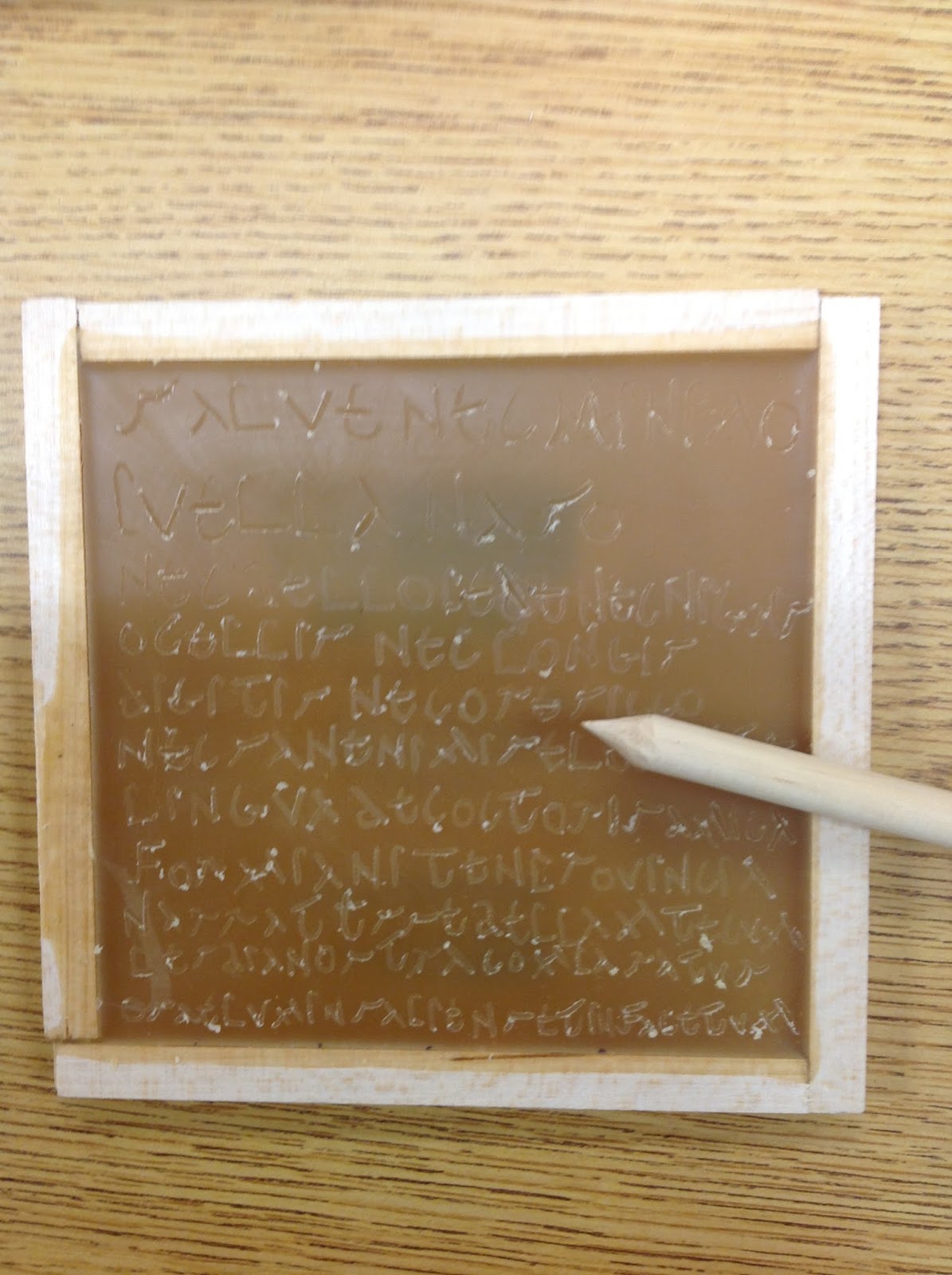
| Student-made wax tablet and stylus with writing in Old Roman Cursive |
An, opsecro hercle, habent quas gallinae manus? Nam has quidem gallina scripsit.
By Hercules, I pray you, did the hand of a chicken do this? Surely a chicken wrote these things. (Plautus, Pseudolus 29-30)
Even the ancient Romans themselves knew that their handwriting had the appearance of chicken scratches. In a decidedly low-tech project, the students in our Latin III class, after having read for two years the literature of Caesar, Cicero, Eutropius, Sallust, Horace, and Catullus, have the chance to enter the chicken coop and explore Roman paleography. They look at the famed Vindolanda tablets and learn to read and write Old Roman Cursive for themselves. They then make their own writing materials, either a wax tablet and stylus or papyrus sheet and reed pen. With these instruments they copy a favorite text in Old Roman Cursive. A key component of the project involves their written reflections, and as always, this year's students had some extraordinary insights.
This project has shown me that today we have it easy. We can just go to the store around the corner and buy multiple pencils, pens, etc., without even thinking about it. The Romans had to use elements from the earth to write. Tony


I had to think about every single movement and swipe I was making.... I was not writing. I was simply copying shapes that I didn't understand. Miles


The personalized formation of every letter from every Roman tells a different story, a story incapable of being capture through stone writing alone. Old Roman cursive is able to capture emotion; large letters may show some anger and thin letters might show delicacy. Overall, Roman cursive can provide new insight to Roman life. Ben


The privilege we have in the 21st century to have removed the entire process of making the staples of living often clouds the respect we should have for possessions. The idea of throwing paper away because something had held a bit through must seem absurd tot h Romans, and it's now a common practice. This has always led me to believe the Romans led a more disciplined life, as they couldn't afford to waste time remaking papyrus if they made errors. Meg


This project also caused me to concentrate intently on each and every word of Catullus 101. As I was writing or drawing rather each and every letter very slowly and repeatedly, I was able to focus on each word, each time presenting me with something new to think about. The repetition from originally seeing the poem, practicing it in old Roman cursive, and then finally transferring it over in ink to papyrus, caused me to find hidden meanings and techniques used by Catullus. This made me realize that both poetry and writing are art forms that can represent a culture. Laura


The handwriting provided something of a link between the work and the person who wrote it. For example, while reading Catullus, it is all too obvious that he is a person interested in more earthly things, like his affairs with Clodia, or mourning the death of his brother.... But seeing it, and even writing it in Old Roman Cursive made it even more...personal. Understanding the script of the Ancient Rome has led me to a realized acknowledgment of these poets and writers as people, instead of just names to be associated with this work and that poem. This experience has developed a more humanizing point of view of normal people who breathed and felt just as we do, instead of being another name in the history book, to be forgotten the very next day. Becky


