

I love stained glass windows and am certainly no iconoclast, but when it comes to the subject of Fr. Dimitri Sala's book The Stained Glass Curtain, I am all for some ecclesiastical glass shattering. Jesus tells us that no one knows when the end of the age will come, and whether the hour is late, as it seems to many, or is yet far off, the Great Commission still stands to go and make disciples of all nations, and our message of the gospel of Jesus Christ would sound much better coming from a unified voice than from the cacophony of infighting brethren.
When The Church Became Larger
I grew up in an independent Christian church in the midwest, and while I read St. Augustine's Confessions as part of an undergraduate philosophy class at Indiana University, I did not come to grasp that a few things had happened between Acts 2 and the present until I was in graduate school. A pastor friend at the time introduced me to the Church Fathers, a Lutheran friend introduced me to high-church liturgy, and suddenly the church became more gloriously grand than I had known. I discovered the 378 volumes of the Patrologia Latina and Patrologia Graeca of Jacques-Paul Migne, and believe me when I say that upon realizing I could access the works of the Church Fathers in their original languages, I thought I might never leave the library.
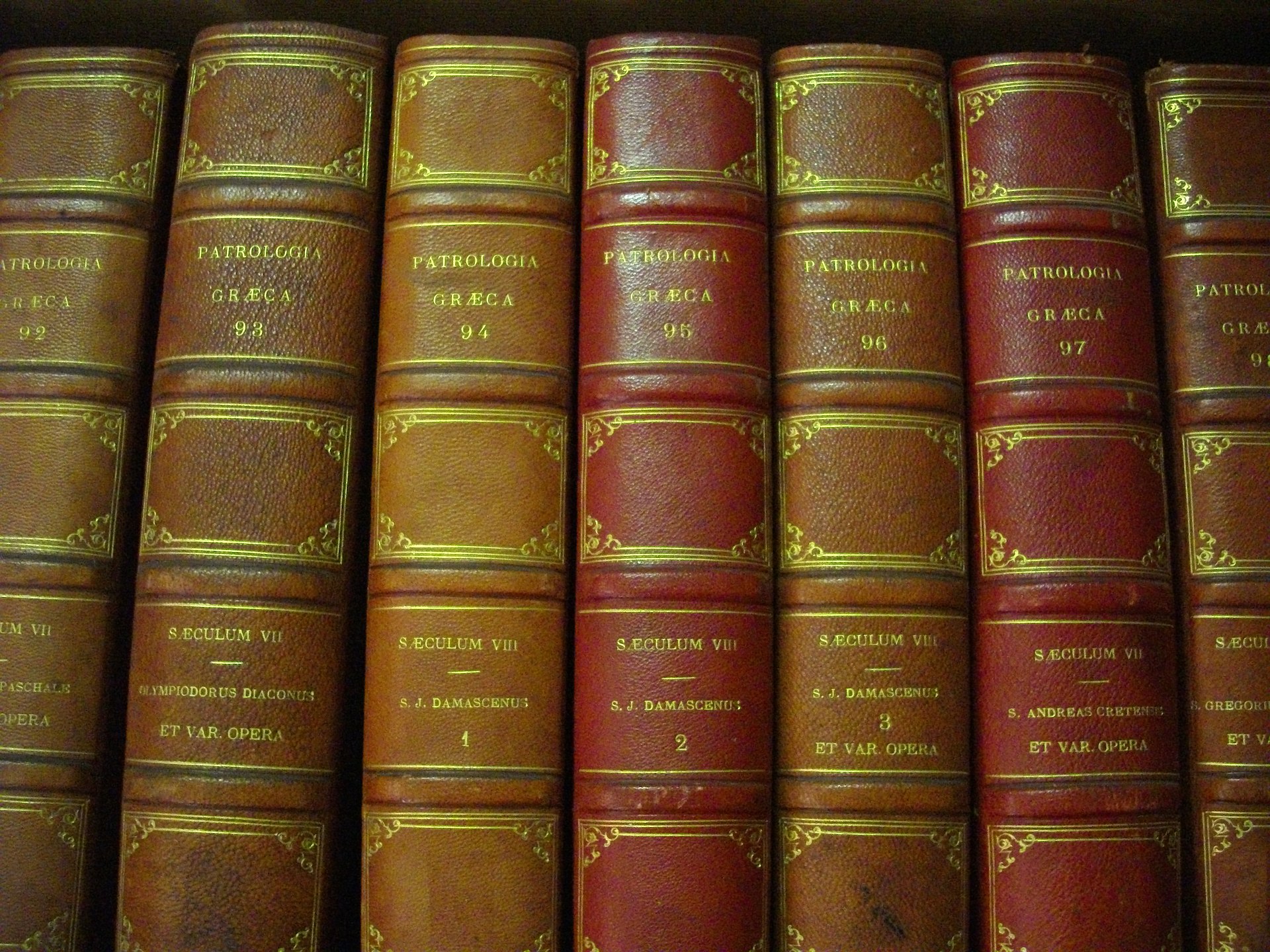 |
| Volumes from Patrologia Graeca |
This kind of reading and discussion led to my becoming acquainted with the writings of Fr. Richard John Neuhaus, Stanley Hauerwas, Lesslie Newbigin, and others. It also took me to Rose Hill in Aiken, South Carolina, for an ecumenical conference with enough luminaries that electric lights would not have been necessary. Peter Kreeft spoke, along with Fr. Neuhaus. There were Harold O. J. Brown, Fr. Patrick Henry Reardon, Bishop (later Metropolitan) Kallistos Ware, J. I. Packer, and Carl Braaten as plenary speakers and numerous other well-known leaders of breakout sessions. There were Catholics, Orthodox, Evangelicals, and mainline Protestants at this conference, including me, a graduate student in Classics who was savoring just how large the body of Christ truly is. If you were not able to attend that event in 1995, you can read all of the amazing talks in Reclaiming the Great Tradition.

A Radio Station That Made Sense
I used to listen to radio on my drive to school, and in the months leading up to the 2008 presidential election, I found one that gave me the information I wanted. At that time I had been listening a lot to the local K-Love affiliate, a Christian music station with Christian-based talk shows woven in. That station, however, was not talking about any of the issues surrounding the election, although many of the secular stations were, and as I searched for something else, I ran across the local EWTN affiliate that was tackling the issues head on and in a fair, balanced, faithful way. I was soon listening to episodes with Fr. Mitch Pacwa and Mother Angelica. My reading expanded into the writings of Cardinal Joseph Ratzinger, who by then had been elected Pope Benedict XVI, Scott Hahn, Stephen Ray, David Currie, and more. I was delving deeper into St. Aquinas, St. Anselm, and some of the exquisitely beautiful prayers of the faith, such as this one from St. Bonaventure, along with the Catechism of the Catholic Church, and one thing became abundantly clear. Catholics, Orthodox, and Protestants have much in common.
Evangelicals and Catholics Together


Among the books I read in those years was Evangelicals and Catholics Together by Fr. Neuhaus and Charles Colson and Becoming a Contagious Christian by Mark Mittelberg, who has since become one of my dearest friends. The former is based on and is an expansion of a document by the same name, which appeared in the May 1994 issue of First Things. It focuses on the evangelistic mission of those who follow Christ and the many points of shared belief between Evangelicals and Catholics. The latter is a landmark book in personal evangelism, which is to say, it is about understanding the gifts God has given each of us so that we, in our unique ways, can best fulfill the evangelistic mission that has been given to us all, and it is through the author of that book that all these threads start coming together.
The Boring Part of Homer's Iliad?
If you have stayed with me so far, congratulations and thank you. It may have felt a bit like reading the famous Catalogue of Ships in Book 2 of Homer's Iliad, the part a lot of people skip, but there was a reason I mentioned all those books and names. Much of my reading, thinking, and discussion for the past thirty years has prepared me for and led me to Fr. Dimitri Sala's The Stained Glass Curtain.
In the fall of 2022, Mark Mittelberg emailed me to say that he and Fr. Dimitri had been talking about this book and that he had given Fr. Dimitri my email. I quickly visited https://www.thestainedglasscurtain.com/ and couldn't wait to purchase the book. Just a few pages in, and I was emailing Fr. Dimitri myself, beating him to the punch, and soon we were emailing and talking on the phone about the importance of this book, both from a Catholic perspective (his) and from an Evangelical perspective (mine). As I devoured the book, I highlighted passage after passage. In fact, the highlighter pictured below was brand new when I began using it on this book. I drained it dry and began another before I had finished reading.
 |
Consider just a few of the many examples.
"[O]n the level of evangelizing with the message of salvation and the working of the Holy Spirit, official Catholic teaching and the preaching of Evangelicals do not differ." (p. 8, italics original)
"[W]hether coming from a Protestant or Catholic source, the gospel is still part of the common heritage of Christianity we share with all who preach it." (p. 12)
"[O]ur disunity radically lessens what God is able to do through us to transform the world by our witness of the gospel." (p. 14, italics original)
"Since its central figure is identified as a personal being -- and one who love us, no less -- Christianity cannot be viewed as an impersonal set of practices, guidelines, or laws. God's purpose in creating us was not simnply to get us to go through a set of motions we call 'worship' or to follow a set of rules we call 'commandments.' No -- He created us foremost to exist in relationship with Him." (p. 37, italics original)
Why The Enthusiasm?
Why am I so enthusiastic about this book that I emptied a highlighter in it and have written this lengthy blog post? It's simple. Nothing is more important than evangelism. Nothing. And because this is the case, I want to see nothing hinder its progress and everything done to advance its cause. Misinformation and misunderstanding that lead to divisions within the body of Christ are not only abhorrent to God (see Romans 16:17, 1 Corinthians 1:10, Galatians 5:19-21, Titus 3:10-11, and Jude 19), but also, as Fr. Dimitri wrote, do harm to our witness to the work of Jesus.
There are, of course, differences across the body of Christ, many of which are quite important. These must be approached with prayer, with humility and grace toward those who would take up their meaningful discussion, and with openness as we "rightly handle the word of truth" to which the Holy Spirit leads us. The temptation we must not only avoid but renounce is the one that would have us start with these differences. If Catholics, Orthodox, and Evangelicals believe any of the same things, as Fr. Dimitri suggests they do regarding the salvific nature of Christ's work and the nature of God as one God eternally existing in three persons, we would do well to remember these two teachings of Jesus.
John said to him, "Teacher, we saw someone casting out demons in your name, and we tried to stop him, because he was not following us." But Jesus said, "Do not stop him, for no one who does a mighty work in my name will be able soon afterward to speak evil of me. For the one who is not against us is for us." (Mark 9:38-40, ESV)
When he saw the crowds, he had compassion for them, because they were harassed and helpless, like sheep without a shepherd. Then he said to his disciples, "The harvest is plentiful, but the laborers are few; therefore pray earnestly to the Lord of the harvest to send out laborers into his harvest." (Matthew 9:36-38, ESV)
