Monday, February 14, 2022

Too Fond

Philosophy books to grade

It has been a long, long time since I was in Kindergarten, putting a big, red F on a quiz I had made for my grandmother.  Back then, I thought that was what teaching was all about, but then I grew up.  Now, grading is one of my least favorite parts of my job as a teacher, as it is for many if not most teachers.  I do not enjoy the tedium of it, but there is another reason grading is a particular challenge for me.  It takes too long.  Now, you may be thinking, "Just assign less work, smart guy, or create assignments that are easier to grade."  That solution, however, misses the root cause of my problem.  Grading takes a long time for me because I am too fond.

A King and His Priest

In the 1964 film Becket, an adaptation of the 1959 Jean Anouillh play Becket or the Honour of God, King Henry II (Peter O'Toole) falls out with his onetime friend Thomas Becket (Richard Burton), whom he had helped make the Archbishop of Canterbury.  In one of the most famous, although undoubtedly not the first, instances of plausible deniability, Henry muses among his noblemen, "Will no one rid me of this meddlesome priest?"  The nobles take this as a command from their sovereign and head out to murder Becket in the cathedral.  Yet it is what Henry says immediately after his provocative query that has always struck me as the heart of this story.  Listen closely in the following clip.


Henry is torn between his need to establish his authority and his deep feeling of friendship with Becket.  In his words, he is too fond.  What on earth could be the comparison between this sort of anguish and the challenge to a teacher grading an assignment?  It is just this.  Like Henry, I am torn by the need to do something, namely, to assign a grade, and the feelings of admiration and inspiration that threaten to overwhelm me as I read what students have written.  I am too fond. 

Student Philosophers


In a recent post I wrote of a project that involved my Latin III students.  They had read selections from the writings of the Stoic philosopher Seneca, and upon completion they had to take their reading a step further.  Seneca had written his philosophy in the form of letters to a friend, and these students were asked to write a philosophical epistle of their own.  Additionally, they had to reflect on which of Seneca's epistles had meant the most to them, which had caused them to look at something in a new way or even for the first time, and which contained ideas they were likely to apply in their own lives.  Everything that follows is student authored.  Take the time to read what they wrote, even the longer passages, and as you do, pause to admire what teenaged students can do.  Oh, and have a kind thought for me.  I must do the mundane work of entering grades for their work, but I would far rather sit in fondest wonder as I ponder their words, or better yet, run through the streets, shouting, "Look at these students!  Aren't they amazing?"  


Philosophia Mea


The following are excerpts from what these students wrote, in imitation of Seneca, in the form of a philosophical epistle.

A lot of times you go through life thinking you need someone's permission to do something so simple.  You might think you need permission from yourself.  You probably think that you need to have your life all sorted out or have everything marked off your to-do list before you do something you want.  But go ahead and give yourself the grace to enjoy life a little bit.

To My Dearest (Future!) Daughter,
          Being a girl isn't easy.  Women are so quick to judge other women, just based on what they see externally.  I want you to know that you are perfect just the way you are.  The only opinion about you that matters is your own.  There will be times where you doubt yourself, where you lack self-confidence, where you may have a poor body-image, or where you make mistakes.  But these adversities are all just a part of life that everyone faces at least once.  I myself have struggled with all of these.  My sweet daughter, always remember that "You are braver than you believe, stronger than you seem, and smarter than you think."  Just being you is more than enough, and I will always love and be proud of you!
          With Endless Love,
                                   Mom

Do not live an outward life.  I urge you, my friend, to build a life that can be self-contained.  Do not depend on other people or things, which pass or change with time, but create a place within your soul where you may retreat to find peace and contentment.  I do not say that you must withdraw from the world; on the contrary, you must find joy in as many things as possible.  Suffering, it seems, waits for us everywhere.  Indeed, it is impossible to live a fully joyful life; there is no one, I tell you, who can be joyful in every moment, but you must strive to do so.  The man who ceases in his walking to listen more closely to a bird or look more closely at a flower is a man who lives a full life.  You must be predisposed to contentment.  The man who relies on other people or remarkable events for his daily happiness is like the man who walks out to an island at low tide and does not know how to swim.  He is at the mercy of the tides and can never be certain of his safety or free to travel where he wishes.  Therefore, dearest friend, carry your joy with you everywhere you go, and do not leave it at the mercy of the world.

Be wary of jealousy.  To combat this you must strive for the virtue of gratitude.  But how do you do this?  Aristotle taught virtue is the mean between two vices, so gratitude is the mean between jealousy, which is wanting someone's good thing or fortune for your own, and anhedonia, not wanting good for yourself.  A great way to counter jealousy is to break yourself of your attachments to possessions since they will never truly bring you happiness; human relationship brings true happiness.

I advise you not to allow life's potential stresses to tear you down.  Parcel the tasks so you can better manage them, and you will find that they truly weren't as stressful as you thought them to be.  If you claim not to have time for breaks, know that you are responsible for your own time management, and you should not allow others to take your time away with things that will not allow you to grow your mind.


The Most Meaningful of Seneca's Epistles

Epistle 20 was especially interesting.  One particularly meaningful sentence was, "I advise you this:  that you not be miserable before the time, since those things at which you paled in fear (as if about to happen), perhaps may never come, for they certainly have not come yet."  This was extremely eye-opening, since I often will stress about things that are completely out of my control.  Worrying is just making my life harder and causing me extra harm.

I found epistle thirty-eight very meaningful since in it, Seneca states to use effective words rather than many words.  I found this statement inspiring since I am a pretty introverted person and sometimes get annoyed with myself or others get annoyed with me for not talking a lot when in a social setting.  I think it is very important to state that which has value and meaning rather than just a bund of meaningless words.

I found epistle eighty-eight very meaningful due to Seneca's emphasis on the idea that titles and degrees and other things which are considered "important" in our modern society are not really that important.  What is important is that you are a good person.  I found this epistle especially touching since I am not really wanting to go to college and so many people have told me that I am ruining my life by doing that and am not being smart.

Epistle LII was meaningful to me because as a teenager, I try to look for someone to be an example.  It can be discouraging when it seems like you an't find anyone, but this epistle reminded me that my options aren't limited to those that I know personally.  Ones that came before me can be examples too.

Epistle 38 was meaningful to me because I find myself rambling a lot and many of the words I say are unnecessary.  Seneca says to use few words with greater meaning and this is something I need to work on.


Which Epistle Prompted You To Consider Something New?


In Epistle 44, Seneca talks about how philosophy is above no one.  This is an idea that I have never thought about before.  I have always been intimidated by the idea of philosophical thinking, because I work better in more black-and-white ways of thinking.  I enjoyed the part where Seneca said that philosophy did not receive Plato as a noble man, but Plato was made noble through philosophy.

The idea in epistle 2 about retaining something from what you read to protect the plagues of life is a new concept to me.  I have always know that readings is supposed to teach you a lesson that you can use in your life but I had never thought about it as building a defense against plagues of evil. This concept makes me want to read more so that I can have the best defenses possible.

I believe that Seneca's thoughts on teaching and learning helped me to see those things in a new light.  Seneca talks about really digesting material and truly understanding it as well as focusing on the actual useful and practical things that can help me to be a better person as well as bettering others.

The idea that made me think in a different way was the idea that you lose credibility if you are not willing to act on your words.  I am now going to think my words through and try to back them up with my actions.


Which Piece of Seneca's Advice Might You Apply In Your Life?


The idea that time is the one thing that we are truly in control of is one thing that was discussed in Epistle 1.  He talked about how time is extremely "slippery," as well as how easy it is for us to let other people take our valuable time away from us.  Personally, I have always prided myself on being decent at time management with my school work; however, I have always put that above everything else in my life.  While this has benefited me from an academic standpoint, life is more than school.

One idea I would likely put into practice is the idea discussed in epistle XXVIII, where Seneca suggests that a person should not change their 'climate,' but they should change their spirit.  An example of this is that sometimes I do not want to do my homework.  Even though I know I must do it in order to get good grades, I sometimes feel like giving up on it.  However, instead of thinking about how boring the homework itself is, I like to think about how I will feel once I am done and have gotten a good grade.  This is an example of a person changing their spirit.

One idea that I would put into practice is the idea, in letter seventy-six, of always learning.  Seneca says that learning must go on as long as you do not know something or as long as you live.  I think this one is important to practice in my life because people need to keep learning and growing as much as they can.

An idea I am most likely to put into practice is from epistle 71.  In this epistle Seneca states that you must plan for your whole life rather than just parts of your life.  we must think more of the end goal rather than just one step at a time.  I think about where I am considering going to college.  I must also consider what I will do after college and where it will take me.  What career will I choose?  I must think more of the future rather than just tomorrow.

I would put into practice the ideas of epistle 33.  I have consistently memorized content for tests throughout middle and high school, and forgot all information directly after it is over.  Sometimes, I don't even know or understand the content, rather I memorize the fact for rehearsal on the test.  I need to start fully understanding the content and truly putting it in memory before I have the ability to rehearse it.

Wednesday, February 9, 2022

Imagination, Education, and Faith

Corpus Hypercubus, Salvador Dali, 1954


Imagine a square on a piece of paper.  Now, imagine stretching that square upward from the surface of the paper.  You would have a cube, right?  Try, if you can, to imagine expanding that cube into four spatial dimensions.  You can't really do it, because we our brains only think in three spatial dimensions (length, width, height), but if you could, you would be imagining a tesseract or a hypercube.  Dali painted one of his crucifixion works showing Christ on a hypercube.  Pretty imaginative, huh?

The Wonder of Imagination


In an age in which I can pull from my pocket a device that allows me both to see and hear a friend halfway around the world as we converse in real time, we may be losing our sense of amazement at imagination itself.  What was, not too many years ago, the province of science fiction is now mundane science.  We can certainly imagine amazing things, and we do on a regular basis, both in the design of products and in our entertainment, but then again, it is not that hard to do so.  We have split the atom and walked on the moon.  We have taken images of far-flung space and helped a 3,000 -year-old mummy speak.  Should it be surprising that we have imagined the Marvel universe onto the silver screen?  To see how amazing human imagination truly is, consider some of what we imagined when we didn't have technological marvels on every corner.

In Book IV of his Metamorphoses, the Roman poet Ovid told the story of Venus and Mars.  It was an adulterous affair between the goddess of love and the god of war, and to get revenge, Vulcan, the husband of Venus and blacksmith of the gods, crafted a net of bronze in which to trap them.  Ovid wrote that the strands of the net lumina fallere possent.  They could deceive the human eye.  The net was so finely woven that it would move with the slightest touch and was unlike anything that a weaver or even a spider could spin.  Ovid, writing at the beginning of the first century A.D., imagined this adulterer's trap at a time when it could not have been produced in reality.  There were many excellent craftsman of that day, to be sure, but none that could have crafted what Ovid conceived in his mind.

Or take Lucian of Samosata, the second century A.D. satirist who wrote what some consider the first science fiction novel, A True Story, with its wild plot describing travel to the moon and interstellar war.  Lucian died sometime around 180 A.D., which is a long time before Neil Armstrong or Star Wars.  Such a tale from a time when there was no electricity or telescopes is, well, quite imaginative, and knowing the circumstances in which it was written, we likely experience a little wonder, if not jaw-dropping amazement, at the very act of Lucian's imagination.

The Necessity of Imagination

Imagination is a critical and foundational component of literacy, something I was discussing recently with a former student now at a major university preparing to become an English teacher.  As our Zoom conversation wound its way through many ideas, I recalled the story of one my of homeroom students years ago as he took our statewide assessment.  One part of the test asked the students to write to a prompt that said something like, "You and your class went on trip to a dairy farm.  Write about what happened on that trip."  This young man raised his hand, and when I went to his desk, quietly said, "I didn't go on that trip."  I replied that this was pretend, that he should imagine what it would have been like and to write about that.  He accepted the advice, and as I walked away, I noticed the ankle bracelet that this sophomore was required to wear while on house arrest.

Since he was in my homeroom, which only met once a week, I did not know him well, and I never learned all of his circumstances, but I was shaken deeply that day, and the ripples of that interaction are with me still.  I did not know what had warranted his house arrest, but I did know that he lacked a skill necessary for learning, imagination.  Whether that had anything to do with his legal trouble, I could not say, but it was heartbreaking to think that a high school sophomore did not recognize an imaginative assignment for what it was or, worse still, lacked the capacity to fulfill it.


The Treachery of Images, René Magritte, 1929

Imagination is at the heart of metaphor, and it is possible to see all language as metaphoric.  When I look at an object sitting on my desk and tell a friend, "That is my stapler," I have made a comparison, a reference.  I have uttered the two syllable word "stapler," perhaps even written its five consonants and two vowels on a piece of paper, and have asked my friend to connect those sounds and letters with the object on my desk and think of them as the same.  It is, when you think about it, an extraordinary act of imagination to think that seven distinct shapes on a piece of paper are the same as a metal and plastic, rectangular device capable of puncturing an object with a slender bit of metal and then bending that metal so that what has been punctured by it cannot readily escape from it.  It takes even greater imagination to suppose that an act of exhalation and vocal cord-vibration is equivalent to that metal and plastic, rectangular device.  If such imagination is required for the identification of a simple office item, how much do we need to understand math or physics or poetry?

Imagination's Raw Materials

Much goes into the making of imagination, both in terms of the material by which imagination works and the working of that material into what we call imagination.  In a similar way, a painting is the product both of physical elements such as paint, brushes, and canvas, along with the training and practice and work of the painter.  What, then, are the materials and the working that go into the formation of imagination?  The answers, of course, far exceed what can be explored here, but there are some basics that can be considered.

Experience, along with the realization that things can be other than they are, is one of the key elements of imagination.  When once I have experienced a coffee cup and have come to understand that its shaped may be varied, I can imagine a cup that will ride without spilling in my car, and so is born the travel mug.  One of the best ways for me to expand rapidly my experience of the world is through reading.  My grandmother used to say that she could go anywhere in a book, and she was right.  Faster than in a Star Trek transporter, I can be whisked by a book to any place in the universe and at any point in history, and this is one of the reasons why reading is crucial, especially in early childhood.  Maryanne Wolf, whose background is in neuroscience and psycholinguistics, has written much about this, and the point is quite simple.  Children need to be read to when they are young and need as much experience with reading as they can get once they are able to read for themselves.  I will never forget when one of my students asked if I had read Seamus Heaney's then new translation of Beowulf.  When I said that I had not, he offered to bring it to me when his dad had finished reading it.  As excited as I was to see the new Beowulf, I was more struck by the comment about his father's reading habits.  Reading was clearly a part of this family's life, not only engaged in with and for the children, but by the adults as well, thus modeling the look of literacy for the younger members.

If reading is a source of experience, one of the necessary ingredients for imagination, how is that experience kneaded and worked into imagination itself?  In no small part this happens through imaginative play among children.  When my son was little, we ran around the backyard in endless re-enactments of the Trojan War.  He was always the victorious Achilles, and I the doomed Hector, and there can be no doubt that the imaginative play of his youth, which included adventures with toy knights and kingdoms built of Legos, shaped the imagination that he now uses as an industrial design major.  Whether it is retelling a story through a classroom play complete with cardboard props and costumes cobbled together from the rummage sale to drawing pictures of a favorite story in a notebook, this sort of creative and recreative work is essential for developing the skill of imagining.

Imagining God

St. Anselm (1033-1109) is famous for putting forth his ontological proof for the existence of God.  In Proslogion 2 he says that God is aliquid quo maius nihil cogitari potest, that than which no greater can be imagined.  He is the very limit of our imagination because He is the source of our imagination, and it certainly takes imagination on our part even to attempt to get our minds around how John described the Incarnation in his gospel when he wrote that the Word was God and the Word became flesh and lived among us.  Our word "imagination" is derived from the Latin word imago, which we find in Colossians 1:15 where Jesus is described as the imago Dei, the image of God.  Just a few lines later in verse 19 we read that all the fullness of God dwelled in Him.  Once again, Jesus, Who is God, is the very limit of our imagination.  He is the fullness of God.  He is that than which no greater can be imagined.

Imagination is necessary not only for attempting to grasp theological concepts, but for the living out of our faith as well.  We live in the world of already-but-not-yet.  Christ is already victorious over all things, and yet we await His return and the renewal of all things.  This is why His description in Revelation 4:8 as the One Who was, Who is, and Who is to come, while seemingly illogical, makes sense, but it does take a stretching of our imagination to get there.  What does it mean, then, to live in such a reality?  We are everyday imagining new ways of doing just that.

Why We Read


Much more can be and has been written about imagination, but I want to close by revisiting the idea of reading.  Not only do books quickly broaden our experiences, the raw material of our imagination, but they allow us to see how others imagine.  For most of human history, people have learned skills through apprenticing, by seeing how others have done something, and this applies well to developing our imagination.  When we see how master authors, both of fiction and nonfiction, have imagined the tale they have to tell, we see yet another way for us to imagine our own tale, a way that we can follow or that will inspire us to imagine something new yet again.

Thursday, February 3, 2022

Leadership Lessons

Title Page of Samuel Clarke's Latin Iliad (published 1729)

What does it say about an organization or business, a school or a church, a team or a group, when its best people start leaving?  

My second-year Latin students have been reading selections from Samuel Clarke's 1720 Latin translation of the Iliad.  They had previously learned some of the rudiments of Greek and had just finished reading parts of Julius Caesar's account of his war in Gaul.  By diving into a Latin translation of the Iliad, a war poem originally written in Greek, they were able to bring both of those strands together.  Among the many themes and ideas that can be drawn from this roaring adventure story are lessons in leadership.  In fact, the entire epic could be read as a case study in leadership styles, but one key thing leapt out recently as we discussed the argument between Agamemnon and Achilles in Book 1.

Upon learning that the plague in the Greek camp outside Troy had been caused by Agamemnon's capture of a Trojan girl who was the daughter of a priest of Apollo, Agamemnon was persuaded to return her to her father.  He demanded, however, that one of the other Greek soldiers replace his lost war prize with one of their own captured Trojan women.  Achilles found this intolerable, arguing that each warrior had won his spoils of war fairly and should not be forced to give up anything.  Set aside for a moment the moral issue of taking human slaves as war prizes and notice what happened next.  When Agamemnon retaliated against Achilles and his defense of the soldiers' spoils by threatening to taking Achilles's own slave woman, Achilles replied,

Nunc itaque abeo in Phthiam: quoniam multo melius est,
Domum ire cum navibus rostratis....

Now, therefore, I leave for Phthia, since it is much better
To go home with my beaked ships....

Achilles was far and away the greatest of the Greek warriors in the Trojan War.  No warrior worthy of the name would leave the fight, but here was Achilles himself willing to pack up and head for home.  It was a question Agamemnon would have to deal with over the course of the Iliad, but it brings up a point that my students and I discussed.  When good, qualified people start to leave, leadership needs to start asking the hard questions of itself.

The most recent in an endless series of articles about teachers leaving education is one in The Wall Street Journal, which talks about companies that are snatching up educators who are, like Achilles, leaving the fight.  Unfortunately, the article makes only one brief reference to "dealing with challenging...administrators" as a cause for the teacher exodus, yet I would argue that it is one of the primary reasons for it.  Several years ago I wrote a piece titled "Bad Administrators Are Killing Education," and little has changed.

To give you an idea of how the leaders of an organization set the tone and influence their employees, consider the following email from my current principal to his staff regarding the cancellation of school for inclement weather.  After laying out the details and discussing what we needed to do with our students, he concluded, "Last, but not least, enjoy your time at home.  God must have thought we needed a break."

You do not need to be a person of any faith at all to recognize the generous humanity in his comment.  And what did that inspire in me?  It made me want to share that generosity of spirit with my students, so when I messaged them about assignments to be completed during our time away from school, I added, "Most importantly, call to mind these words from Roman poet Horace in Ode I.9.1-6.

Vides ut alta stet nive candidum
Soracte nec iam sustineant onus
silvae laborantes geluque
flumina constiterint acuto?

Dissolve frigus ligna super foco
large reponens...

Do you see how Mt. Soracte stands gleaming
With deep snow and the struggling forests
Do not sustain their burden and
The rivers are frozen with sharp ice?

Melt the cold as you place upon the hearth
A large stack of wood...

As I work on other school matters during this snow day and drink a cup of Earl Grey, I cannot help but think that if Agamemnon had been more like my principal, Achilles would have stayed.  I am quite certain that if more building and district level leaders in education followed his model, we would not be facing quite so sharp a crisis in education.


Tuesday, February 1, 2022

Jesus and Seneca


Several years ago, the fifth-year Latin students at the school where I was teaching wanted to read some Roman philosophy, so I suggested Seneca, the 1st century A.D. Stoic.  After they had read some of his works, they insisted that I include him in one of my classes.  They thought his ideas and advice were sound and would be particularly well suited to teenagers.  Since they were teens themselves, I took their word on this last point, pulled together selections from Seneca's 124 philosophical epistles, and put them together in a small volume that would allow students to read some of his best works, record their translations on the pages with the Latin text, and have space to write their own philosophical musings.

My current Latin III students at Guerin Catholic High School have recently been reading and discussing Seneca, and one of them made an interesting connection with something Jesus had said.


Guerin Latin students discussing their translations of Seneca

We also have a Verse of the Week, a Latin verse from the Bible, that we read and discuss each week, and the verse for this particular week was Matthew 6:34, "Nolite ergo solliciti esse in crastinum.  Crastinus enim dies sollicitus erit sibi ipsi:  sufficit diei malitia sua."  "So don't worry about tomorrow, for tomorrow will bring its own worries.  Today's trouble is enough for today."  I commented that this seemed like the kind of thing Seneca would say, and Erin immediately replied, "It's like what he said in Epistle 13 about not worrying because things may not actually happen."  She was referring to the passage in which Seneca had written, "Illud tibi praecipio, ne sis miser ante tempus, cum illa quae velut imminentia expavisti fortasse numquam ventura sint, certe non venerint."  "I advise you this, that you not be miserable before the time, since those things at which you paled in fear as if imminent perhaps may never come, for they certainly have not come yet."

I wish I could write that I expounded upon this meaningfully, that I drew forth from this student's observation further profound insight, but I didn't.  I fumbled some sort of affirming comment and moved on because her keen insight had simply blown me away.  This high school student had made a connection between something Jesus had said and something Seneca had written as effortlessly as other people cite sports statistics or quote song lyrics.  Do not let anyone tell you that young minds are incapable of some of the sharpest and deepest thought.  Do not let anyone say that we must come down to some imagined inferior level when working with them.  That is nonsense.  High school students are more than capable of rich, meaningful engagement with the greatest art, music, poetry, philosophy, and science that we have created.  We do them and the world a disservice, whether by pandering to them with silliness or by burdening them with great quantities of work in misguided attempts to instill rigor into the curriculum.  What is needed is straightforward, deep, and deeply human interaction with the discoveries and achievements of the past as we guide our children to the fullest use of their gifts.

Tuesday, January 25, 2022

Julius Caesar and (Not So) Modern Education


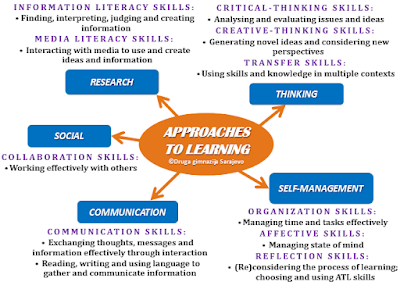
The school where I currently teach Latin is an IB World School, as was the one where I spent the most recent 23 years of my career.  You can read more about the International Baccalaureate program on our website, but the aspect of IB on which I want to focus is called ATL, Approaches To Learning.  One handy graphic lays out the ATLs like this.


An argument can be made, quite easily in fact, that these approaches to learning, while displayed here in somewhat new packaging, have in fact formed the basis of good teaching and learning for a long, long time.  Because that is true, I have found that a project I have for many years assigned to Latin II students fulfills this model of instruction quite nicely.  Or perhaps I should say that this model matches well with a meaningful project my students have regularly pursued.

After spending quite a bit of time reading in Latin the war writings of Julius Caesar in his campaigns against Gaul, the students choose partners (social) to work together to explore more deeply some aspect of the ancient Roman military.  They must pick an issue or problem the Roman army of the 1st century B.C. would have had to address and then find out how the Romans actually handled it (research, communication).  They must work together (social) to analyze (thinking) how well the Romans handled it given the resources available to them, and they must devise an alternative solution (thinking), one not necessarily better, but at least different, that the Romans could have employed, again given only the resources available to them.  They have time both in and out of class to complete this, and I frequently use guiding questions to help them maintain their focus (self-management).  Finally, they must present their findings and alternative solutions to the class (communication).  The fun part, of course, is in their sharing of items they have made to illustrate their work, but more on that below.

Several years ago I co-hosted a podcast with Michigan Teacher of the Year Gary Abud, Jr.  In one of our episodes, we spoke with Dr. Bernard Barcio, himself an Indiana Teacher of the Year and a 44-year veteran of high school and university classrooms.  He talked about his decades-long project of guiding students in the construction of catapults, an effort that gained annual attention in the national news and that has been chronicled with archival video here.  As we discussed in that podcast, such an approach to education grew to take on the name "project-based learning," although when Dr. Barcio began it back in the 1960s, it carried no such appellation.  It was merely good teaching.

I am pleased, of course, if something I do in the classroom checks the boxes of the IB approach to learning.  We are, after all, an IB World School.  Yet what I, and I think the International Baccalaureate Organization itself, would argue is that this approach is simply about helping students make the most of their learning, regardless of what name the approach goes by.

What follows are pictures from this year's Caesar projects by the Latin II students at Guerin Catholic High School.  


On group recreated testudo,  the tortoise shell formation of the Roman army.

Another group baked buccellatum, the hardtack eaten by soldiers. Yes, with jaw-breaking effort, I ate one!

One group crafted a Roman gladius from wood.

Some may wonder why, in the age of electronic technology, my students create old-fashioned posters of the information.  Some of my other projects do indeed ask students to present using electronic technology, but this project allows me to display student work in the hallway.  Not only does this affirm the value of their work, but it allows other students to see the kinds of things we do in our classes, perhaps giving them something to look forward to when they reach Latin II.


In the end, this project helps students develop multiple skills while exploring topics of their choosing relevant to our class.  It ticks off the boxes of modern education theory, but in fact it is simply the kind of thing that teachers have long used to help students make the most of their learning.  When it comes to successful strategies, I think Caesar would have like this one.

Saturday, January 22, 2022

What It Means To Compete

Eleven of my Latin students recently competed with Latin students from around Indiana at what we call certamen (care-TAH-mun).  Certamen is the Latin word for competition, and this particular form of competition sees students participating individually and collectively to answer questions about ancient history and mythology as well as Latin grammar and translation, which makes this event a competition in the true sense of the word.  "Competition" comes from two Latin words and literally means "to seek together."  In its purest sense, competition is seeking a goal along with others.  This can, of course, devolve into a slug fest of sheer brutality, whether in sports or music or academics, but that sense of competition is too narrow to capture the essence of what it means cum petere.  Because certamen represents competition as it should be, I was able to do something at this event that I have waited my entire career to do, but more on that later.

My students have re-launched a chapter of the Junior Classical League at our school after a hiatus of several years.  One of my predecessors had sponsored a chapter, but in recent years it had not been active.  Because this was our first time to participate in a state certamen, I had told my students to have fun.  There are students who compete with no more preparation than what they have received in class, some who supplement that by reading history or mythology on their own, and some who who hold regular, after-school practices and are the killer elite.  I was proud of our students simply for showing up, but when the day ended, I was smiling from ear to ear.

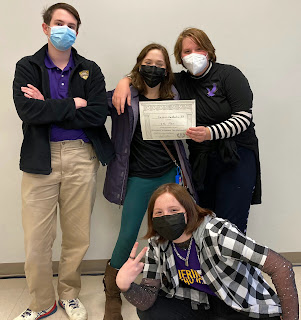
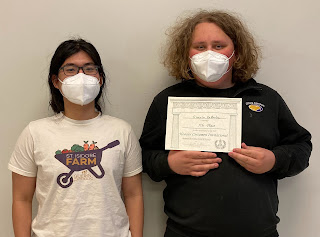
1st place-winning Latin II Team

One of our second-year Latin teams took first place with only two players!  And I should add that one of them is a freshman!  Our other teams acquitted themselves in fine order taking fifth, sixth, and seventh places.

Latin I Team
Latin II Team
Latin III/IV Team

I said earlier that I was able to do something at this event for the first time in my career.  Competition indeed means seeking along with, but who is the object of the preposition "with?"  In a purely secular understanding, competition is seeking along with others who are seeking the same thing, yet Christians know that any such seeking not attempted along with God is futile.  As we read in John 15:5, "Sine me nihil potestis facere."  "Apart from me, you can do nothing."  Although I have always prayed for my students before competitions and tests, I have done so silently.  Today, because my students and I were representing Guerin Catholic High School, I was able to pray openly with them, and that made this particular competition all the sweeter.


Friday, January 7, 2022

Teaching In a Coat and Tie

I teach in a coat and tie.  Never in my career have I been required to do so, nor am I making a fashion statement.  As far as that goes, my sartorial selections are quite traditional, e.g. navy jacket with tan or grey slacks, blue tie with grey jacket and navy slacks, and so forth.  My reason for how I dress to teach each day is rooted in one of the most fundamental aspects of my teaching philosophy, the importance of modeling.  If anyone is having visions of me as a runway model, please stop.  That is not what I mean.

I am speaking of what the historian Livy meant in the preface to his Ab Urbe Condita.  He begins his 142-book history of Rome from its founding to the death of Drusus in 9 A.D. by stating his desire that his readers pay close attention to quae vita, qui mores fuerint, the life and habits of life that once were.  Cicero had earlier said something similar in his speech Pro Archia, an ostensibly defense oration that was more of an encomium on learning.  He asks rhetorically, "Quam multas nobis imagines--non solum ad intuendum, verum etiam ad imitandum--fortissimorum virorum expressas scriptores et Graeci et Latini reliquerunt?"  "How many images have both Greek and Latin authors left us, not only for gazing at, but also for imitating?"  (Pro Archia, 14)

What do an ancient Roman historian and statesman-cum-philosopher have to do with how I dress to teach high school students?  They both speak to the importance of models of behavior.  I dress as I do because that is how my dad dressed.  He had been an elementary teacher before I was born, but as I grew up I knew him as an elementary school principal.

Norman Perkins, Principal of Galena Elementary School, 1968-1991l

This picture, which was converted into a painting and hung in his school when he retired, represents the image of my dad that I saw every day when he came home from work.  It was a professional look, one that conveyed respect for his job as an educator and the people with whom he worked.  When I began teaching at a middle school in Kansas City, his was the model for my own apparel.  In fact, it was not until years later that I realized why I had made the dress decisions that I had.  At the time it was simply the natural thing to do.

Surely, you must be thinking, this cannot be the point of this blog post.  There must be a more significant purpose to this, and indeed there is.  Cicero and Livy were right.  Imitation is far more than a form of flattery, sincere or otherwise.  It is a foundational principle of learning, and this is part of why Cato the Elder's definition of an orator, quoted by Quintillian in Institutio Oratoria 12.1.1, was "Vir bonus dicendi peritus."  For both Cato and Quintillian, the ideal orator was not merely a person skilled in speaking, but a good person skilled in speaking.  It was not enough to learn phrasing and breath control and all manner of rhetorical devices.  These cannot exist in a vacuum but must be used by particular human beings, and what kind of people they are matters as much as the abilities they express.  The Stoic philosopher Seneca gave voice to this in his Epistle 88 when he suggested that rather than spending a great deal of time to earn the title o hominem litteratum, o well read man, "Simus hoc titulo rusticiore contenti:  O virum bonum!"  "Let us," he argues, "be content with a more rustic title:  O good man!"

Perhaps this is the reason that imitation of the true, the good, and the beautiful is rarely discussed in schools of education or in professional development conferences.  We have always, even in Seneca's time, distanced ourselves from that which smacked of the rustic because of an urban prejudice that values the supposed sophistication of the city over anything else.  It is helpful, as with any prejudice, to forego judgment until one has examined all sides fully, and once this is done regarding imitation of the good person, it will become clear why this should be a foundational educational principle and not merely a quaint rustic notion best forgotten.

Simply put, we do not like hypocrites.  We are unlikely to take seriously the advice to quit cigarettes if it is given by our chain-smoking doctor.  Once again, it is Seneca who speaks to this in Epistle 52 and summarizes the idea by admonishing his readers, "Eum elige adiutorem quem magis admireris cum videris quam cum audieris."  "Choose a guide whom you admire more when you see him than when you listen to him."

As a teacher I am called to a certain nobility of character.  Since I am a Latin teacher, that character should reflect the nobility and beauty of thought and creation expressed by the best of the ancient Greeks and Romans.  Teaching involves incarnation.  It is not enough that I dictate facts that students could just as easily and possibly better glean from a text or online source.  I must embody what I teach, for it is the witness of my life that will produce the most memorable lesson.  For a fuller discussion of this, read George Steiner's Lessons of the Masters, one of the finest books on what truly transpires between teachers and students.

Yet I am not a teacher first but rather a follower of Jesus Christ.  As a Christian I am called to follow my Father's example in far more significant ways than I did in patterning my professional dress after that of my earthly father.  This, of course, would be impossible if God were merely an abstract deity, an idea, a notion developed in the collective human mind over centuries.  Our Father is real and in the most basic, etymological sense of that word.  Those questioning this with the challenge that they have never seen Him join the ranks of Philip, the disciple of Jesus, and Christ's response to him applies today.

Philip said to him, "Lord, show us the Father, and it is enough for us."  Jesus said to him, "Have I been with you so long, and you still do not know me, Philip?  Whoever has seen me has seen the Father.  Hw can you say, "Show us the Father?"  (John 14:8-9, ESV)

I hope, at the end of the day, I have done more than just dress as Norman Perkins once did as the principal of an elementary school in southern Indiana.  My goal as a Christian teacher is to model, however imperfectly, my life on that of my Father in heaven, and this each of us can do by looking to the fullest representation of Him the world has seen, Jesus Christ.

Friday, December 17, 2021

Mr. Holland's Aeneid


The 1995 film Mr. Holland's Opus tells the story of Glenn Holland, an aspiring musician and composer whose dream is to create one memorable work of music.  To pay his bills, however, he takes a job as a high school band teacher, never considering that to be his true vocation and spending his evenings laboring over his composition.  As Emilio Estevez says to his father, Martin Sheen, in The Way, you don't choose a life, you live one, and the one that Mr. Holland lives seems far from the one he would have chosen.  As the film develops, both he and the audience discover that his true composition, the opus for which he will be known, is the work he has accomplished with his students.

For many years I have wanted to publish a translation of Vergil's Aeneid.  I have played with a half dozen or more metrical schemes in which to do it and have considered prose as well.  Since 1533 and the Scots translation by Gavin Douglas, there has been a nearly unbroken succession of English renderings up to and including the one by Shadi Bartsch in 2021.  However the concept of need is defined, there can hardly be one for yet another English Aeneid.  Why, then, I have been lured by the Siren's call of this notoriously difficult task for so many years?

The opening of Aeneid, Book 1, by Gavin Douglas

When I was a boy, I played dentist when I came home from the dentist's office, barber after having my hair cut, and teacher following a day of Kindergarten.  The latter was enacted with my grandmother as my student and largely for the gleeful pleasure of putting a big, red F on her papers, regardless of her actual achievement.  The mimetic impulse is in all of us.  As children we role play and act out the lives of those around us in preparation for our adult callings, but even adults still feel the pull of mimesis as we wear jerseys bearing the names of a favorite athlete, display posters of a beloved band or album in the garage, or even try keeping up with the Joneses as we rush to purchase the latest technology.

For me, I want to go ever deeper into the amazing, beautiful, moving, haunting, inspiring, magnificent work that Vergil crafted two millennia ago.  So taken am I with it that at times I can only nod in mute agreement with Tennyson's eulogy for the nineteenth centenary of the Roman poet's death.

I salute thee, Mantovano,

I that loved thee since my day began,

Wielder of the stateliest measure

Ever moulded by the lips of man.

Statue of Vergil in the Piazza Virgiliana in Mantua

What that means, in practical terms, is that I have always wanted to translate this poem.  I want to get as deep into its words and artistry and story as I possibly can, and this means giving my own performance of it in translation.  This desire is not to satisfy any glaring need in the literary world, for there are many perfectly good translations, although none can, given the nature and limitations of language, completely capture all of Vergil, and that is one of the reasons why I think I have decided to abandon the project.  Every translation into any language of a work like this can only result in one seeing through a glass darkly, and in the particular case of the Aeneid, many of the translations are deeply tinted windows indeed.  The best one can hope for is to produce a lens with the faintest color possible through which to glimpse the original, but try as one may, there will always be that hint of hue to lend a perspective not present in the model.

There is another reason why I suspect I shall never complete a written translation, and it takes us back to the film Mr. Holland's Opus.  I have, in fact, translated the Aeneid countless times as a work of performance art in my high school advanced Latin classes.  There, my students and I have explored shades and nuances and subtleties.  We have played with synonyms in an attempt to capture the right essence of a word.  We have compared and contrasted bits of plot with storylines in other works and have explored artistic expressions in Vergil's poetry alongside not only other works of literature but other genres of art, including music, film, and painting.  Every year I read it with students, I read it anew and discover some wonderful gem that had escaped notice.  Seen this way, my translation of the Aeneid is not entirely my own, but is a crowdsourced work of living art, not to be read in the paper-and-board books that line a shelf, but to be expressed in the lives of Vergil's audience, those auditores who still hear his stately measures echoing across the millennia.

Post Scriptum

After writing this post more than a month ago, I delayed publishing it until I had finished another project that it had inspired.  I could find nowhere on the Internet a complete listing of all the English translations of the Aeneid, much less direct links to them, and so I decided to fill that need.  As nearly as I can tell, there have been ninety-seven translations into English of Vergil's poem from 1513 to 2021.  I created the website Aeneid Translator to list every English translation in chronological order.  Where online or print texts are available, I have provided links.  Please be sure to check out the About page on the site where I talk about a former teacher of mine who was in no small measure the muse for this project.

Finally, I have two requests.  PLEASE contact me if you know of other translations that I have missed, online or print editions that I am unaware of, corrections to any dates that are wrong, or if you have a print translation that I do not own (see the color-coded legend on the website).  I may be interested in purchasing it from you.  I would also ask that you share the website with teachers, scholars, students, and friends who have any interest.  I want this to be a helpful resource.  It is not fancy, but I hope it will fill a need.

Friday, December 10, 2021

Sharing a Classroom

My classroom is small, measuring about 23' x 13'.  For this reason, most of my Latin classes meet in other classrooms.  As I have written elsewhere, and borrowing Hamlet's expression, I could be bounded in a nutshell and count myself the king of infinite space, and because this is true, I do not mind at all sharing my small classroom with many, many other teachers.  Both in this classroom, which is really more of an office, and in any place where I teach, I do not teach alone but am engaged in a most collaborative enterprise, for I have the pleasure of working alongside some of the greatest teachers the world has ever known.

There are Socrates and Plato and Alexander Pope, to say nothing of Catullus, Cicero, Horace, Ovid, and Vergil.  The history teachers have their say thanks to Livy and Tacitus, and of course Homer holds a mighty sway.

Texts and commentaries

Oxford and Loeb texts

Penguin translations

Sometimes they speak their native Greek or Latin, and sometimes they speak in English, but always they are there, guiding the conversations I have with my students.  Even when their voices cannot be heard directly, they are teaching nonetheless, for they are like the waters described by William Butler Yeats in "The Lake Isle of Innisfree."

I will arise and go now, for always night and day

I hear lake water lapping with low sounds by the shore;

While I stand on the roadway, or on the pavements grey,

I hear it in the deep heart's core.

Although the majority of my fellow teachers speak their wisdom from across the centuries, there are more modern educators as well, speaking to matters of linguistics and philosophy and the natural sciences.

A few of my colleagues who teach philosophy and science


Surely, you say, these do not all make their way into the daily curriculum of a high school Latin class.  Surely it would not be appropriate for them to do so.  Isn't a secondary language class about nouns and verbs and learning the basics?  No, they do not all make their way into our daily lessons, at least not explicitly so, but I disagree with the notion that any of these teachers should not be allowed through the door.  In 1970, G. P. Goold, who over his illustrious career served as the chair of Classics departments at Harvard, University College London, and Yale, as well as serving as the chief editor of the Loeb Classical Library for twenty-five years, wrote a most unfortunate statement with which I took issue in an article I wrote a few years ago about a textual difficulty in Vergil's Aeneid.  Goold wrote, "An elementary teacher, to reach in due season the end of his curriculum, must every hour turn a Nelson eye to serious problems and refrain from pursuing truth beyond the charted boundaries of the textbook."  I wrote in response, "I would argue that the true magister can never be so bound, but must, along with the students, pursue the truth, no matter how anfractuous the path."

And if truth, rather than the important but necessarily lesser goals of skills proficiency and career readiness, is the foundation and raison d'etre of education, then surely there must be another teacher in every classroom, even the one who claimed to be truth itself, Jesus Christ.

The 3-D printed bust of Christ, courtesy of my son

You see, all of these great teachers have taught me.  I am the product of their wisdom, eloquence, and art, and in that way alone, they are teaching my students as surely as I am.  Because I have spent considerable time with many of them, their words and ideas are also at the ready when I attempt to do what all teachers do, make connections.  Education is essentially helping someone see that this is that.  In its simplest expression it may be an equation, for example one connecting the ideas of 2 + 2 and 4.  In more complex forms it can be seen in metaphors, allusions, and parables.  Indeed the metaphoric nature of all language points to the this-is-that nature of communication, of which formal education is but one particular instance.  For this reason, the assassination of President Kennedy can make its way into a reading of Caesar in Gaul.  The dual nature of light as wave and particle will enter into a discussion about the opening of Vergil's Aeneid.  Even Disney's The Lion King will help to illustrate the aspects of Catiline's conspiracy and the fertile ground for demagoguery among the poor and disenfranchised.

Just as these secular teachers weave their way seamlessly and effortlessly through our exploration of Latin, so does the greatest teacher of them all, but for a different reason and in different ways.  I am blessed now, somewhere past the midpoint of my career, to teach in a school where Christ is acknowledged as Lord.  We are, therefore, free to offer a complete approach to learning, one that does not exclude faith as a way of knowing.  My students and I can easily make references to Scripture just as we do to writings by Plato or Homer.  Yet, and far more significantly, Christ is present in our classes in a way the others cannot be, for He is still alive.  His Holy Spirit dwells within us, leading us, according to John 16:13, into all truth, which, as stated above, is the reason a school exists.  Although it is my name on the door, my small classroom is actually crowded with the greatest of all teachers, and I am more than grateful to share with them the delightful, exciting, and provocative calling of teaching.