While cleaning out some things at my mom's house, I ran across something she had saved from my freshman year at Indiana University. Apparently I had written a poem about a speech we had read in our Cicero class, and my dad had typed it up. What could have prompted a young man of eighteen to compose on such a topic? The answer can be found in 374 words.
A Speech and a Poem
My first Latin class at IU was a 300-level course in Cicero taught by Betty Rose Nagle, about whom I have written here, here, and here. Among the pieces we read that semester was Cicero's Pro Milone, a speech in defense of Titus Annius Milo that he delivered in 52 B.C. I had read some Cicero in my Latin III class in high school and was already in a bit of awe over his command of the language, but one sentence in that undergraduate class took my breath away. I couldn't leave it alone, and so I ended up writing a poem about it.
We often talk in our upper level Latin classes about the various benefits of literature, one of which is that literary works, like works of art of music, can capture moments for us. The artistic efforts of another can express for us the deepest emotions for which we do not possess the words. What follows is a young man's attempt to capture in his own words something that had so captivated his mind. It is not a good poem, borrowing too heavily on the lines by Chapman that it references and too filled with the gushing emotion of a teenager, but the poem itself is not what is important here, but rather what inspired it.
374 Words
Cicero is famous for his periodic sentences, seemingly interminable constructions filled to the brim with parallelism and subordinate clauses. One can get lost just trying to find the main verb. Although this is not the style preferred today, and many teachers would likely pull out the red pen to suggest that one of his creations was in fact a run-on, when you work through a sentence like this and see the incredible balance of word against word, clause against clause, and the ebb and flow of intensity of thought, you cannot help but be amazed at its construction. Think of the feeling you had when standing in the grandest building and marveling at both its architecture and the effort of its assembly. Here was the sentence that inspired me as an undergraduate freshman.
De qua, si iam nollem ita diluere crimen, ut dilui, tamen impune Miloni palam clamare ac mentiri gloriose liceret: "Occidi, occidi, non Sp. Maelium, qui annona levanda iacturisque rei familiaris, quia nimis amplecti plebem videbatur, in suspicionem incidit regni appetendi; non Ti. Gracchum, qui conlegae magistratum per seditionem abrogavit, quorum interfectores impleverunt orbem terrarum nominis sui gloria; sed eum—auderet enim dicere, cum patriam periculo suo liberasset—cuius nefandum adulterium in pulvinaribus sanctissimis nobilissimae feminae comprehenderunt; eum cuius supplicio senatus sollemnis religiones expiandas saepe censuit—eum quem cum sorore germana nefarium stuprum fecisse L. Lucullus iuratus se quaestionibus habitis dixit comperisse; eum qui civem quem senatus, quem populus Romanus, quem omnes gentes urbis ac vitae civium conservatorem iudicarant, servorum armis exterminavit; eum qui regna dedit, ademit, orbem terrarum quibuscum voluit partitus est; eum qui, plurimis caedibus in foro factis, singulari virtute et gloria civem domum vi et armis compulit; eum cui nihil umquam nefas fuit, nec in facinore nec in libidine; eum qui aedem Nympharum incendit, ut memoriam publicam recensionis tabulis publicis impressam exstingueret; eum denique, cui iam nulla lex erat, nullum civile ius, nulli possessionum termini; qui non calumnia litium, non iniustis vindiciis ac sacramentis alienos fundos, sed castris, exercitu, signis inferendis petebat; qui non solum Etruscos—eos enim penitus contempserat—sed hunc P. Varium, fortissimum atque optimum civem, iudicem nostrum, pellere possessionibus armis castrisque conatus est; qui cum architectis et decempedis villas multorum hortosque peragrabat; qui Ianiculo et Alpibus spem possessionum terminarat suarum; qui, cum ab equite Romano splendido et forti, M. Paconio, non impetrasset ut sibi insulam in lacu Prilio venderet, repente luntribus in eam insulam materiem, calcem, caementa, arma convexit, dominoque trans ripam inspectante, non dubitavit exstruere aedificium in alieno; qui huic T. Furfanio,—cui viro, di immortales! (quid enim ego de muliercula Scantia, quid de adulescente P. Apinio dicam? quorum utrique mortem est minitatus, nisi sibi hortorum possessione cessissent),—sed ausum esse Furfanio dicere, si sibi pecuniam, quantam poposcerat, non dedisset, mortuum se in domum eius inlaturum, qua invidia huic esset tali viro conflagrandum; qui Appium fratrem, hominem mihi coniunctum fidissima gratia, absentem de possessione fundi deiecit; qui parietem sic per vestibulum sororis instituit ducere, sic agere fundamenta, ut sororem non modo vestibulo privaret, sed omni aditu et limine." (Pro Milone, 27.72-75)
Let your eyes scan that block of text. It is comprised of 374 words, contains numerous historical allusions, tricola, anaphora, asyndeton, and more. The translation by Michael Grant for the Penguin edition breaks this one, periodic sentence in Latin into twenty-two English sentences across three and a half paragraphs.
You may or may not like Cicero's philosophy. You may or may not like his politics. You may or may not enjoy his style of oratory. Regardless where one stands on the content of his words, any fair reading must surely leave a person willing to acknowledge his matchless command of the language.
After finding this poem from long ago, I looked up the sentence that inspired it in the edition I still have from that class. It contains my penciled notes in the margins, including the notation that this part of the speech is an example of prosopoeia, which my marginalia define as "putting words in Milo's mouth." Apart from this being a trip down my own, personal, memory lane, it prompts a question. What turns of a phrase in a favorite book or poem, what individual sentences, what whole paragraphs or stanzas, leave you breathless not only for their content, but their form as well?
Those interested in the meaning of Cicero's sentence can find a translation here.
Golf is a challenging game, but the perfectly hit shot, one that causes the ball to explode from the sweet spot of the club face, is one of the most satisfying and exhilarating of feelings. No one needs to write one more piece about how challenging teaching is. The internet is filled with such articles. But when everything comes together in a day of stunning academic experience and student ability on display, that needs to be shared and celebrated.
To The Stars Through Antiquity
Apollo 1 Exhibit at Kennedy Space Center
Ad astra per aspera. To the stars through difficulties. The path to the stars has indeed been a difficult and a long one, perhaps longer than many realize, stretching back as it does to the age of classical antiquity. We recently completed a unit in our Latin II classes that saw our high school students reading selections from Plato, Aristotle, and Cicero about space, along with parts of the first science fiction novel, True History, written by Lucian of Samosata in the second century A.D. To get the full story on this unit, which saw students translating and discussing ancient works on outer space, being introduced to ancient technology through the Antikythera Mechanism and ancient mathematics through the calculation of the earth's circumference by Eratosthenes, and exploring the music of the spheres with NASA's discovery of the sound of black holes and the classical music of Gustav Holst, check out our short documentary.
One part of the unit about which I was particularly excited came at the end. After three weeks of deep study in ancient readings on space, our students met a friend of mine via Zoom. Neil Jenkins and I go back to first grade in our friendship, but I did not bring him in for us to discuss our fondness for '80s music and Miami Vice. He holds a Ph.D. in physics from the University of Alabama and is an amateur astrophotographer, although you should not let the title "amateur" mislead you into thinking his work is second rate.
IC 1805 The Heart Nebula in the Constellation Cassiopeia Event Horizon Astrophotography (c) 2021
The Great Orion Nebula M42 Event Horizon Astrophotography (c) 2022
He talked with the students about quantum physics, laser physics, and astrophotography, along with how his Christian faith and work as a scientist fit perfectly together. When students were asking for his email, asking me for copies of his slides, and staying after class to discuss further the wonders of space, I knew this had been a meaningful event.
Duces Discipuli Facti
As soon as the last bell of the day had rung, another small group of students came to the room for a leadership meeting about a Latin club event. My intent was to let them handle everything, and I doubt I could have added much that afternoon anyway. My mind and heart were already too full from the Zoom class with Dr. Jenkins. As it turned out, I was not needed. These student officers led with such efficiency they could have given a lesson to many adults. They worked together, listened to each other's ideas, yet did not become stuck in the mire of indecision. Just when I thought my heart could take no more of being impressed with students, I was overwhelmed by their display of leadership skills. In Book 1 of the Aeneid, Vergil describes Queen Dido by saying, dux femina facti, the leader of the deed was a woman. In this case, the leaders of the deed were students, and I could have offered nothing that would have made their work better. On the drive home, I called my wife and more or less babbled. I could not find the words to describe these extraordinary young people and was reminded of the a scene in Contact, the 1997 movie featuring Jodie Foster as Dr. Ellie Arroway, who takes a trip through a wormhole to another part of the universe. Stupefied at what she sees, all she can say is that instead of a scientist, they should have sent a poet.
Life's Rich Pageant
For many people, the phrase "life's rich pageant" is familiar because it is the title of R.E.M.'s fourth album, although it has a much longer history. I reach for that phrase often, for it captures perfectly what is my typical experience of the academic and educational life. Have I known the sorts of stories that are driving so many people out of the education profession? I have, but they have never been the norm. When given the opportunity, young people will astonish with the depth of their thought and their ability to do something with it, and I saw that once again just the other day.
Update
Two weeks after publishing this post, I came across an amazing, new discovery. The star catalogue of Hipparchus, long thought to have been lost, has been discovered, in part, as a palimpsest at an Egyptian monastery. The following images are from the article about this amazing find in the Journal for the History of Astronomy.
Detail of f. 53v, beginning of the first column of undertext (Syriac overtext in dark brown, and faint traces of a few letters of the undertext).
Detail of f. 53v (multispectral image, by the Early Manuscripts Electronic Library and the Lazarus Project of the University of Rochester processed by Keith T. Knox: the enhanced Greek undertext appears in red below the Syriac overtext in black).
An excellent article in Nature puts this amazing discovery into context. As we continue to learn more about the ancient world, we also find new ways to combine modern technology with fields of study such as archaeology, linguistics, philology, science, and more. Putting together a passion for classical studies, computer imaging, and astronomy, for example, can lead to an exciting career, and as the Roman playwright Terence once wrote, "Homo sum: humani nil a me alienum puto." "I am a human being: I think nothing human alien to me." (Heuton Timorumenos, 77)
All teachers and students begin with the same type of relationship. The one knows something the other does not, together they work so that both know the same thing, and for the majority of those thus engaged, the relationship progresses no further. This is not to say that teachers and students do not care for one another, often quite deeply, but there is a gap existing between them that, while narrowed by this and that, is rarely bridged so that a new type of relationship is formed. But what happens when it is bridged?
The Pontifical Nature of Teaching
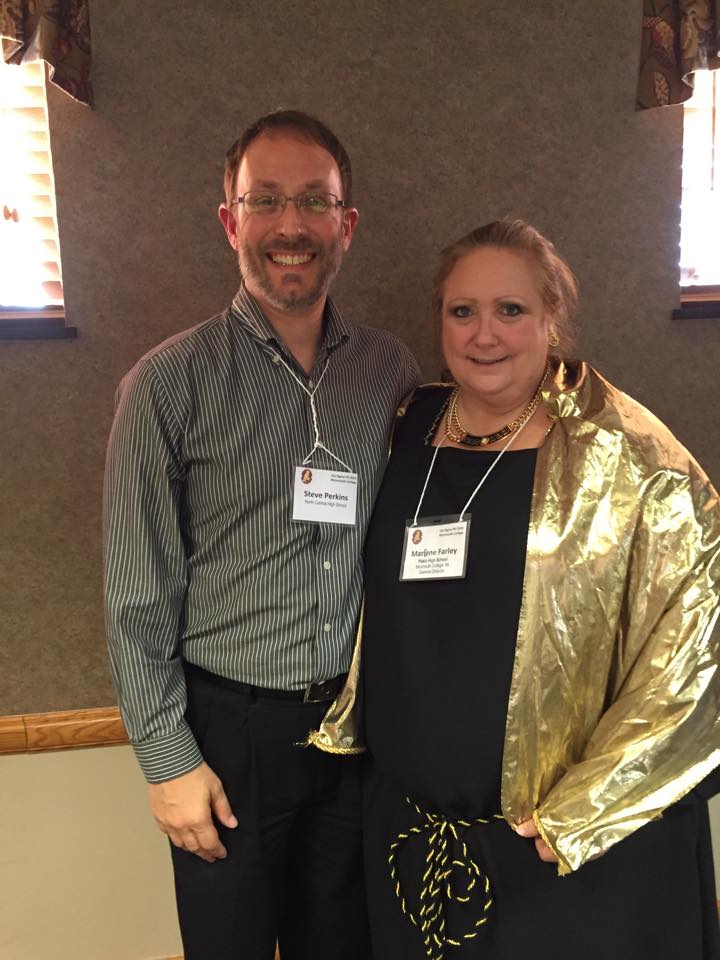
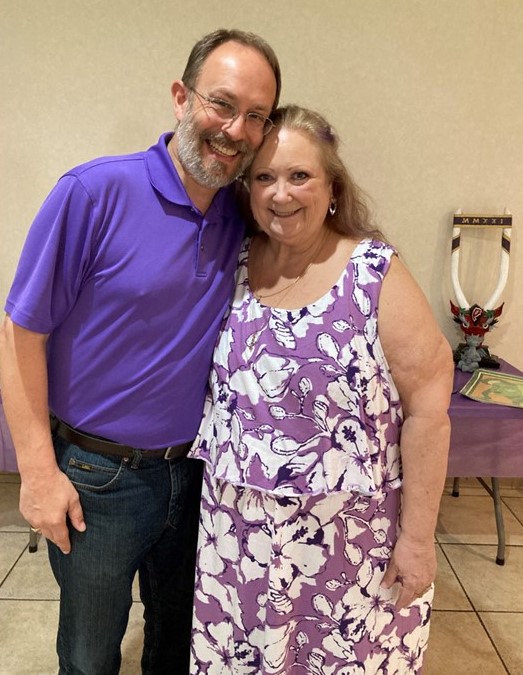
All teaching is pontifical in nature, which is to say, it involves bridge building. As I wrote in another post, "Matters of faith and religion connect the human with the transcendent, and a teacher, no less than a priest, is a pontiff, which, as the Latin root pontifex reveals, is a bridge builder. Teachers help to connect students with ideas, with others, with themselves, and at times even with what lies beyond it all." With Marcene Farley, there was another bridge being built during my senior year in high school, although we were both unaware of its construction or where it would lead.
Marcene arrived as the new Latin teacher for the start of my senior year and was called Miss Holverson back then, having not yet met her husband Mack. She did the things that a good teacher does and then some, including taking my friend Bryan and me to the state Latin convention. This, of course, required Roman attire, and Marcene participated right along with the rest of us. Then again, she clearly had a penchant for dressing up in class, but this was all part of her strategy for helping to build that bridge between her students and the life of ancient Rome.
The Other Side of the Desk
When people become teachers, they often speak of moving to the other side of the desk, which is to say they gain a new perspective on what goes on in a classroom. Nearly everyone knows what it is like to be a student, but the view is far different from the position of teacher. Fortunately, I had in Marcene a teacher who was also a colleague. Although we never taught in the same school, we talked many times over the years, often at length, about issues in education and with our particular students. We shared triumphs and heartbreaks in a way that only teachers can, for teachers are involved in that most human of enterprises, the shared journey of discovery, and like any journey, there are both pinnacles and pitfalls.
I was fortunate to speak at Marcene's invitation on a number of occasions once she had moved back to Illinois was teaching at Pekin Community High School. Three times I had the opportunity to address the Illinois Junior Classical League convention when she hosted it at her school and performed my presentation of Cicero at the Eta Sigma Phi convention at her alma mater, Monmouth College. I was always pleased to speak at her invitation, and there was an excitement for both of us. We were able to reconnect not only as teacher and student, but as colleagues, and it was clear that the bridge was extending far from what it had been when I was in high school
De Amicitia
Cicero (106-43 B.C.) wrote a treatise on friendship called De Amicitia, or "On Friendship." A passage I have quoted often says this. "Qui esset tantus fructus in prosperis rebus, nisi haberes, qui illis aeque ac tu ipse gauderet? Adversas vero ferre difficile esset sine eo qui illas gravius etiam quam tu ferret." (De Amicitia, 22). "How great would be the benefit in good times if you did not have someone who would rejoice in them as much as you? Indeed it would be difficult to bear adversity without someone who would bear it even more gravely than you."
Marcene was with me when I was named 2014 Indiana Teacher of the Year and she was with me again when my son and I saw '80s hair band Stryper near where she lived. In fact, she was the one who yelled to leader singer Michael Sweet to get his attention, which led to the first of my many interactions with the rock star. It was no surprise that she would do this. After all, she once talked with Dee Snider of Twisted Sister about his Latin tattoo! Cicero was right in what he said, for both of those moments were all the better for her being part of them.
.
Dee Snider and Marcene
When her husband, Mack, passed away, I traveled to Illinois for the funeral. I wouldn't have missed it for anything. I was there to support my friend in keeping with the second part of what Cicero wrote.
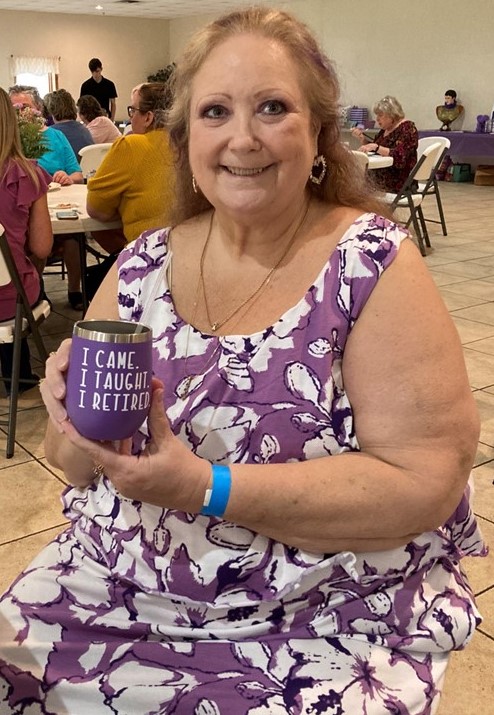
And I was there for Marcene's retirement party at the end of the 2021-2022 school year. There was a constant stream of people for hours that Saturday afternoon as former students, their parents, and colleagues came to show their love for a woman who had touched so many lives in such profound ways. My only quibble with the event is about one of the gifts she received. Someone gave her a mug that says, "I came, I taught, I retired," but that last part only expresses a momentary fact of history. The mug should have read, "I came, I taught, I shaped lives in ways I will never know."
You know this woman, although unless you attended New Albany High School between 1952 and 1986, it is unlikely you ever met her. If, on the other hand, you were one of my students in Missouri, Texas, or Indiana, you have. In fact, if you have ever encountered one of Alice Ranck's students...teachers, doctors, lawyers, athletes, business people, moms, dads, coaches, and more...you have in some way come to know her.
Dedication for Dedication
I have written about this extraordinary Latin teacher before, and now I need to post an addendum. On Sunday, April 24th, 2022, the New Albany High School media center was formally dedicated as the Alice Ranck Hettle Media Center. It seemed only fitting that a space we used to call a library be dedicated to a teacher whose dedication both to academics and her students was and perhaps always will remain unparalleled.
Although she retired more than thirty-five years ago to marry a man she had met in the 8th grade, none of us could ever call her Mrs. Hettle. She was always "Miss Ranck" or "Miss Alice" to her students, the latter appellation undoubtedly derived from her own habit of addressing us as "Mr." or "Miss" and then our first name. I was always "Mr. Steve" to her.
After her passing in 2019, a group of her former students began to plan a suitable and permanent way to honor this woman who had so profoundly influenced so many lives. The choice of the library/media center was obvious, as was the choice for a quotation on the plaque that now adorns the wall to the right of the picture above.
Seneca was a Stoic philosopher who lived from 4 B.C. to A.D. 65, and in Epistle LXXVI he wrote, "Tamdiu discendum est quamdiu nescias." "You must keep learning as long as there is something you do not know." Had Seneca not said it first, Miss Ranck surely would have said it herself, for she would often stop class to impart some bit of wisdom, prefaced by her trademark statement, "This is more important than any Latin I will teach you." It is for that reason more than her clear presentation of the subjunctive mood or the ablative absolute that so many people were present for this dedication.
Across the Decades
Steven Prince, Latin Teacher, NAHS
The emcee of the ceremony, current New Albany High School Latin teacher Steve Prince, asked people to stand as he called out the decades, and people rose who had been students of Miss Ranck in the 1960s, 1970s, and 1980s. The youngest among us had last sat in a classroom with Miss Ranck thirty-five years ago, the eldest more sixty. What could possibly draw people from as far away as Houston, Texas? What could have compelled people with physical infirmities for whom motion was clearly a challenge to visit a southern Indiana high school on a Sunday afternoon? The answer is simple. We were there for Miss Ranck.
When she was inducted into the NAHS Hall of Fame several years ago, Miss Ranck said, "It is our responsibility as educators to provide a sound education based on ethical principles. Innate within every human being is first the desire to be noticed and to be loved, then comes the need to be taught to learn how to learn. It is the role of the teacher to notice and yes, to love the student so much that he is ready to learn, and in turn develop all of his potential. What better way for a teen-ager to learn to live honorably and well than to read from the literary masterpieces of Cicero."
After school board member Elizabeth Galligan read a poignant piece to acknowledge and commemorate the life of this extraordinary teacher, person after person took the microphone to share a "Miss Ranck" story. Had Steve Prince not drawn this portion to a close, we could have been there all night listening to stories about this woman, whose first year of teaching was at Spartanburg High School in Lynn, Indiana, during the 1945-1946 school year, we could have been there all night.
That's My Teacher
I have friends in many noble professions, yet I do not think there is a calling that produces the excited statement, whether by a child or a senior citizen, quite like, "That's my teacher!"
My calculus teacher, Jim Dickman
As guests began filling the atrium for the ceremony, I spotted across the room the man who had been my calculus teacher my senior year, Mr. Jim Dickman. I quickly grabbed my daughter and asked her to take a picture of the two of us. Mr. Dickman had also been a student of Miss Ranck, and although he is now retired and I am in the second phase of my own career, I was still excited to see "my teacher."
L to R: Steve Perkins, Tim Harbison, Steve Prince
Many of Miss Ranck's students went on to become teachers and college professors, but only three that we know of became Latin teachers. Tim Harbison, Steve Prince, and I share a special bond in that, but as all teachers know, there is something about the student-teacher relationship that is unlike any other. The eminent polymath George Steiner wrote of this in Lessons of the Masters, a book that should be required reading for all teachers and that I explored in another post. Those who have experienced such a special connection with a teacher can recognize the reason why in Miss Ranck's words above. Before it is an academic relationship, it is a relationship based in love.
A Personal Note
To date I have taught more than 2,200 students, and while I have been blessed by a great many extraordinary teachers, a topic I have written about in "Why I Love Teaching, Part 1," it would not be too much to say that I would not have taught any of them had it not been for Miss Ranck. As I described in the post titled "Infinite Space," God spoke to me when one day in 1986 she made an offhand reference to Antioch as the first place where anyone was ever called a Christian. The call I felt on my life that day in Room C317 has led me to a life I have been blessed beyond measure to lead. For this reason, I was grateful when Steve Prince took a few of us on a tour of the school and I was able to see that room once again.
Some things have change since I sat in that room years ago, learning from textbooks like Latin For Americans and Our Latin Heritage. The door is in a new location, and there used to be windows that looked out across the football field. For me, however, it was sacred ground, for it was there that I learned from Miss Ranck, heard the voice of God, and was inspired by the calling to which I have given my life.
I teach in a coat and tie. Never in my career have I been required to do so, nor am I making a fashion statement. As far as that goes, my sartorial selections are quite traditional, e.g. navy jacket with tan or grey slacks, blue tie with grey jacket and navy slacks, and so forth. My reason for how I dress to teach each day is rooted in one of the most fundamental aspects of my teaching philosophy, the importance of modeling. If anyone is having visions of me as a runway model, please stop. That is not what I mean.
I am speaking of what the historian Livy meant in the preface to his Ab Urbe Condita. He begins his 142-book history of Rome from its founding to the death of Drusus in 9 A.D. by stating his desire that his readers pay close attention to quae vita, qui mores fuerint, the life and habits of life that once were. Cicero had earlier said something similar in his speech Pro Archia, an ostensibly defense oration that was more of an encomium on learning. He asks rhetorically, "Quam multas nobis imagines--non solum ad intuendum, verum etiam ad imitandum--fortissimorum virorum expressas scriptores et Graeci et Latini reliquerunt?" "How many images have both Greek and Latin authors left us, not only for gazing at, but also for imitating?" (Pro Archia, 14)
What do an ancient Roman historian and statesman-cum-philosopher have to do with how I dress to teach high school students? They both speak to the importance of models of behavior. I dress as I do because that is how my dad dressed. He had been an elementary teacher before I was born, but as I grew up I knew him as an elementary school principal.
Norman Perkins, Principal of Galena Elementary School, 1968-1991l
This picture, which was converted into a painting and hung in his school when he retired, represents the image of my dad that I saw every day when he came home from work. It was a professional look, one that conveyed respect for his job as an educator and the people with whom he worked. When I began teaching at a middle school in Kansas City, his was the model for my own apparel. In fact, it was not until years later that I realized why I had made the dress decisions that I had. At the time it was simply the natural thing to do.
Surely, you must be thinking, this cannot be the point of this blog post. There must be a more significant purpose to this, and indeed there is. Cicero and Livy were right. Imitation is far more than a form of flattery, sincere or otherwise. It is a foundational principle of learning, and this is part of why Cato the Elder's definition of an orator, quoted by Quintillian in Institutio Oratoria 12.1.1, was "Vir bonus dicendi peritus." For both Cato and Quintillian, the ideal orator was not merely a person skilled in speaking, but a good person skilled in speaking. It was not enough to learn phrasing and breath control and all manner of rhetorical devices. These cannot exist in a vacuum but must be used by particular human beings, and what kind of people they are matters as much as the abilities they express. The Stoic philosopher Seneca gave voice to this in his Epistle 88 when he suggested that rather than spending a great deal of time to earn the title o hominem litteratum, o well read man, "Simus hoc titulo rusticiore contenti: O virum bonum!" "Let us," he argues, "be content with a more rustic title: O good man!"
Perhaps this is the reason that imitation of the true, the good, and the beautiful is rarely discussed in schools of education or in professional development conferences. We have always, even in Seneca's time, distanced ourselves from that which smacked of the rustic because of an urban prejudice that values the supposed sophistication of the city over anything else. It is helpful, as with any prejudice, to forego judgment until one has examined all sides fully, and once this is done regarding imitation of the good person, it will become clear why this should be a foundational educational principle and not merely a quaint rustic notion best forgotten.
Simply put, we do not like hypocrites. We are unlikely to take seriously the advice to quit cigarettes if it is given by our chain-smoking doctor. Once again, it is Seneca who speaks to this in Epistle 52 and summarizes the idea by admonishing his readers, "Eum elige adiutorem quem magis admireris cum videris quam cum audieris." "Choose a guide whom you admire more when you see him than when you listen to him."
As a teacher I am called to a certain nobility of character. Since I am a Latin teacher, that character should reflect the nobility and beauty of thought and creation expressed by the best of the ancient Greeks and Romans. Teaching involves incarnation. It is not enough that I dictate facts that students could just as easily and possibly better glean from a text or online source. I must embody what I teach, for it is the witness of my life that will produce the most memorable lesson. For a fuller discussion of this, read George Steiner's Lessons of the Masters, one of the finest books on what truly transpires between teachers and students.
Yet I am not a teacher first but rather a follower of Jesus Christ. As a Christian I am called to follow my Father's example in far more significant ways than I did in patterning my professional dress after that of my earthly father. This, of course, would be impossible if God were merely an abstract deity, an idea, a notion developed in the collective human mind over centuries. Our Father is real and in the most basic, etymological sense of that word. Those questioning this with the challenge that they have never seen Him join the ranks of Philip, the disciple of Jesus, and Christ's response to him applies today.
Philip said to him, "Lord, show us the Father, and it is enough for us." Jesus said to him, "Have I been with you so long, and you still do not know me, Philip? Whoever has seen me has seen the Father. Hw can you say, "Show us the Father?" (John 14:8-9, ESV)
I hope, at the end of the day, I have done more than just dress as Norman Perkins once did as the principal of an elementary school in southern Indiana. My goal as a Christian teacher is to model, however imperfectly, my life on that of my Father in heaven, and this each of us can do by looking to the fullest representation of Him the world has seen, Jesus Christ.
My classroom is small, measuring about 23' x 13'. For this reason, most of my Latin classes meet in other classrooms. As I have written elsewhere, and borrowing Hamlet's expression, I could be bounded in a nutshell and count myself the king of infinite space, and because this is true, I do not mind at all sharing my small classroom with many, many other teachers. Both in this classroom, which is really more of an office, and in any place where I teach, I do not teach alone but am engaged in a most collaborative enterprise, for I have the pleasure of working alongside some of the greatest teachers the world has ever known.
There are Socrates and Plato and Alexander Pope, to say nothing of Catullus, Cicero, Horace, Ovid, and Vergil. The history teachers have their say thanks to Livy and Tacitus, and of course Homer holds a mighty sway.
Texts and commentaries
Oxford and Loeb texts
Penguin translations
Sometimes they speak their native Greek or Latin, and sometimes they speak in English, but always they are there, guiding the conversations I have with my students. Even when their voices cannot be heard directly, they are teaching nonetheless, for they are like the waters described by William Butler Yeats in "The Lake Isle of Innisfree."
I will arise and go now, for always night and day
I hear lake water lapping with low sounds by the shore;
While I stand on the roadway, or on the pavements grey,
I hear it in the deep heart's core.
Although the majority of my fellow teachers speak their wisdom from across the centuries, there are more modern educators as well, speaking to matters of linguistics and philosophy and the natural sciences.
A few of my colleagues who teach philosophy and science
Surely, you say, these do not all make their way into the daily curriculum of a high school Latin class. Surely it would not be appropriate for them to do so. Isn't a secondary language class about nouns and verbs and learning the basics? No, they do not all make their way into our daily lessons, at least not explicitly so, but I disagree with the notion that any of these teachers should not be allowed through the door. In 1970, G. P. Goold, who over his illustrious career served as the chair of Classics departments at Harvard, University College London, and Yale, as well as serving as the chief editor of the Loeb Classical Library for twenty-five years, wrote a most unfortunate statement with which I took issue in an article I wrote a few years ago about a textual difficulty in Vergil's Aeneid. Goold wrote, "An elementary teacher, to reach in due season the end of his curriculum, must every hour turn a Nelson eye to serious problems and refrain from pursuing truth beyond the charted boundaries of the textbook." I wrote in response, "I would argue that the true magister can never be so bound, but must, along with the students, pursue the truth, no matter how anfractuous the path."
And if truth, rather than the important but necessarily lesser goals of skills proficiency and career readiness, is the foundation and raison d'etre of education, then surely there must be another teacher in every classroom, even the one who claimed to be truth itself, Jesus Christ.
The 3-D printed bust of Christ, courtesy of my son
You see, all of these great teachers have taught me. I am the product of their wisdom, eloquence, and art, and in that way alone, they are teaching my students as surely as I am. Because I have spent considerable time with many of them, their words and ideas are also at the ready when I attempt to do what all teachers do, make connections. Education is essentially helping someone see that this is that. In its simplest expression it may be an equation, for example one connecting the ideas of 2 + 2 and 4. In more complex forms it can be seen in metaphors, allusions, and parables. Indeed the metaphoric nature of all language points to the this-is-that nature of communication, of which formal education is but one particular instance. For this reason, the assassination of President Kennedy can make its way into a reading of Caesar in Gaul. The dual nature of light as wave and particle will enter into a discussion about the opening of Vergil's Aeneid. Even Disney's The Lion King will help to illustrate the aspects of Catiline's conspiracy and the fertile ground for demagoguery among the poor and disenfranchised.
Just as these secular teachers weave their way seamlessly and effortlessly through our exploration of Latin, so does the greatest teacher of them all, but for a different reason and in different ways. I am blessed now, somewhere past the midpoint of my career, to teach in a school where Christ is acknowledged as Lord. We are, therefore, free to offer a complete approach to learning, one that does not exclude faith as a way of knowing. My students and I can easily make references to Scripture just as we do to writings by Plato or Homer. Yet, and far more significantly, Christ is present in our classes in a way the others cannot be, for He is still alive. His Holy Spirit dwells within us, leading us, according to John 16:13, into all truth, which, as stated above, is the reason a school exists. Although it is my name on the door, my small classroom is actually crowded with the greatest of all teachers, and I am more than grateful to share with them the delightful, exciting, and provocative calling of teaching.
A friend of mine shared that an educator in her child's district had sent the following to parents as part of a district-wide communication. "Reality is created by the mind. We can change our reality by changing our mind." This quotation was attributed to Plato.
My immediate reaction was that Plato could not have written that statement. As I texted my friend, that statement is closer to what the pre-Socratic philosopher Protragoras said in his famous dictum, "Man is the measure of all things," which Plato utterly destroyed in his dialogue Theaetetus. I added that according to his theory of forms laid out in Book 7 of Republic, Plato suggests that reality is not the physical objects around us, but rather transcendent forms accessible only to the mind. This in no way suggests reality is subjective and created by the mind, as the quotation sent to the parents does, but rather the exact opposite.
All this reminds me of a scene from The West Wing (S04, E04) in which Deputy Chief of Staff Josh Lyman (Bradley Whitford) asks his assistant Donna Moss (Janel Maloney) to attend a self-help seminar hosted by someone who is advising their opponent in the upcoming presidential election. The scene that follows depicts what happens when she returns to the office.
Not only does proper citation of sources matter so that others can follow the same research and so that we do not misattribute facts and quotations, but it matters because it usually indicates a broader, deeper acquaintance with primary sources and the bases of research. Few people actually want the cheap, knock-off perfume or jewelry. They want what is genuine, although many are happy to pass off their work as authentic when in fact it is a pale imitation.
The Roman orator Cicero (106-43 B.C.) was known to end sections of his speeches with certain rhythms. One in particular followed the pattern DUM dum dum DUM dum, which was easily achieved by putting the present infinitive of the verb "to be" next to a 3rd person singular present passive subjunctive from a second conjugation verb. Esse videatur was a common example, so common in fact that people who wanted to imitate Ciceronian style thought it was good enough just to tack that wording onto the ends of sentences. Needless to say, DUM dum dum DUM dum does not an orator make.
The song that captures this best for me is George Strait's "The Real Thing," which is from his 2001 album The Road Less Traveled. He sings of discovering rock and roll in the '50s and realizing there was more to music than just what he had heard on the radio. As he sings in the chorus line, "I don't want you under my roof with your 86 proof watered down 'til it tastes like tea. You're gonna pull my string, make it the real thing for me."
I couldn't agree more. It is important to use and cite primary sources, to take the extra step to do the research, and to express your ideas, not with imitated eloquence, but with the force and beauty that can come for dealing with the real thing.
This post is for me, although I hope others will read it as well. It is for me because I want to chronicle one of the most wonderful events in my nearly three-decade career and it is for me because it will be filled with the names and personal stories I look forward to re-reading and remembering long after I have left my classroom for the final time. If you do choose to read this, or even to skim over it, I think you will be amazed and inspired by what students can do and what education can look like when what matters most still matters.
In the spring of 1987, my Latin teacher Marcene (Holverson) Farley made me aware of scholarship opportunities from the Indiana Junior Classical League. One of the applications required an essay based on a favorite Latin quotation, so I picked one by an author I had studied as a junior the previous year under Alice (Ranck) Hettle. "Ceteros pudeat si qui ita se litteris abdiderunt ut nihil ex eis possint neque ad communem adferre fructum neque in aspectum lucemque proferre." (Pro Archia, 12) "Let others be ashamed if they have so hidden themselves in literature that they can offer nothing from it for the common good or can bring forth nothing into the light to be seen."
That line had stayed with me and came to mind again more than twenty years later when, as I was driving to school one morning in 2009, I had an idea. I had read once about a group of college students reading Homer's Iliad aloud in Greek and getting pledges as a fundraiser. Cicero's quotation and that article came rushing through my mind like two pieces of uranium-235 at Los Alamos, and the result was a powerful new idea. What if high school students read aloud one of the Greco-Roman epic poems to raise money in an effort to fight poverty?
Details quickly came together, and a student named Brent Eickhoff introduced me to Shirley Mullin, owner of Kids Ink Bookstore at 5619 North Illinois Street in Indianapolis. She agreed to host our event and dedicated space in her front window where the students could sit to read. Zoe (Smith) Crafton, another student, designed a logo for us that we used on t-shirts for the readers and on a banner to advertise what we called Reading The War On Poverty, or RTWOP.
That first year saw Latin students from North Central High School reading aloud the entirety of Homer's Iliad in English translation. With the money they raised and a donation from the bookstore from that day's sales, we were able to give more than $1000 to Shepherd Community Center, whose mission is to help break the cycle of poverty in Indianapolis. The event was so successful that we wanted to do it again, and Shirley and her staff at Kids Ink were pleased to help.
The following year our Latin students read Homer's Odyssey, the year after that Vergil's Aeneid, and the fourth year started the cycle over with the Iliad. Each year saw them raise more than $1000 for Shepherd, and RTWOP quickly became a flagship event in our Latin program.
In April of 2017, I was listening to students read the Aeneid in our ninth RTWOP and began thinking of what we could do to celebrate our tenth anniversary in 2018. People had often asked if we would read one of the epics in its original language, so we decided to break our repeating three-year cycle to read the Aeneid again, but in Latin. More ideas developed, and we decided that RTWOP 10 would feature
students reading in Latin
a microphone and speaker to project the reading outside the store
an invitation for alumni to participate with current students
a commemorative edition of the Aeneid to give each reader
the goal of raising $10,000
That last feature was by far the most ambitious, so we started a GoFundMe campaign to help. Within minutes of launching it, we started receiving donations, and as the 2017-2018 school year progressed, we dared to hope we might actually reach our goal.
The next most ambitious part of RTWOP 10 was producing a commemorative edition of the Aeneid. There are many editions available, but I wanted something special, something personal for the readers, and the only way to get that was to produce it myself. I used a version that was in the public domain and formatted the text throughout the summer and fall of 2017 and the winter of 2018. For the front cover I used a t-shirt design created by one of my students, Alexandria Ruschman, and included Zoe Crafton's original logo on the back along with our logo for North Central Latin, which had been designed years ago by my sister-in-law, Melanee (Stillions) Habig. My son, Austin, helped with the cover design, and I added a preface that concluded, "I could say regarding my pride in all my students what Jupiter said in Aeneid I.278 of the achievements that would come from the Romans, 'His ego nec metas rerum nec tempora pono.' I set neither limit nor time to it."
Far less daunting was assembling the readers. RTWOP has become a much-anticipated event in our classes, and the reading times always fill up quickly. I had established an alumni group on Facebook and through it was able to invite former students. Twelve alumni eagerly signed up, and the remaining spots were filled with first- through fifth-year students. A small army of fifty-nine readers would read in fifteen minute shifts for four hours on a Friday evening and eleven more on Saturday. From the money they would raise, along with the GoFundMe contributions and a donation from Kids Ink, we hoped to reach our $10K goal.
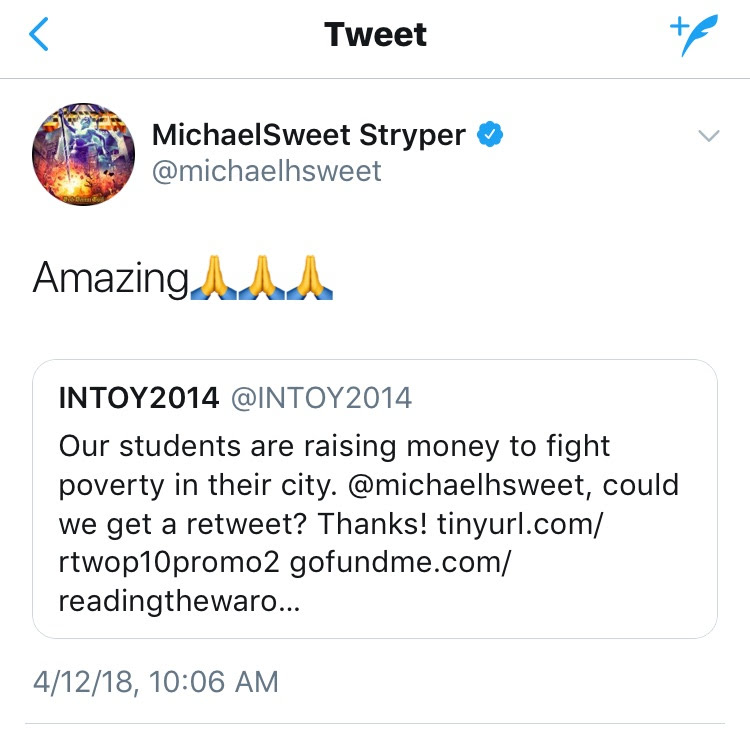
And then there was the social media campaign. For a full year there were Facebook and Instagram posts and tweets promoting what we were doing, and there were two, true highlights, but to understand why they were so special, you need to know something about me. In the words of Joan Jett, "I love rock 'n' roll!" In fact, I publish a blog called The Roman Rocker. Classic rock, hard rock, and metal are what I love, so I was beyond thrilled when Michael Sweet, the lead singer of Stryper, tweeted about the project to nearly 76k followers and David Coverdale of Whitesnake, who has 218k followers, liked one of our tweets.
When the weekend finally arrived for RTWOP 10, the students and I were quite excited. The weather was beautiful, and blue sky, white clouds, and temperatures in the 70s guaranteed a lot of people would be out in the delightful neighborhood of Illinois Street. From 4:00-8:00 p.m. on Friday, April 27, and from 9:00 a.m.-8:00 p.m. on Saturday, April 28, current Latin students and alumni read the Aeneid aloud in Latin. That ancient language was heard along Illinois Street as it was broadcast through our speaker, and people took notice. Many customers came in, eager to learn more about the event, and almost all gave a donation. When all was said and done, these Latin students and alumni had helped raise more than $12K for Shepherd Community Center, garnering the attention of the Indianapolis ABC affiliate, RTV6 as well. Pride, joy, overwhelming satisfaction in the achievement of students...these come nowhere to close to describing how I felt and continue to feel. Can you even imagine what it was like to see students using their learning to benefit others this way? You can gain some sense of it from the pictures and videos that follow, but before I include those, I want to say a word about the alumni and others who dropped by. In addition to my twelve former students who read, including three who had read in the inaugural event ten years before, other alumni stopped in just to say hi and to support what was going on. With all of them it was a thrill beyond words to hear stories about what they had studied after high school, where they were working, and developments in their families. Two of my former students had married each other, and two others are dating. One is currently a Classical Studies major at my alma mater Indiana University. She hopes to be the first woman to translate the Iliad, Odyssey, and Aeneid into English. And one young man was excited to tell me he had achieved his dream of joining his father as a firefighter with the Indianapolis Fire Department. Along with these were Indiana Senior Classical League advisor Tony Martin, co-chair of the Indiana Junior Classical League Lisanne Pierson, and Latin teachers Kelly Williams-Ihlendorf of Bishop Chatard High School, Matt Hilton of Chatard, and Melissa Perkins of The Master's Study. Their presence during the event along with messages of support from Jeremy Walker, IJCL co-chair, and many others meant all the world. If you have read this far, you know two things. You know both what amazing things students can do and are doing to use their education for the betterment of others and how incredibly proud I am of all of them. Now treat yourself to some pictures and video from this amazing event, including the presentation of what we raised to the folks at Shepherd Community Center.
The Alumni
Brooke was of the readers in the first RTWOP and again in RTWOP 10.
She is in her fourth year of veterinary school at Purdue University.
Brenda (left) studied film making and is making a documentary of RTWOP 10.
Sara (right) is an instructional aide at one of our elementary schools.
Serenity (left) is currently studying at Butler University.
Eliot (left) is studying aquatic biology at Ball State University.
Hannah (right) is majoring in Classical Studies at Indiana University and hopes to be the first woman to translate all three Greek and Latin epics.
Ian (left) stopped by to support his former Latin Club, and we had fun reminiscing about a video he had made when he was a senior.
Greg (right) was one of early Latin students at North Central. His inquisitive mind had him asking me many questions ranging from German to the ancient city of Tyre!
Jay and Lauren (Hill) left Latin, got married, and are now an engineer and science teacher.
Morgan (right) studied biology and came by to support her alma mater.
Ginny and Alex (left) are studying computers, and Ted (right) just achieved his dream of becoming a firefighter with the Indianapolis Fire Department.
Shanice wants to be an elementary teacher, and Brandon studied music education at Howard University. They were among the original readers ten years ago, and Brandon even recreated the picture that has become the symbol of Reading The War On Poverty for a decade.
Current Students
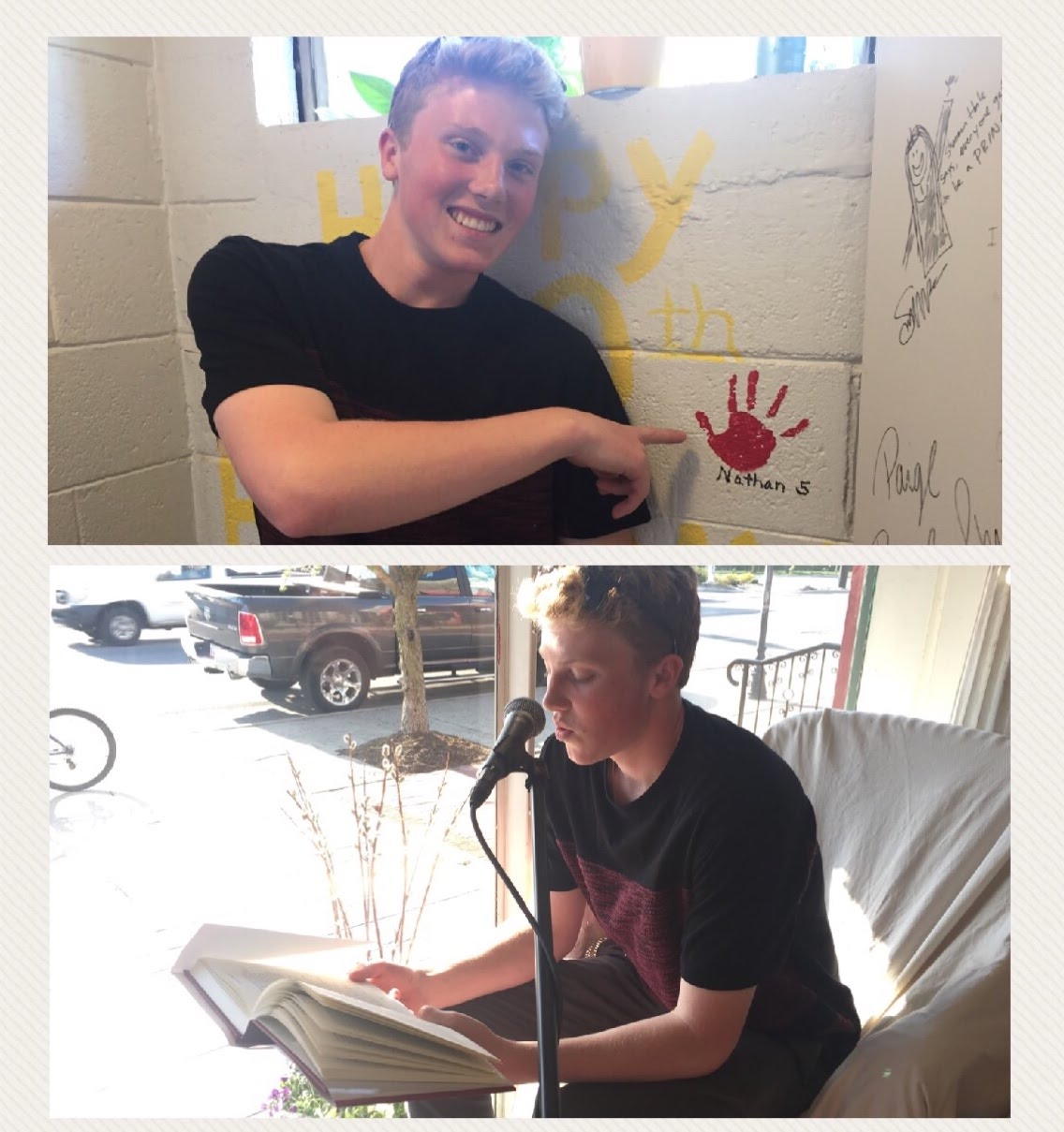
Special note: Nathan used to visit this bookstore when he was a boy and put his hand print on the wall when he was 5.
Extras
Matt Hilton and Tony Martin (left) are the Latin teacher at Bishop Chatard High School and the Indiana Senior Classical League Advisor.
Shirley Mullin (right) and her employees have graciously hosted us for ten years!
The plaque (left) we gave Kids Ink to thank them for their service.
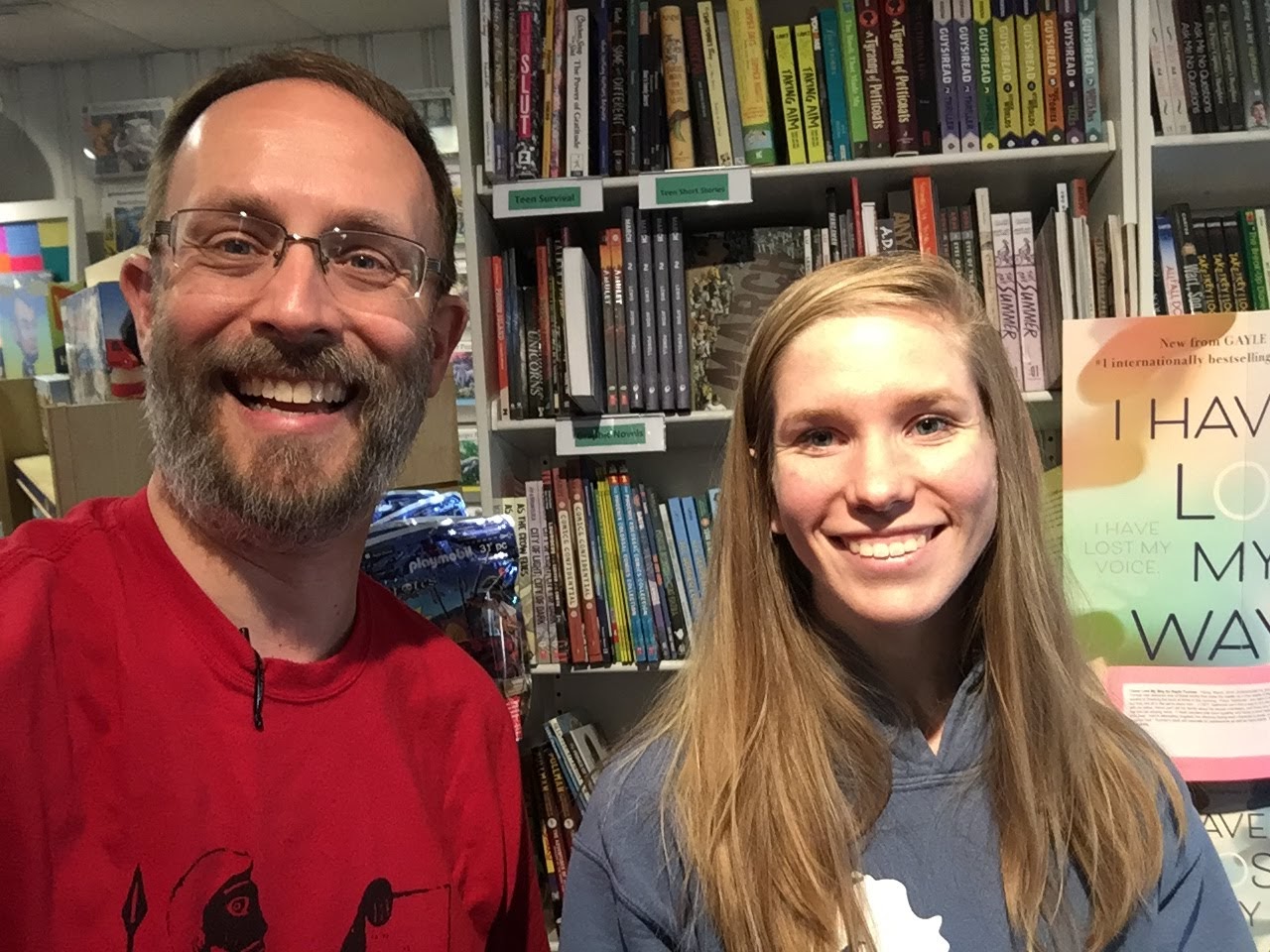
My wife standing between Lisanne Pierson, Indiana Junior Classical Co-Chair, and me (right). Melissa is a Latin teacher at The Master's Study.
Videos
What does Latin sound like? Listen as these students read Vergil's Aeneid in the original language.
And what did it look like to promote this project in the age of social media? Check out our promotional videos, including one that sees me getting pied in the face by my students!
The Presentation
When all was said and done, North Central Latin students had helped raise $12,455.34 to help fight poverty in their city, which was even more than our giant check indicated thanks to additional donations. Some of our club officers as well as Indiana Junior Classical League state officers who attend North Central presented the check to Steve DeBuhr and the good people at Shepherd Community Center on the last day of school, May 24, 2018.