Showing posts with label Guerin Catholic Junior Classical League. Show all posts

Saturday, January 22, 2022

What It Means To Compete

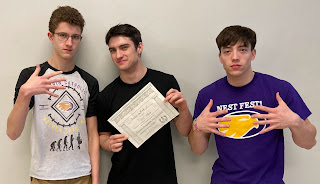
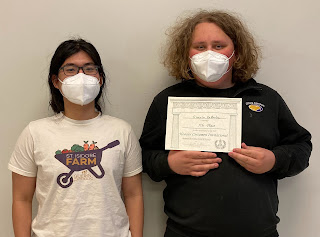
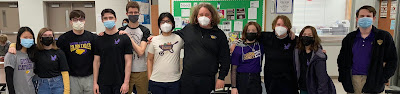
Eleven of my Latin students recently competed with Latin students from around Indiana at what we call certamen (care-TAH-mun).  Certamen is the Latin word for competition, and this particular form of competition sees students participating individually and collectively to answer questions about ancient history and mythology as well as Latin grammar and translation, which makes this event a competition in the true sense of the word.  "Competition" comes from two Latin words and literally means "to seek together."  In its purest sense, competition is seeking a goal along with others.  This can, of course, devolve into a slug fest of sheer brutality, whether in sports or music or academics, but that sense of competition is too narrow to capture the essence of what it means cum petere.  Because certamen represents competition as it should be, I was able to do something at this event that I have waited my entire career to do, but more on that later.

My students have re-launched a chapter of the Junior Classical League at our school after a hiatus of several years.  One of my predecessors had sponsored a chapter, but in recent years it had not been active.  Because this was our first time to participate in a state certamen, I had told my students to have fun.  There are students who compete with no more preparation than what they have received in class, some who supplement that by reading history or mythology on their own, and some who who hold regular, after-school practices and are the killer elite.  I was proud of our students simply for showing up, but when the day ended, I was smiling from ear to ear.
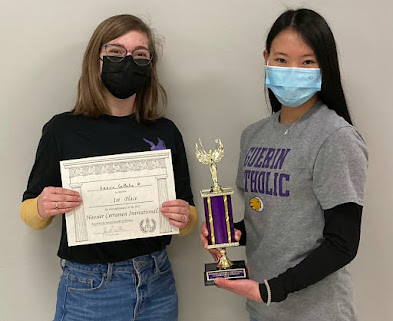
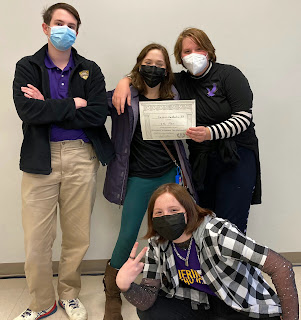
1st place-winning Latin II Team

One of our second-year Latin teams took first place with only two players!  And I should add that one of them is a freshman!  Our other teams acquitted themselves in fine order taking fifth, sixth, and seventh places.
Latin I Team
Latin II Team
Latin III/IV Team

I said earlier that I was able to do something at this event for the first time in my career.  Competition indeed means seeking along with, but who is the object of the preposition "with?"  In a purely secular understanding, competition is seeking along with others who are seeking the same thing, yet Christians know that any such seeking not attempted along with God is futile.  As we read in John 15:5, "Sine me nihil potestis facere."  "Apart from me, you can do nothing."  Although I have always prayed for my students before competitions and tests, I have done so silently.  Today, because my students and I were representing Guerin Catholic High School, I was able to pray openly with them, and that made this particular competition all the sweeter.



Tuesday, November 16, 2021

Intellectual Curiosity


Guerin Catholic Junior Classical League recently hosted my friend Prof. Bronwen Wickkiser, chair of Classics at Wabash College, to deliver a talk titled "Medicine and Miracle in Greco-Roman Antiquity" (full video linked below). Bronwen and I first met when we were in graduate school at The University of Texas in Austin back in the mid-90s, and those were heady days indeed as we learned from and worked alongside scholars such as Peter Green, Michael Gagarin, Paul Woodruff, Karl GalinskyPaula Perlman, Thomas Palaima, M. Gwyn Morgan, Douglass Parker, Andrew Riggsby, Gareth Morgan, and many others, including current Classics chair Lesley Dean-Jones.  Yet this was not just a reunion for two former graduate school office mates.  It was a chance for our high school students to experience a scholar of the first rank and for that scholar to interact with highly curious young people.


Just a few of the students who filled our media center for Prof. Wickkiser's talk

One of our GCJCL leaders introduces our speaker and opens with prayer

Prof. Wickkiser began with a famous fresco of Iapyx healing Aeneas as the goddess Venus looks on.  She explained the roles of both human and divine healers in antiquity, pointing out the easy interaction among them in both literature and the graphic art of frescoes and vase paintings.


A student prepares to ask Prof. Wickkiser a question

She walked us through sculptures related to the healing arts of antiquity and explored with us in detail some of the dedications to Asklepios from his sanctuary in Epidauros.  Everyone was intrigued by the records of miraculous healings, some of which took place in quite dramatic ways.

Much ancient art depicts various aspects of the healing arts


Professor Wickkiser discussing various medical implements that have survived from antiquity


I was fascinated by the content of her talk, to be sure, but I could not help observing the atmosphere of the event produced by the interactions between professor and students.  Prof. Wickkiser did not merely lecture, but rather asked questions that drew her audience into an already engaging presentation, and the students were more than eager to respond with answers.  They then returned the favor by asking, even after a full day of academic study, provocative questions of the professor throughout the talk.  Yet one of the most important aspects of the afternoon was what one of our science teachers pointed out to me afterward.  She observed that Prof. Wickkiser did not always have an answer for some of our students' questions and would respond by saying something like, "That is a really good question.  I had not thought about that, but that is very interesting to consider."  Perhaps even more valuable than a presentation on ancient medicine was the opportunity for intellectually curious students to see modeled that same intellectual curiosity by a scholar.  This, more than test scores of any kind, is the heart of true education.

Bronwen Wickkiser and Steve Perkins (Guerin Latin Teacher)

Former grad school office mates clowning around

Click here for Prof. Wickkiser's full presentation