Tuesday, January 25, 2022

Julius Caesar and (Not So) Modern Education


The school where I currently teach Latin is an IB World School, as was the one where I spent the most recent 23 years of my career.  You can read more about the International Baccalaureate program on our website, but the aspect of IB on which I want to focus is called ATL, Approaches To Learning.  One handy graphic lays out the ATLs like this.
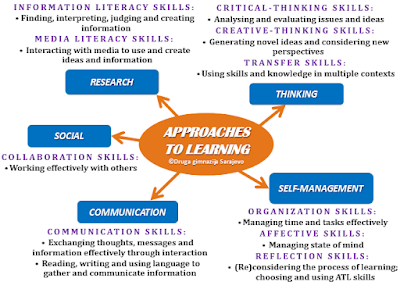

An argument can be made, quite easily in fact, that these approaches to learning, while displayed here in somewhat new packaging, have in fact formed the basis of good teaching and learning for a long, long time.  Because that is true, I have found that a project I have for many years assigned to Latin II students fulfills this model of instruction quite nicely.  Or perhaps I should say that this model matches well with a meaningful project my students have regularly pursued.

After spending quite a bit of time reading in Latin the war writings of Julius Caesar in his campaigns against Gaul, the students choose partners (social) to work together to explore more deeply some aspect of the ancient Roman military.  They must pick an issue or problem the Roman army of the 1st century B.C. would have had to address and then find out how the Romans actually handled it (research, communication).  They must work together (social) to analyze (thinking) how well the Romans handled it given the resources available to them, and they must devise an alternative solution (thinking), one not necessarily better, but at least different, that the Romans could have employed, again given only the resources available to them.  They have time both in and out of class to complete this, and I frequently use guiding questions to help them maintain their focus (self-management).  Finally, they must present their findings and alternative solutions to the class (communication).  The fun part, of course, is in their sharing of items they have made to illustrate their work, but more on that below.

Several years ago I co-hosted a podcast with Michigan Teacher of the Year Gary Abud, Jr.  In one of our episodes, we spoke with Dr. Bernard Barcio, himself an Indiana Teacher of the Year and a 44-year veteran of high school and university classrooms.  He talked about his decades-long project of guiding students in the construction of catapults, an effort that gained annual attention in the national news and that has been chronicled with archival video here.  As we discussed in that podcast, such an approach to education grew to take on the name "project-based learning," although when Dr. Barcio began it back in the 1960s, it carried no such appellation.  It was merely good teaching.

I am pleased, of course, if something I do in the classroom checks the boxes of the IB approach to learning.  We are, after all, an IB World School.  Yet what I, and I think the International Baccalaureate Organization itself, would argue is that this approach is simply about helping students make the most of their learning, regardless of what name the approach goes by.

What follows are pictures from this year's Caesar projects by the Latin II students at Guerin Catholic High School.  


On group recreated testudo,  the tortoise shell formation of the Roman army.

Another group baked buccellatum, the hardtack eaten by soldiers. Yes, with jaw-breaking effort, I ate one!

One group crafted a Roman gladius from wood.

Some may wonder why, in the age of electronic technology, my students create old-fashioned posters of the information.  Some of my other projects do indeed ask students to present using electronic technology, but this project allows me to display student work in the hallway.  Not only does this affirm the value of their work, but it allows other students to see the kinds of things we do in our classes, perhaps giving them something to look forward to when they reach Latin II.


In the end, this project helps students develop multiple skills while exploring topics of their choosing relevant to our class.  It ticks off the boxes of modern education theory, but in fact it is simply the kind of thing that teachers have long used to help students make the most of their learning.  When it comes to successful strategies, I think Caesar would have like this one.

Saturday, January 22, 2022

What It Means To Compete

Eleven of my Latin students recently competed with Latin students from around Indiana at what we call certamen (care-TAH-mun).  Certamen is the Latin word for competition, and this particular form of competition sees students participating individually and collectively to answer questions about ancient history and mythology as well as Latin grammar and translation, which makes this event a competition in the true sense of the word.  "Competition" comes from two Latin words and literally means "to seek together."  In its purest sense, competition is seeking a goal along with others.  This can, of course, devolve into a slug fest of sheer brutality, whether in sports or music or academics, but that sense of competition is too narrow to capture the essence of what it means cum petere.  Because certamen represents competition as it should be, I was able to do something at this event that I have waited my entire career to do, but more on that later.

My students have re-launched a chapter of the Junior Classical League at our school after a hiatus of several years.  One of my predecessors had sponsored a chapter, but in recent years it had not been active.  Because this was our first time to participate in a state certamen, I had told my students to have fun.  There are students who compete with no more preparation than what they have received in class, some who supplement that by reading history or mythology on their own, and some who who hold regular, after-school practices and are the killer elite.  I was proud of our students simply for showing up, but when the day ended, I was smiling from ear to ear.

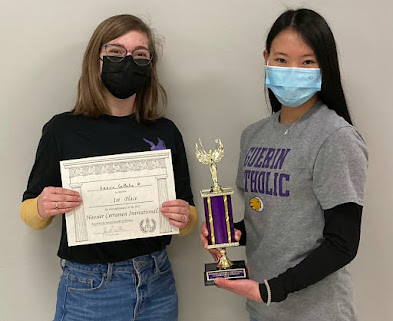
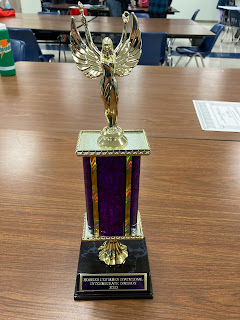
1st place-winning Latin II Team

One of our second-year Latin teams took first place with only two players!  And I should add that one of them is a freshman!  Our other teams acquitted themselves in fine order taking fifth, sixth, and seventh places.

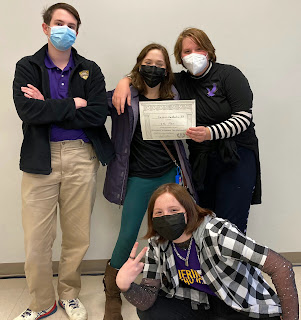
Latin I Team
Latin II Team
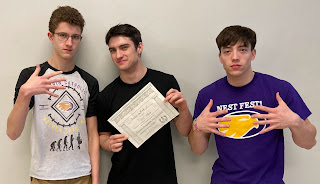
Latin III/IV Team

I said earlier that I was able to do something at this event for the first time in my career.  Competition indeed means seeking along with, but who is the object of the preposition "with?"  In a purely secular understanding, competition is seeking along with others who are seeking the same thing, yet Christians know that any such seeking not attempted along with God is futile.  As we read in John 15:5, "Sine me nihil potestis facere."  "Apart from me, you can do nothing."  Although I have always prayed for my students before competitions and tests, I have done so silently.  Today, because my students and I were representing Guerin Catholic High School, I was able to pray openly with them, and that made this particular competition all the sweeter.


Friday, January 7, 2022

Teaching In a Coat and Tie

I teach in a coat and tie.  Never in my career have I been required to do so, nor am I making a fashion statement.  As far as that goes, my sartorial selections are quite traditional, e.g. navy jacket with tan or grey slacks, blue tie with grey jacket and navy slacks, and so forth.  My reason for how I dress to teach each day is rooted in one of the most fundamental aspects of my teaching philosophy, the importance of modeling.  If anyone is having visions of me as a runway model, please stop.  That is not what I mean.

I am speaking of what the historian Livy meant in the preface to his Ab Urbe Condita.  He begins his 142-book history of Rome from its founding to the death of Drusus in 9 A.D. by stating his desire that his readers pay close attention to quae vita, qui mores fuerint, the life and habits of life that once were.  Cicero had earlier said something similar in his speech Pro Archia, an ostensibly defense oration that was more of an encomium on learning.  He asks rhetorically, "Quam multas nobis imagines--non solum ad intuendum, verum etiam ad imitandum--fortissimorum virorum expressas scriptores et Graeci et Latini reliquerunt?"  "How many images have both Greek and Latin authors left us, not only for gazing at, but also for imitating?"  (Pro Archia, 14)

What do an ancient Roman historian and statesman-cum-philosopher have to do with how I dress to teach high school students?  They both speak to the importance of models of behavior.  I dress as I do because that is how my dad dressed.  He had been an elementary teacher before I was born, but as I grew up I knew him as an elementary school principal.

Norman Perkins, Principal of Galena Elementary School, 1968-1991l

This picture, which was converted into a painting and hung in his school when he retired, represents the image of my dad that I saw every day when he came home from work.  It was a professional look, one that conveyed respect for his job as an educator and the people with whom he worked.  When I began teaching at a middle school in Kansas City, his was the model for my own apparel.  In fact, it was not until years later that I realized why I had made the dress decisions that I had.  At the time it was simply the natural thing to do.

Surely, you must be thinking, this cannot be the point of this blog post.  There must be a more significant purpose to this, and indeed there is.  Cicero and Livy were right.  Imitation is far more than a form of flattery, sincere or otherwise.  It is a foundational principle of learning, and this is part of why Cato the Elder's definition of an orator, quoted by Quintillian in Institutio Oratoria 12.1.1, was "Vir bonus dicendi peritus."  For both Cato and Quintillian, the ideal orator was not merely a person skilled in speaking, but a good person skilled in speaking.  It was not enough to learn phrasing and breath control and all manner of rhetorical devices.  These cannot exist in a vacuum but must be used by particular human beings, and what kind of people they are matters as much as the abilities they express.  The Stoic philosopher Seneca gave voice to this in his Epistle 88 when he suggested that rather than spending a great deal of time to earn the title o hominem litteratum, o well read man, "Simus hoc titulo rusticiore contenti:  O virum bonum!"  "Let us," he argues, "be content with a more rustic title:  O good man!"

Perhaps this is the reason that imitation of the true, the good, and the beautiful is rarely discussed in schools of education or in professional development conferences.  We have always, even in Seneca's time, distanced ourselves from that which smacked of the rustic because of an urban prejudice that values the supposed sophistication of the city over anything else.  It is helpful, as with any prejudice, to forego judgment until one has examined all sides fully, and once this is done regarding imitation of the good person, it will become clear why this should be a foundational educational principle and not merely a quaint rustic notion best forgotten.

Simply put, we do not like hypocrites.  We are unlikely to take seriously the advice to quit cigarettes if it is given by our chain-smoking doctor.  Once again, it is Seneca who speaks to this in Epistle 52 and summarizes the idea by admonishing his readers, "Eum elige adiutorem quem magis admireris cum videris quam cum audieris."  "Choose a guide whom you admire more when you see him than when you listen to him."

As a teacher I am called to a certain nobility of character.  Since I am a Latin teacher, that character should reflect the nobility and beauty of thought and creation expressed by the best of the ancient Greeks and Romans.  Teaching involves incarnation.  It is not enough that I dictate facts that students could just as easily and possibly better glean from a text or online source.  I must embody what I teach, for it is the witness of my life that will produce the most memorable lesson.  For a fuller discussion of this, read George Steiner's Lessons of the Masters, one of the finest books on what truly transpires between teachers and students.

Yet I am not a teacher first but rather a follower of Jesus Christ.  As a Christian I am called to follow my Father's example in far more significant ways than I did in patterning my professional dress after that of my earthly father.  This, of course, would be impossible if God were merely an abstract deity, an idea, a notion developed in the collective human mind over centuries.  Our Father is real and in the most basic, etymological sense of that word.  Those questioning this with the challenge that they have never seen Him join the ranks of Philip, the disciple of Jesus, and Christ's response to him applies today.

Philip said to him, "Lord, show us the Father, and it is enough for us."  Jesus said to him, "Have I been with you so long, and you still do not know me, Philip?  Whoever has seen me has seen the Father.  Hw can you say, "Show us the Father?"  (John 14:8-9, ESV)

I hope, at the end of the day, I have done more than just dress as Norman Perkins once did as the principal of an elementary school in southern Indiana.  My goal as a Christian teacher is to model, however imperfectly, my life on that of my Father in heaven, and this each of us can do by looking to the fullest representation of Him the world has seen, Jesus Christ.

Friday, December 17, 2021

Mr. Holland's Aeneid


The 1995 film Mr. Holland's Opus tells the story of Glenn Holland, an aspiring musician and composer whose dream is to create one memorable work of music.  To pay his bills, however, he takes a job as a high school band teacher, never considering that to be his true vocation and spending his evenings laboring over his composition.  As Emilio Estevez says to his father, Martin Sheen, in The Way, you don't choose a life, you live one, and the one that Mr. Holland lives seems far from the one he would have chosen.  As the film develops, both he and the audience discover that his true composition, the opus for which he will be known, is the work he has accomplished with his students.

For many years I have wanted to publish a translation of Vergil's Aeneid.  I have played with a half dozen or more metrical schemes in which to do it and have considered prose as well.  Since 1533 and the Scots translation by Gavin Douglas, there has been a nearly unbroken succession of English renderings up to and including the one by Shadi Bartsch in 2021.  However the concept of need is defined, there can hardly be one for yet another English Aeneid.  Why, then, I have been lured by the Siren's call of this notoriously difficult task for so many years?

The opening of Aeneid, Book 1, by Gavin Douglas

When I was a boy, I played dentist when I came home from the dentist's office, barber after having my hair cut, and teacher following a day of Kindergarten.  The latter was enacted with my grandmother as my student and largely for the gleeful pleasure of putting a big, red F on her papers, regardless of her actual achievement.  The mimetic impulse is in all of us.  As children we role play and act out the lives of those around us in preparation for our adult callings, but even adults still feel the pull of mimesis as we wear jerseys bearing the names of a favorite athlete, display posters of a beloved band or album in the garage, or even try keeping up with the Joneses as we rush to purchase the latest technology.

For me, I want to go ever deeper into the amazing, beautiful, moving, haunting, inspiring, magnificent work that Vergil crafted two millennia ago.  So taken am I with it that at times I can only nod in mute agreement with Tennyson's eulogy for the nineteenth centenary of the Roman poet's death.

I salute thee, Mantovano,

I that loved thee since my day began,

Wielder of the stateliest measure

Ever moulded by the lips of man.

Statue of Vergil in the Piazza Virgiliana in Mantua

What that means, in practical terms, is that I have always wanted to translate this poem.  I want to get as deep into its words and artistry and story as I possibly can, and this means giving my own performance of it in translation.  This desire is not to satisfy any glaring need in the literary world, for there are many perfectly good translations, although none can, given the nature and limitations of language, completely capture all of Vergil, and that is one of the reasons why I think I have decided to abandon the project.  Every translation into any language of a work like this can only result in one seeing through a glass darkly, and in the particular case of the Aeneid, many of the translations are deeply tinted windows indeed.  The best one can hope for is to produce a lens with the faintest color possible through which to glimpse the original, but try as one may, there will always be that hint of hue to lend a perspective not present in the model.

There is another reason why I suspect I shall never complete a written translation, and it takes us back to the film Mr. Holland's Opus.  I have, in fact, translated the Aeneid countless times as a work of performance art in my high school advanced Latin classes.  There, my students and I have explored shades and nuances and subtleties.  We have played with synonyms in an attempt to capture the right essence of a word.  We have compared and contrasted bits of plot with storylines in other works and have explored artistic expressions in Vergil's poetry alongside not only other works of literature but other genres of art, including music, film, and painting.  Every year I read it with students, I read it anew and discover some wonderful gem that had escaped notice.  Seen this way, my translation of the Aeneid is not entirely my own, but is a crowdsourced work of living art, not to be read in the paper-and-board books that line a shelf, but to be expressed in the lives of Vergil's audience, those auditores who still hear his stately measures echoing across the millennia.

Post Scriptum

After writing this post more than a month ago, I delayed publishing it until I had finished another project that it had inspired.  I could find nowhere on the Internet a complete listing of all the English translations of the Aeneid, much less direct links to them, and so I decided to fill that need.  As nearly as I can tell, there have been ninety-seven translations into English of Vergil's poem from 1513 to 2021.  I created the website Aeneid Translator to list every English translation in chronological order.  Where online or print texts are available, I have provided links.  Please be sure to check out the About page on the site where I talk about a former teacher of mine who was in no small measure the muse for this project.

Finally, I have two requests.  PLEASE contact me if you know of other translations that I have missed, online or print editions that I am unaware of, corrections to any dates that are wrong, or if you have a print translation that I do not own (see the color-coded legend on the website).  I may be interested in purchasing it from you.  I would also ask that you share the website with teachers, scholars, students, and friends who have any interest.  I want this to be a helpful resource.  It is not fancy, but I hope it will fill a need.

Friday, December 10, 2021

Sharing a Classroom

My classroom is small, measuring about 23' x 13'.  For this reason, most of my Latin classes meet in other classrooms.  As I have written elsewhere, and borrowing Hamlet's expression, I could be bounded in a nutshell and count myself the king of infinite space, and because this is true, I do not mind at all sharing my small classroom with many, many other teachers.  Both in this classroom, which is really more of an office, and in any place where I teach, I do not teach alone but am engaged in a most collaborative enterprise, for I have the pleasure of working alongside some of the greatest teachers the world has ever known.

There are Socrates and Plato and Alexander Pope, to say nothing of Catullus, Cicero, Horace, Ovid, and Vergil.  The history teachers have their say thanks to Livy and Tacitus, and of course Homer holds a mighty sway.

Texts and commentaries

Oxford and Loeb texts

Penguin translations

Sometimes they speak their native Greek or Latin, and sometimes they speak in English, but always they are there, guiding the conversations I have with my students.  Even when their voices cannot be heard directly, they are teaching nonetheless, for they are like the waters described by William Butler Yeats in "The Lake Isle of Innisfree."

I will arise and go now, for always night and day

I hear lake water lapping with low sounds by the shore;

While I stand on the roadway, or on the pavements grey,

I hear it in the deep heart's core.

Although the majority of my fellow teachers speak their wisdom from across the centuries, there are more modern educators as well, speaking to matters of linguistics and philosophy and the natural sciences.

A few of my colleagues who teach philosophy and science


Surely, you say, these do not all make their way into the daily curriculum of a high school Latin class.  Surely it would not be appropriate for them to do so.  Isn't a secondary language class about nouns and verbs and learning the basics?  No, they do not all make their way into our daily lessons, at least not explicitly so, but I disagree with the notion that any of these teachers should not be allowed through the door.  In 1970, G. P. Goold, who over his illustrious career served as the chair of Classics departments at Harvard, University College London, and Yale, as well as serving as the chief editor of the Loeb Classical Library for twenty-five years, wrote a most unfortunate statement with which I took issue in an article I wrote a few years ago about a textual difficulty in Vergil's Aeneid.  Goold wrote, "An elementary teacher, to reach in due season the end of his curriculum, must every hour turn a Nelson eye to serious problems and refrain from pursuing truth beyond the charted boundaries of the textbook."  I wrote in response, "I would argue that the true magister can never be so bound, but must, along with the students, pursue the truth, no matter how anfractuous the path."

And if truth, rather than the important but necessarily lesser goals of skills proficiency and career readiness, is the foundation and raison d'etre of education, then surely there must be another teacher in every classroom, even the one who claimed to be truth itself, Jesus Christ.

The 3-D printed bust of Christ, courtesy of my son

You see, all of these great teachers have taught me.  I am the product of their wisdom, eloquence, and art, and in that way alone, they are teaching my students as surely as I am.  Because I have spent considerable time with many of them, their words and ideas are also at the ready when I attempt to do what all teachers do, make connections.  Education is essentially helping someone see that this is that.  In its simplest expression it may be an equation, for example one connecting the ideas of 2 + 2 and 4.  In more complex forms it can be seen in metaphors, allusions, and parables.  Indeed the metaphoric nature of all language points to the this-is-that nature of communication, of which formal education is but one particular instance.  For this reason, the assassination of President Kennedy can make its way into a reading of Caesar in Gaul.  The dual nature of light as wave and particle will enter into a discussion about the opening of Vergil's Aeneid.  Even Disney's The Lion King will help to illustrate the aspects of Catiline's conspiracy and the fertile ground for demagoguery among the poor and disenfranchised.

Just as these secular teachers weave their way seamlessly and effortlessly through our exploration of Latin, so does the greatest teacher of them all, but for a different reason and in different ways.  I am blessed now, somewhere past the midpoint of my career, to teach in a school where Christ is acknowledged as Lord.  We are, therefore, free to offer a complete approach to learning, one that does not exclude faith as a way of knowing.  My students and I can easily make references to Scripture just as we do to writings by Plato or Homer.  Yet, and far more significantly, Christ is present in our classes in a way the others cannot be, for He is still alive.  His Holy Spirit dwells within us, leading us, according to John 16:13, into all truth, which, as stated above, is the reason a school exists.  Although it is my name on the door, my small classroom is actually crowded with the greatest of all teachers, and I am more than grateful to share with them the delightful, exciting, and provocative calling of teaching.


Tuesday, November 16, 2021

Intellectual Curiosity


Guerin Catholic Junior Classical League recently hosted my friend Prof. Bronwen Wickkiser, chair of Classics at Wabash College, to deliver a talk titled "Medicine and Miracle in Greco-Roman Antiquity" (full video linked below). Bronwen and I first met when we were in graduate school at The University of Texas in Austin back in the mid-90s, and those were heady days indeed as we learned from and worked alongside scholars such as Peter Green, Michael Gagarin, Paul Woodruff, Karl GalinskyPaula Perlman, Thomas Palaima, M. Gwyn Morgan, Douglass Parker, Andrew Riggsby, Gareth Morgan, and many others, including current Classics chair Lesley Dean-Jones.  Yet this was not just a reunion for two former graduate school office mates.  It was a chance for our high school students to experience a scholar of the first rank and for that scholar to interact with highly curious young people.


Just a few of the students who filled our media center for Prof. Wickkiser's talk

One of our GCJCL leaders introduces our speaker and opens with prayer

Prof. Wickkiser began with a famous fresco of Iapyx healing Aeneas as the goddess Venus looks on.  She explained the roles of both human and divine healers in antiquity, pointing out the easy interaction among them in both literature and the graphic art of frescoes and vase paintings.


A student prepares to ask Prof. Wickkiser a question

She walked us through sculptures related to the healing arts of antiquity and explored with us in detail some of the dedications to Asklepios from his sanctuary in Epidauros.  Everyone was intrigued by the records of miraculous healings, some of which took place in quite dramatic ways.

Much ancient art depicts various aspects of the healing arts


Professor Wickkiser discussing various medical implements that have survived from antiquity


I was fascinated by the content of her talk, to be sure, but I could not help observing the atmosphere of the event produced by the interactions between professor and students.  Prof. Wickkiser did not merely lecture, but rather asked questions that drew her audience into an already engaging presentation, and the students were more than eager to respond with answers.  They then returned the favor by asking, even after a full day of academic study, provocative questions of the professor throughout the talk.  Yet one of the most important aspects of the afternoon was what one of our science teachers pointed out to me afterward.  She observed that Prof. Wickkiser did not always have an answer for some of our students' questions and would respond by saying something like, "That is a really good question.  I had not thought about that, but that is very interesting to consider."  Perhaps even more valuable than a presentation on ancient medicine was the opportunity for intellectually curious students to see modeled that same intellectual curiosity by a scholar.  This, more than test scores of any kind, is the heart of true education.

Bronwen Wickkiser and Steve Perkins (Guerin Latin Teacher)

Former grad school office mates clowning around

Click here for Prof. Wickkiser's full presentation


Wednesday, November 10, 2021

When Christ Is The Teacher


When you enter our school, you see this sign on the wall to the right.  It reads, "Be it known to all who enter here that Christ is the reason for this school.  He is the unseen but ever present teacher in its classes.  He is the model of its faculty and the inspiration of its students."  If this is true, then there should be some proof of it, and this post offers just a fraction of the ample evidence that can be seen on any day at Guerin Catholic High School.

We are on a trimester system and just finished the final exams for our first trimester.  Each week my Latin I and Latin II students had received a Bible verse in Latin, different for each of the two courses, that they copied into their notebooks.  Each day we would practice pronunciation of Latin by reciting the verse together and then inviting one student to read it solo.  We talked each day a bit about the given verse, often asking questions and exploring its theological and sometimes its grammatical depth.  The last question on the final exam for each of these courses asked the students to identify one verse from the trimester, explain what it means, and discuss what it means to them.  You do not need to hear any more from me.  What follows are the words of some of my students.  They prove without a shadow of a doubt that the sign hanging inside the entrance to our school speaks the truth.