Tuesday, June 28, 2022

In Defense of Modern Story Telling


Rage -- goddess, sing the rage of Peleus' son Achilles.

So begins one of the earliest works of dramatic poetry in human history, the Iliad by Homer.  Contrast that with the famous opening of Julius Caesar's Commentaries on the Gallic War.  "All of Gaul is divided into three parts."  The latter introduces a work of nonfiction and is just what one would expect from a general writing in the field.  There is no preface.  The work jumps straight into the facts.  The opening line in the Iliad, however, makes it clear that this work is something different, and although both works describe events of war, Homer's first line declares that he has something more to communicate than facts alone.  He draws our attention immediately into the emotional world of one man.  He takes us to another time and place, immersing us in a tale of his own creation, and in so doing shows himself to be a story teller.

Immersion in Time and Place


A story does more than convey facts.  It attempts to draw people into a time and place different from their own, and it is one of the extraordinary powers of language to do just that.  It is one thing to state that a picture taken in 2021 is of a spiral galaxy and something else entirely to say, "A long time ago in a galaxy far, far away."  The famous opening to the Star Wars movies, which is nothing more than a string of words that do not even form a complete sentence, triggers something in our minds.  It sparks our imagination, and we enter a time and place we have never been.  This is what good story telling does, and we have been doing it for thousands of years and always with one goal, to transport our audience ever deeper into, ever closer to the image that we have in mind.

Thespis

We quickly learned that for all the power of spoken language to accomplish this feat of transportation, acting out those words brought our audience a bit more into the story, and hence was born the stage play. Thespis in the sixth century B.C. was the first to perform a story, and thespians have continued his work unbroken to today.  And then the roof blew off.

Non-Book Snobbery


I have never understood the snobbery of those who look down their noses at stories presented in a form other than that of the written page.  For those of us who enjoy reading, there is an immense pleasure in the activity, and the preference for images conjured in one's own mind by written words over those given to us visually is fair enough, but the underlying goal of storytelling remains to draw the audience ever deeper into, ever closer to the story in the author's mind, we have been adding to the written word ever since Thespis first trod the boards.  We have added music and costumes and sets.  With the advent of cameras we created motion pictures and then motion pictures with sound.  Suddenly anything seemed possible.  We could travel to the moon long before Neil Armstrong was old enough to pronounce the word.  Always the goal remained of becoming more immersed into the story, and a major leap forward was the introduction of 3-D technology.  Images leapt out of the screen, causing us to flinch as our brains told us that an object was in fact about to hit us.  Homer, with his poetic descriptions of brazen arms clanging about a warrior's head as his teeth clenched the bloody dust, would surely have approved.

From Georges Méliès's 1902 film A Trip To the Moon


Flying Through a Quidditch Pitch


My family recently visited Universal Studios in Orlando for the first time, and as we thoroughly enjoyed each other and our experience, I could not help but think a bit as we strolled through the blazing Florida sun.  We went on many of the rides, but one will suffice for the purposes of this piece, Harry Potter and The Forbidden Journey.  In this as in most of its other attractions, Universal has constructed a seamless blend of video and physical set pieces to take guests directly into various stories.  In the case of The Forbidden Journey, guests walk through Hogwarts, the legendary wizarding school, and everything convinces you that this is the real thing.  By the time you have made your way through the queue, you are deeply immersed in the sense of the place, and then you enter the ride itself.  The video below does not even begin to do justice to the experience.


Your brain becomes utterly convinced that you are in fact flying...soaring out of Hogwarts, swooping over a Quidditch pitch, and hurtling just beyond the reach of a dragon's flaming breath whose heat you can actually feel....and your body reacts accordingly.

From Homer to Thespis to...


I love reading.  In fact, I took one novel with me on our trip to Florida and downloaded two others along the way.  Yet as a reader and a writer, I never lose sight of the fact that connection, immersion, and identity are what it is all about.  We want to share ideas and experiences by helping other connect with them, immerse themselves in them, and become part of them.  Current technology has taken storytelling to the next level in this, and I for one cannot wait to see where we will go next.

Tuesday, May 31, 2022

Bridging The Gap


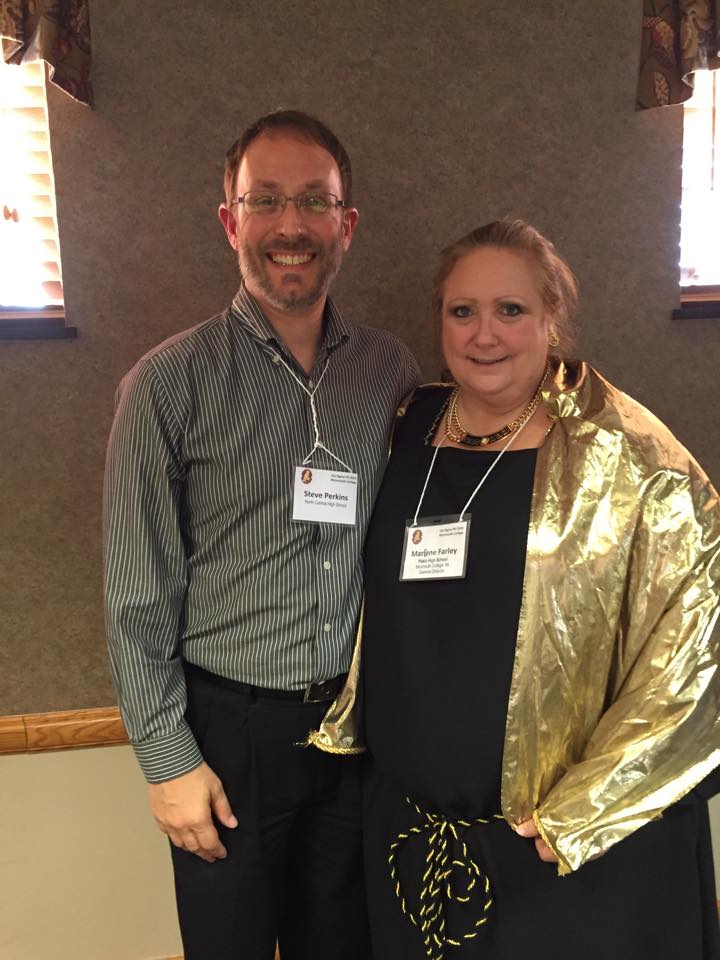
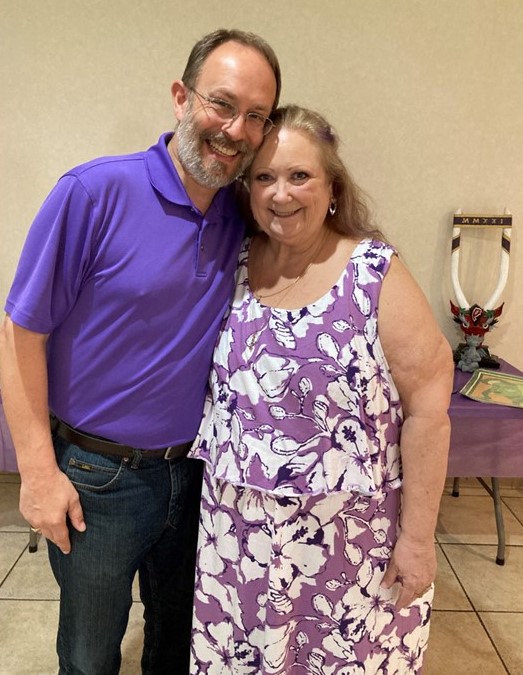
Marcene Holverson, me, Bryan McCorkle, my mom

All teachers and students begin with the same type of relationship.  The one knows something the other does not, together they work so that both know the same thing, and for the majority of those thus engaged, the relationship progresses no further.  This is not to say that teachers and students do not care for one another, often quite deeply, but there is a gap existing between them that, while narrowed by this and that, is rarely bridged so that a new type of relationship is formed.  But what happens when it is bridged?

The Pontifical Nature of Teaching


All teaching is pontifical in nature, which is to say, it involves bridge building.  As I wrote in another post, "Matters of faith and religion connect the human with the transcendent, and a teacher, no less than a priest, is a pontiff, which, as the Latin root pontifex reveals, is a bridge builder.  Teachers help to connect students with ideas, with others, with themselves, and at times even with what lies beyond it all."  With Marcene Farley, there was another bridge being built during my senior year in high school, although we were both unaware of its construction or where it would lead.

Marcene arrived as the new Latin teacher for the start of my senior year and was called Miss Holverson back then, having not yet met her husband Mack.  She did the things that a good teacher does and then some, including taking my friend Bryan and me to the state Latin convention.  This, of course, required Roman attire, and Marcene participated right along with the rest of us.  Then again, she clearly had a penchant for dressing up in class, but this was all part of her strategy for helping to build that bridge between her students and the life of ancient Rome.


The Other Side of the Desk


When people become teachers, they often speak of moving to the other side of the desk, which is to say they gain a new perspective on what goes on in a classroom.  Nearly everyone knows what it is like to be a student, but the view is far different from the position of teacher.  Fortunately, I had in Marcene a teacher who was also a colleague.  Although we never taught in the same school, we talked many times over the years, often at length, about issues in education and with our particular students.  We shared triumphs and heartbreaks in a way that only teachers can, for teachers are involved in that most human of enterprises, the shared journey of discovery, and like any journey, there are both pinnacles and pitfalls.

I was fortunate to speak at Marcene's invitation on a number of occasions once she had moved back to Illinois was teaching at Pekin Community High School.  Three times I had the opportunity to address the Illinois Junior Classical League convention when she hosted it at her school and performed my presentation of Cicero at the Eta Sigma Phi convention at her alma mater, Monmouth College.  I was always pleased to speak at her invitation, and there was an excitement for both of us.  We were able to reconnect not only as teacher and student, but as colleagues, and it was clear that the bridge was extending far from what it had been when I was in high school


De Amicitia


Cicero (106-43 B.C.) wrote a treatise on friendship called De Amicitia, or "On Friendship."  A passage I have quoted often says this.  "Qui esset tantus fructus in prosperis rebus, nisi haberes, qui illis aeque ac tu ipse gauderet? Adversas vero ferre difficile esset sine eo qui illas gravius etiam quam tu ferret."  (De Amicitia, 22).  "How great would be the benefit in good times if you did not have someone who would rejoice in them as much as you?  Indeed it would be difficult to bear adversity without someone who would bear it even more gravely than you."

Marcene was with me when I was named 2014 Indiana Teacher of the Year and she was with me again when my son and I saw '80s hair band Stryper near where she lived.  In fact, she was the one who yelled to leader singer Michael Sweet to get his attention, which led to the first of my many interactions with the rock star.  It was no surprise that she would do this.  After all, she once talked with Dee Snider of Twisted Sister about his Latin tattoo!  Cicero was right in what he said, for both of those moments were all the better for her being part of them.


Dee Snider and Marcene

When her husband, Mack, passed away, I traveled to Illinois for the funeral.  I wouldn't have missed it for anything.  I was there to support my friend in keeping with the second part of what Cicero wrote.

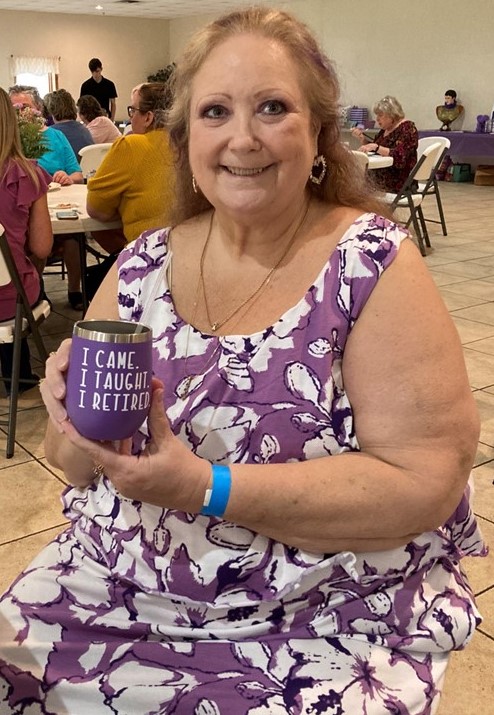
And I was there for Marcene's retirement party at the end of the 2021-2022 school year.  There was a constant stream of people for hours that Saturday afternoon as former students, their parents, and colleagues came to show their love for a woman who had touched so many lives in such profound ways.  My only quibble with the event is about one of the gifts she received.  Someone gave her a mug that says, "I came, I taught, I retired," but that last part only expresses a momentary fact of history.  The mug should have read, "I came, I taught, I shaped lives in ways I will never know."


Tuesday, May 24, 2022

Hidden Treasure


I recently thought I had fallen into a real life version of a Dan Brown novel or the Nicholas Cage move National Treasure.  As I scrolled through some of my picture uploads on Facebook, I found one of the title page of a book I had forgotten I owned.  I knew instantly where the book was, and given what it was, I could hardly wait to pull it from its shelf.  When I did, I discovered something even more amazing.  

My Currently Favorite Collection


I am not a huge collector of things, but I have enjoyed collecting fountain pens, miniature Mustang cars, and the complete discography of certain rock and metal artists.  My favorite collection at the moment, however, is of English translations of Vergil's Aeneid.  In the fall of 2021, I launched a website listing every English translation of the epic poem in chronological order from the first in 1513 to the most recent.  I wrote about that website in a post called "Mr. Holland's Aeneid," which explains that the new website Aeneid Translator would include a color-coded system to indicate the translations that I actually own.  Until recently, my collection totaled thirty-seven translations, including every one from 1937 through 2021.  Just the other day, that total climbed to thirty-eight.

As I was scrolling through some old pictures on Facebook, I ran across one from the title page to a translation of the works of Vergil.  Since the picture was in my photos, I realized that I must own the book and immediately remembered


not only that I did own it, but where it was in my bookcases.  I ran to that particular bookcase, pulled off the volume, and began to explore what I had.

The Excitement of Discovery


The oldest translation of Vergil's Aeneid in my possession is the 1685 translation by John Dryden, but it is a 20th century edition.  Prior to my recent discovery, I had thought the oldest volume in our personal library was the 1794 edition of Cicero's De Oratore that I had purchased at an antiquarian bookshop in Florence, Italy.  This forgotten edition of Vergil published in 1770 bested that by twenty-four years.

It is the dream of book lovers to discover a long lost work.  Indeed, this idea forms the core of one of the best-selling books of all time, Umberto Eco's The Name of The Rose, but let us be clear.  I did not unearth on a bookshelf in my Indiana home the lost second book of Aristotle's Poetics.  Still, just as children enjoy dressing up and playing as their favorite literary or movie characters, so I enjoyed the thrill of discovery when I realized just how old this volume was and what it contained.

As you can see from the title page in the picture above, this book contains the prose translation of Vergil's works.  It is, in fact, the first of two volumes (someday, perhaps, I will procure the second), that cover all of the Roman poet's works, the Eclogues, the Georgics, and the Aeneid.  The prose rendering is that of Joseph Davidson, originally published in 1743.  As you can see from the opening page to the first book of the Aeneid, this is more than a simple translation.


Each page contains the Latin text, a section titled Ordo that puts the Latin into more traditionally English word order, Davidson's prose translation, and then copious notes.  After the double discovery of the oldest book in my library and a translation of Vergil I did not remember I had, a third thrill of excitement came when I noticed that in Davidson's comparison of the opening lines of the Aeneid with those of Homer's Odyssey, he cited Alexander Pope's translation after giving the Greek.  I have a good friend who is Beowulf fan, and he and I love to tease each other about who was the better poet, the Beowulf bard or Alexander Pope.  For my money, Pope will always win.  I have loved his heroic couplets since I was a senior in high school, and his translation of Homer, particularly the Iliad, is one of my favorite works of all time.

Holding a first edition of Pope's Iliad translation from 1715

These discoveries alone would have been enough to excite a bibliophile, but something even better was hiding in these three-hundred-year-old pages.

The Chief Design of Education


At the beginning of his book, Davidson includes an essay "To Those Gentlemen Who have the immediate Care of Education," and in it he lays out an understanding of education that has been held in various degrees by most people in most cultures, is espoused and practiced by some of us today, but has for too many others become a lost treasure.

Davidson refers to those of us who are teachers as "faithful guides, who, no doubt, will, in whatever author you teach, guard your pupils against the influence of any thing that has a tendency to corrupt their principles or morals" and then goes on to show why Vergil is such a suitable author for this purpose.  According to Davidson, "There is a peculiar tenderness and humanity diffused through all his writings, which never fails to make the heart better, and sends away every well disposed mind from the reading of him, equally pleased and improved.  He animates the soul to the love of virtue, by setting before us the most noble examples; corrects the passions, by showing their fatal effects, when indulged to excess, or when directed to improper objects; makes us feel the peace and serenity they bring, when conducted by reason, and regulated within the bounds of prudence and moderation.  From him we learn the force of piety, and what powerful incentives to fortitude, and every heroic virtue, arise from the belief of a deity, and a providence supremely wise and good.  In a word, every image, every description, every character he exhibits; his fables, his allegories, his episodes, all are calculated, not only to please the fancy, but to instruct the judgment, and form the heart."

If that sounds quaint, outdated, or even inappropriate for the modern classroom, we have sad proof of how far we have drifted from the true purpose of education.  It is about far more than teaching mere facts, the sufficient memorization of which can be determined by an exam, and Davidson states this pointedly.  "To teach boys to understand an author's language, is, you know, but the least part of your duty.  To acquaint them with his spirit and virtuous design, to form their taste aright, that they may be able to correct his faults and relish his beauties, feel the force of his pious or humane sentiments, and learn to copy out his heroic characters, and imitate his generous examples; in a word, to teach them to be sound critics on life and manners and to distinguish the true from the false, ... this is your honourable province, and the chief design of education."

Isn't that asking too much of our teachers?  It is if we insist on placing foolish burdens on them under the guise of professionalism.  Earlier in his essay Davidson had explained why he had produced this particular edition of Vergil's works.  "If it gives you some relief from the more disagreeable and burdensome part of your work, it is only to leave you freer and more disengaged in the execution of what is the principal business of education."  Davidson knew, as have most people in most societies through the ages, that education is a grander enterprise than the mechanical drudgery into which it can be corrupted.  He went on to say, "You, by your very profession, are solemnly engaged to teach and exemplify goodness to mankind, at a time of life when they are most capable of being taught, when their docile minds may easily be moulded to every shape of goodness, and are susceptible of the most durable impressions.  [T]he legislature may enact, and the magistrate may execute salutary law; but what will all avail, unless the foundations of national virtue be laid in the right forming of the heart at first?  If the fountains be foul and impure, all the art of man will not make the streams run pure and unpolluted.  The Scripture tells us, that the tree must first be made good, and then its fruits will be good also; but if the tree be corrupt, the fruit likewise will partake of the corruption.  Indeed experience shows us, that the best education is not of itself sufficient to establish the mind in an habitual, uniform course of integrity; yet the same experience evinces, that nothing is of so much importance towards effecting this great end, as to give the mind an early turn and bias to the right side; and that, without this, all other means, humanly speaking, will have but a weak and transient influence."

The legislature may enact, and the magistrate may execute salutary law; but what will all avail, unless the foundations of national virtue be laid in the right forming of the heart at first?  What, indeed.


Monday, May 16, 2022

When Alps on Alps Arise


So pleas'd at first, the tow'ring Alps we try,

Mount o'er the vales, and seem to tread the sky;

Th' eternal snows appear already past,

And the first clouds and mountains seem the last;

But those attain'd, we tremble to survey

The growing labours of the lenthen'd way,

Th' increasing prospect tires our wand'ring eyes,

Hills peep o'er hills, and Alps on Alps arise!

The blog post I wrote as I concluded a 30 year-career in public education took its title from a poem, so it seemed only fitting that this, my 200th post and the one reflecting on my first year in private education, should do the same.


I Had No Idea


In the 1997 film adaptation of Carl Sagan's novel Contact, Dr. Ellie Arroway (Jodie Foster) becomes the first human to travel through a wormhole to encounter extraterrestrial life.  Dr. Arroway is a scientist who only believes in facts and what can be proven through science.  Yet when she encounters the majesty of the far-flung heavens, she stammers, "I had no idea," as she realizes that perhaps a poet would have made a better first ambassador from earth.


This fairly accurately captures what I have felt throughout this school year.  I had no idea.  I had no idea education could be like this.  I had imagined something like it and had even been told by others that it existed, but until I experienced it for myself, I could not truly appreciate the wonders.

Any endeavor conducted apart from or even in opposition to Jesus Christ can seem good and nice.  Hamlet, however, well distinguished between what seems to be the case and what is.  As he famously railed against his mother in Act 1, Scene 2,

Seems, madam!  Nay, it is!  I know not 'seems.'
'Tis not alone my inky cloak, good mother,
Nor customary suits of solemn black,
Nor windy suspiration of forced breath,
No, nor the fruitful river in the eye,
Nor the dejected 'havior of the visage,
Together with all forms, moods, shows of grief,
That can denote me truly.  These indeed seem,
For they are actions that a man might play.
But I have that within which passes show.
These but the trappings and the suits of woe.

Indeed, with this first year at Guerin Catholic High School, I have experienced that which passes show, that which goes far beyond the trappings and the suits of academic achievement that amount to little more than new clothes for the emperor and that have brought about more woe than we would like to credit them.  I am talking about education rooted in the person of Jesus Christ and pursued for His glory.

Undoubtedly there are those who are having trouble reading at the moment, so enraged have they become by my comments casting aspersions on taxpayer-supported, government-run institutions of education.  Yet I will stand with Hamlet in preferring that something be rather than that it seem, a sentiment that goes back to Sallust and before him to Cicero and before him to Aeschylus*, and will state again and unequivocally that anything enacted apart from Jesus Christ can at best seem good.  Of course, I am far from the first to say this.  God inspired Solomon in Psalm 127:1 to proclaim, "Unless the LORD builds the house, those who build it labor in vain," and Jesus Himself put it more directly when He stated, "Apart from me you can do nothing."

One of the best and most recent articulations of the implications of this truth came from Dr. Helen Freeh in her article "Pursue Truth, Find Her, then Do Something."  In that piece, Dr. Freeh says what has needed to be said for some time.  We cannot continue to hope for a better outcome from our schools merely by re-arranging the pieces of a broken game.  We must rediscover the purpose of education, one that is rooted in objective and transcendent truth, and then not the disembodied concept of truth belonging to the philosophers, but the fully incarnated truth who is Jesus Christ.

Golden Streamers of Glory


Since the day I visited St. Theodore Guerin Catholic High School to interview for the position of Latin teacher, I knew that something was different about the place.  We use the phrase genius loci to describe the atmosphere, the feel, of a particular place, and it was clear even as I waited in the front office for the principal that the spirit here was none other than the Holy Spirit, the third person of the Trinity, for as I flipped through Impact, our school's biannual magazine I came across an article by a student who said that the highlight of his career at Guerin was the junior retreat during which he had grown closer to Jesus.  I was struck by the spiritual depth of the young man's comment, and that was but a foretaste of what I would come to experience.

The metaphor I have used most when trying to convey to friends what I have come to sense at Guerin is the image of golden streamers of glory.  It is difficult to put such experiences into words, but time and again I have perceived almost physical, golden streamers blowing through the hallways of our school.  I could point to the happy faces of the students, the genuine joy of the faculty, or the selfless support of our administration and parents as the reason, but then we would have to wonder about even the source of those.  After a moment's thought, the reason for all this is quite obvious.  What else should one expect in a school where Jesus Christ is glorified and the words of the Great Commission to teach all that He has commanded are taken seriously?

Inside the front door of our school

The Sound of Music


Alexander Pope (1688-1744) has been my favorite poet since I discovered him in our Brit Lit class my senior year of high school, and I chose the words from his Essay on Criticism at the beginning of this post to open my valedictory address to our senior class.  The context shows that when Pope describes hills peeping over hills and Alps arising on Alps, he is describing the daunting scene that often confronts us after we have begun an exciting journey, yet I take those lines now in a different way.  I think of Maria in The Sound of Music.  As I conclude my first year of teaching at a Christian school after retiring from public education, I see majestic hills yet to climb, hills filled with the sound of music, and I look forward with renewed vigor and enthusiasm to attempting their ascent with the wonderful students and faculty at St. Theodore Guerin Catholic High School as together we follow the One Who prepares the path before us.


*In Seven Against Thebes, line 592, by Aeschylus we read, "ou gar dokein aristos, all' einai thelei" "οὐ γὰρ δοκεῖν ἄριστοςἀλλ᾽ εἶναι θέλει."  "For he wants not to seem but to be the bravest."

Cicero wrote in De Amicitia 98, "Virtute enim ipsa non tam multi praediti esse quam videri volunt."  "For there are not so many who wish to be endowed with virtue itself rather than to seem so." 

In Sallust's Bellum Catilinae 54 we find Cato the Younger being described as someone who "esse quam videri bonus malebat," or someone who "preferred to be good rather than to seem good."


Monday, April 25, 2022

The Woman You Know And Have Never Met


Alice Ranck Hettle

You know this woman, although unless you attended New Albany High School between 1952 and 1986, it is unlikely you ever met her.  If, on the other hand, you were one of my students in Missouri, Texas, or Indiana, you have.  In fact, if you have ever encountered one of Alice Ranck's students...teachers, doctors, lawyers, athletes, business people, moms, dads, coaches, and more...you have in some way come to know her.

Dedication for Dedication


I have written about this extraordinary Latin teacher before, and now I need to post an addendum.  On Sunday, April 24th, 2022, the New Albany High School media center was formally dedicated as the Alice Ranck Hettle Media Center.  It seemed only fitting that a space we used to call a library be dedicated to a teacher whose dedication both to academics and her students was and perhaps always will remain unparalleled.


Although she retired more than thirty-five years ago to marry a man she had met in the 8th grade, none of us could ever call her Mrs. Hettle.  She was always "Miss Ranck" or "Miss Alice" to her students, the latter appellation undoubtedly derived from her own habit of addressing us as "Mr." or "Miss" and then our first name.  I was always "Mr. Steve" to her.

After her passing in 2019, a group of her former students began to plan a suitable and permanent way to honor this woman who had so profoundly influenced so many lives.  The choice of the library/media center was obvious, as was the choice for a quotation on the plaque that now adorns the wall to the right of the picture above.


Seneca was a Stoic philosopher who lived from 4 B.C. to A.D. 65, and in Epistle LXXVI he wrote, "Tamdiu discendum est quamdiu nescias."  "You must keep learning as long as there is something you do not know."  Had Seneca not said it first, Miss Ranck surely would have said it herself, for she would often stop class to impart some bit of wisdom, prefaced by her trademark statement, "This is more important than any Latin I will teach you."  It is for that reason more than her clear presentation of the subjunctive mood or the ablative absolute that so many people were present for this dedication.

Across the Decades


Steven Prince, Latin Teacher, NAHS

The emcee of the ceremony, current New Albany High School Latin teacher Steve Prince, asked people to stand as he called out the decades, and people rose who had been students of Miss Ranck in the 1960s, 1970s, and 1980s.  The youngest among us had last sat in a classroom with Miss Ranck thirty-five years ago, the eldest more sixty.  What could possibly draw people from as far away as Houston, Texas?  What could have compelled people with physical infirmities for whom motion was clearly a challenge to visit a southern Indiana high school on a Sunday afternoon?  The answer is simple.  We were there for Miss Ranck.

When she was inducted into the NAHS Hall of Fame several years ago, Miss Ranck said, "It is our responsibility as educators to provide a sound education based on ethical principles.  Innate within every human being is first the desire to be noticed and to be loved, then comes the need to be taught to learn how to learn.  It is the role of the teacher to notice and yes, to love the student so much that he is ready to learn, and in turn develop all of his potential.  What better way for a teen-ager to learn to live honorably and well than to read from the literary masterpieces of Cicero."

After school board member Elizabeth Galligan read a poignant piece to acknowledge and commemorate the life of this extraordinary teacher, person after person took the microphone to share a "Miss Ranck" story.  Had Steve Prince not drawn this portion to a close, we could have been there all night listening to stories about this woman, whose first year of teaching was at Spartanburg High School in Lynn, Indiana, during the 1945-1946 school year, we could have been there all night.


That's My Teacher


I have friends in many noble professions, yet I do not think there is a calling that produces the excited statement, whether by a child or a senior citizen, quite like, "That's my teacher!"  

My calculus teacher, Jim Dickman

As guests began filling the atrium for the ceremony, I spotted across the room the man who had been my calculus teacher my senior year, Mr. Jim Dickman.  I quickly grabbed my daughter and asked her to take a picture of the two of us.  Mr. Dickman had also been a student of Miss Ranck, and although he is now retired and I am in the second phase of my own career, I was still excited to see "my teacher."

L to R:  Steve Perkins, Tim Harbison, Steve Prince

Many of Miss Ranck's students went on to become teachers and college professors, but only three that we know of became Latin teachers.  Tim Harbison, Steve Prince, and I share a special bond in that, but as all teachers know, there is something about the student-teacher relationship that is unlike any other.  The eminent polymath George Steiner wrote of this in Lessons of the Masters, a book that should be required reading for all teachers and that I explored in another post.  Those who have experienced such a special connection with a teacher can recognize the reason why in Miss Ranck's words above.  Before it is an academic relationship, it is a relationship based in love.

A Personal Note


To date I have taught more than 2,200 students, and while I have been blessed by a great many extraordinary teachers, a topic I have written about in "Why I Love Teaching, Part 1," it would not be too much to say that I would not have taught any of them had it not been for Miss Ranck.  As I described in the post titled "Infinite Space," God spoke to me when one day in 1986 she made an offhand reference to Antioch as the first place where anyone was ever called a Christian.  The call I felt on my life that day in Room C317 has led me to a life I have been blessed beyond measure to lead.  For this reason, I was grateful when Steve Prince took a few of us on a tour of the school and I was able to see that room once again.


Some things have change since I sat in that room years ago, learning from textbooks like Latin For Americans and Our Latin Heritage.  The door is in a new location, and there used to be windows that looked out across the football field.  For me, however, it was sacred ground, for it was there that I learned from Miss Ranck, heard the voice of God, and was inspired by the calling to which I have given my life.


Wednesday, April 20, 2022

A Brief Post on Mistakes


Errare humanum est.  To err is human.  This is proved in the frequent misattribution of this quotation to the Roman philosopher Seneca.  It seems the kind of thing he might have said, but we have no evidence that he actually said it.  But is that a really big deal?  If making mistakes is human, then perhaps we should just learn to live with them.

When Mistakes Matter


At some point in my Latin classes, we talk about how the Latin texts they read in their books came into existence.  We have no autographs from any ancient author, which is to say, we have no manuscripts written in their own hand.  We possess copies of works by people like Homer and Plato and Cicero and Vergil, but we do not have even one scrap of papyrus in their handwriting.  Copies were made even in their day, and then copies of those copies were made, after which copies of copies of copies were made, and so on down through the ages.  If you have ever copied something, however, you know that it is easy for your eyes to skip words, to write the same word twice, or to make other errors in transcription.

When I was a graduate assistant in Classics at The University of Texas, I was grading a set of etymology exams for a certain professor and noticed that a large number of the students had incorrectly defined a particular word.  Even stranger was that they had all misdefined it in the same way.  The word was "anthropocentric," and these students had defined it as an adjective related to the belief that "man is the center of the unwise."  I have often told my own students that if an answer does not make sense, it is probably wrong, but this professor had obviously not given such advice.  Eventually I figured out what had happened.  Apparently a student with illegible penmanship had shared his notes with the class, and although he had written "universe," the word looked like "unwise," and that was what the students had memorized for the test.

This kind of thing happened all the time in the transcription of ancient texts across the centuries, especially when those doing the copying did not know the language they were transcribing.  As a result, scholars have poured much work into establishing authoritative versions of texts by comparing the various manuscripts and applying philological rules to resolve discrepancies.  For more on this, see Max Hardy's excellent article in the online journal Antigone.

A Calligraphic Goof


I encountered this scribal problem firsthand recently after putting on our dry erase board the Verse of the Week for our Latin III class.  A student had come to see me before school, and as we talked, my eye wandered over to the board, and suddenly I saw the error, but even that I corrected incorrectly.  In the picture above you can see the Latin of 1 Peter 3:15.  The first word in the next-to-last line is posenti, which is not a Latin word at all.  I began to think about the verse and, not having memorized it in Latin, assumed that I miswritten petenti, figuring that since "e" and "o" are similar, my brain had simply taken one for the other.  Furthermore, because there are two instances of the long "s" in satisfactionem immediately above, I had mistakenly used the long "s" instead of "t."  My mental emendation had the benefit of keeping the sense of the verse, but when I actually looked at the Vulgate, I found that not only had I misspelled a word, but my intended correction was wrong as well.  The actual word in that verse is poscenti, and I had left out the letter "c."


The corrected version

I quickly changed the word on the board, and all was well, but it was an interesting reminder of the kind of thing that happened countless times as scribes copied the works of antiquity.  It is also a reminder of the debt of gratitude we owe classical philologists who have produced reliable texts that we can be quite confident express what the ancient authors wrote.

Wednesday, April 6, 2022

Vowels and Baptism

It can be caused by viruses, bacteria, and parasites.  Lactose, fructose, and artificial sweeteners can cause it as well.  It can even be associated with diseases such as ulcerative colitis, and despite its relatively simple treatment, there is some debate over how to spell it, or at least there was recently among some of my friends.

When Wordsmiths Text

In a text thread of three other friends and me, one of us had shared a screenshot from a news update on a certain illness, one of the symptoms of which included the condition described above.  What bothered someone on the thread was that the word was spelled "diarrhoea" instead of the more familiar "diarrhea."  One of my friends quipped, "I'm sure Steve will give us a full etymological report, replete with Latin roots -- whether we want it or not!"  Since I am the obliging type, sent them a diagram tracing the roots of the word to the original Greek noun "diarrhoia," and began unpacking the matter at hand.

You will notice that the Greek noun ends with iota alpha (ia in the transliteration).  That iota often comes into English as "e," as in "Phoinix" becoming "Phoenix."  Same thing with Phoibos -> Phoebus, as in Apollo.  There is a tendency in English to collapse diphthongs into single vowels.  The spelling you see is legitimate and is closer to a transliteration from the Greek.  This is why "caelestis," the Latin word for "heavenly," comes into English as "celestial."  The "ae" diphthong has collapsed into the single vowel "e."

[Referring back to the original issue of why someone might spell "diarrhea" with an "o," I added the following.]  Richmond Lattimore did this kind of thing in his translations of Homer.  He wanted to convey a sense of the Greek, so he used transliterations of names, e.g. Achilleus (Achilles), Hektor (Hector), Achaians (Achaeans), etc.

After introducing Richmond Latimore into the discussion, I thought I would share with my friends the translation of the New Testament that this renowned translator of Homer's Iliad and Odyssey had produced, and it was then that our conversation took an important turn.


From Vowels to Baptism

As I searched for a link to Lattimore's New Testament, I ran across the story of his baptism in 1983, just a year before his death.  The story was told more than twenty years later by Rev. Andrew Mead in a sermon on Sunday, January 16, 2005.  The message is short, and I urge you to follow this link and read it now.

I remember excitedly discovering Lattimore's translation of the New Testament nearly thirty years ago, and I was drawn, as I always am when picking up any translation, to the preface.  This preface did not, as one might expect in a Bible, give historical or theological or other specifically biblical information.  It did, however, as one would expect in a translation of Homer or Vergil, present stylistic information and a discussion of the translator's method and underlying theory of translation.  This was a scholar's work.  It was the work of a poet, and it never occurred to me that there might have been something more going on for Lattimore himself.  Yet there clearly was, as Lattimore revealed to Rev. Mead, to whom he had just admitted his desire for Christian baptism at the age of 73.  Mead shares in his sermon that he pressed Lattimore on what had apparently been Lattimore's known difficulties with the faith.

"Dr. Lattimore [though he preferred it, it was difficult for me to call him Dick], I thought you had reservations about the Christian faith and the Church."  "I did," he replied.  "But you don't any longer?"  "No, not any longer."  "Please then may I ask you, when did they go away?"  He was silent for a space; then, again with that smile and twinkling eyes, he answered, "Somewhere in Saint Luke."

The Closeness of Reading

Translation involves the close reading of a text.  Even someone with a cursory knowledge of another language can skim a text in that language and glean information, but translation is something entirely different.  Is the verb in the indicative or subjunctive mood?  To what does this relative pronoun refer?  Answering questions like these is essential to making an accurate translation, but when it comes to the biblical text, this close reading leads to another kind of closeness, one that Lattimore clearly experienced.  When we slow down and ponder a biblical text, when we look at it from multiple angles and ruminate on it, as it were, at the atomic level, we are drawn closer to the One Who is the author, or more simply, to The One Who Is.

There is a difference between to hen,” The One, of Plotinus, and “ho ōn,” The One Who Is.  It is the latter that we see surrounding the head of Jesus in icons and that we find in Revelation 4:8.  A close reading of these two Greek phrases reveals an impersonal quality to the former and a personal aspect to the latter, and therein lies all the difference.  God is not an idea, but a person.  To be precise, He is three persons eternally existing as one deity, and it would seem that this is Whom the renowned translator Richmond Lattimore encountered when reading closely the biblical text.  It is not necessary, of course, to read Hebrew or Greek or Latin to encounter God in the Bible.  What is necessary is a slow, careful reading, one that does more than skim a text to glean information.  Lattimore said that his reservations about the Christian faith were allayed "somewhere in Saint Luke."  What an exciting proposition to think that you, too, may encounter  ho ōn,” The One Who Is, as you read the Bible today!


Friday, April 1, 2022

Words Matter

Michael Biehn as Johnny Ringo in Tombstone

The 1993 film Tombstone opens with a scene of violence as members of the ruthless gang known as the Cowboys invade a wedding party.  The priest hurls words of Scripture at them in Spanish, and one of the gang translates, albeit loosely, for their leader, Curly Bill Brosius.  Fearsome gunslinger Johnny Ringo, however, knows better what was said.


Cowboy:  Patron, he say, uh, someone will come to revenge for him.  Something like a, a... sick horse who comes to sit with him.  He talk crazy.

Ringo:  That's not what he said, ya ignorant wretch.  Your Spanish is worse than your English.


Later, as the Cowboys help themselves to food from the wedding banquet, Curly Bill revisits the topic.


Curly Bill:  Hey, Johnny, what'd that Mexican mean..."a sick horse is gonna get us," huh?

Ringo:  He's quoting the Bible.  Revelations.  "Behold, a pale horse.  The man who sat on him was Death.  And hell followed with him."

Words matter.  Translators bear an enormous responsibility, one that is almost impossible to fulfill perfectly, and this is the reason the Italian expression traduttore, traditore exists.  The translator is in one aspect or another nearly always a traitor.

Consider the story of the woman caught in adultery that is told in John, chapter 8.  When the Pharisees bring the woman to Jesus, they cite the law of Moses for what should happen to her, and both the original Greek and the Latin of the Vulgate are quite clear.

ἐν δὲ τῶ νόμῳ ἡμῖν μωϊσῆς ἐνετείλατο τὰς τοιαύτας λιθάζειν.
In lege autem Moyses mandavit nobis huiusmodi lapidare.
In the law Moses commanded us to stone women of this sort.

The key words here are τὰς τοιαύτας in the Greek and huismodi in the Latin.  They both indicate categories or types.  The Pharisees are applying the general to the specific.  In general, women caught in adultery are to be stoned.  This particular woman was caught in adultery, and the consequence is clear.

Most English translations of the Bible get this right, but one, the New Living Translation, misses the mark.  It translates John 8:5 to say, "The law of Moses says to stone her."  As we just saw, the implication of the law is precisely that, and so, on one hand the NLT scholars were justified in this translation, yet they have also proved the truth of the Italian expression traduttore, traditore, for they have betrayed a key aspect of this verse.  The Pharisees see the woman merely as a category, but Jesus sees her as something else, something more.  He sees her as a person.


Fr. Mark Toups in The Ascension Lenten Companion has this to say about what happened that day just east of Jerusalem.

They stand behind her, the scribes and the Pharisees, each of them teeming with righteousness.  They bend down, looking around, hunting for the perfect rock to hurl so that they can crush her to death.

They do not see a woman.  They do not see a person.  They see a category.  To them she is a category, a thing with a label:  "an adulteress."  They are ready to stone her, to kill her, because they want to remove the category.

Jesus does not see a category; he sees a woman.  Jesus sees a person.  Jesus sees this particular person.  To Jesus she is not a category:  "adulteress."  No, she is a person.  She is a person who has made an egregious mistake, but she is a person who can be forgiven.  (p. 135)

By rushing on to the implication of the law for this particular moment, the NLT passes too quickly over what is really going on here, but if we stop for a moment, we see a profound lesson for ourselves.  How often do we in the shrill age of screeching social media merely see people as the categories into which they seem to fit?  It is easy to rail against Debbie the Democrat or Rob the Republican, Harry the Hollywood Elite or Charlotte the CEO, especially from the anonymity of a social media screen name, but what do we actually know of Debbie or Rob or Harry or Charlotte the human beings created in the image of God who have the same opportunity to accept redemption through Jesus Christ as any other man or woman?  Of course, Jesus was right in Matthew 7 when He said that we can know people by their fruits, which is to say, by their words and actions, but what does that mean?  Does it mean that we can use what people say and do to assign them to categories that we can then proceed to pillory, reject, or dismiss?  Or does it mean that we can use those fruits to see when people are not walking with Christ so that we can reach out to them as the salt and light Jesus has called us to be?

This gospel story convicts me, for I, like most people these days, can get caught up in the bloodless blood sport of sitting around with like-minded friends to skewer with wicked wit groups of people whose words and deeds seem out of alignment with what we think is right.  We should not turn a blind eye to sin, nor should we excuse sinful behavior, but we must be careful not see people merely as categories and rather as Jesus saw them, as He has seen each of us, as friends in need of His grace. 


Monday, March 28, 2022

Pen and Ink

In what might be the project with the greatest potential for mess, our Latin III students explore the world of Medieval calligraphy and text production as they learn to write in Carolingian Minuscule.  As I have described in another post, our Latin students are not strangers to working with ancient writing materials, and with this project they move from antiquity to the era of Charlemagne (747-814).  After spending much of the year reading the oratory and philosophy of Cicero, the philosophy of Seneca, and parts of the Bible, including the full Epistle to Titus, the students take a break from strictly linguistic work and enter the artistic aspect of presenting words in writing.

They begin by learning to dip pens in ink and write with metal nibs.  To be sure, the scribes in Charlemagne's time cut their pens from quills and made their own ink, but we can take advantage of a few modern conveniences!  I pour the ink into small, plastic cups, and the first step is for the students to become familiar writing a Speedball C-3 nib.

There is, of course, the challenge of learning to write with a square nib as opposed to the round point of the typical ballpoint or gel pen of today.  In addition, the students have to become comfortable with how much pressure to use.  Too much produces a blob or river of ink on the paper, but too little leaves a thin, scratchy trail.  There is also the issue of how often to dip the pen into ink.  Depending on how the nib is formed or has changed with use, some students can write a line or two before needing to dip again, yet others must get more ink after just a word or two.  For this reason, they first just doodle.  They write their names or draw shapes and lines to get the feel of the pens.

From there they begin to learn how to form the letters in what we know as Carolingian Minuscule.  This is a relatively simple script to learn, and once the students have broken down the basic strokes needed to make the letters, they practice by writing the alphabet multiple times.  The next level of practice comes from copying a simple and familiar Latin text, perhaps something from their first year of study that they remember fondly.  Once they have achieved a reasonable level of comfort, it is time for the real project to begin.

They are invited to choose a passage from Cicero, Seneca, or the Bible that we have read and that has particular meaning for them and then copy it in Carolingian Minuscule.  To add a bit of ambiance, we listen to the monks of Santo Domingo de Silos and their ethereal, Gregorian chant along the way.  Using markers, colored pencils, or even crayons, the students decorate the page in the style of the illuminated manuscripts that we have examined and submit a short paper that explores why they chose the text they did, what challenges they faced in learning to write in this style of Medieval calligraphy, and what insights they have gained into the production of texts in the Middle Ages.  It is no surprise that what they produce, both in the art of their manuscripts and in their written reflections, is quite beautiful.  Take a moment and enjoy this short video of their work and excerpts of what they shared.


Monks spent their whole lives copying the Bible letter by letter in painstaking detail so that the word of God could be read to people around the world.  I also never realized how much each page and really each letter is like its own little work of art.  -- Sophia


I've seen some illuminated texts in person, and the pages were massive.  I can't imagine how long it would take to fill one of those pages with text and images when even the small page that I did, with markers instead of paint to boot, took me hours to complete.  I wonder whether they felt the need to get every page exactly perfect, in which case they must have done many drafts and sketches of pages to ensure that they were achieving exactly the images they wanted, or whether they painted spontaneously without any guides or detailed planning, which sounds terrifying.  -- Marian


I struggled to keep the pen at the 45-degree angle that would lead to writing perfection, and when I did get back on track with the pen, my pen would run out of ink and the loop would start all over again.  Another minor problem I faced was with letter similarity, as I would often begin a letter, and my brain would make it a different letter, as the case with c and e.  -- Nathan


This whole experience left me with a much larger appreciation for the monks, or anyone, who copied and produced these manuscripts.  It took me about two class periods, almost three hours, to write four sentences.  I cannot imagine how long it would take to write even one book of the Bible. -- Sophie


While I was learning to write in Carolingian Minuscule, I found myself getting frustrated because of how long it would take me to write just one word.  After practicing the alphabet, I did find it a bit easier and I noticed I was writing faster.  After completing the calligraphy portion of this project, I was very glad I took as much time as I did and I was impressed with how good my writing looked.  -- Heidi


It took me around 60 minutes just to write less than two sentences, as compared to completing most of this paper in minutes.  From that difficulty I can also see that someone would have really cared about what they are copying compared to how people can copy something down on a computer without even thinking about it.  -- Otto


After a couple of sentences my hand was hurting.  I cannot imagine having to do this all day.  It was a cool experience and I had never tried calligraphy before or used real ink when writing.  I enjoyed it a lot and I have a much greater appreciation for scribes and monks.  -- Erin