Monday, August 9, 2021

Infinite Space


"I could be bounded in a nutshell, and count myself a king of infinite space...."  Hamlet, II.ii

The picture above is from my new classroom at Guerin Catholic High School, where I will begin my thirty-first year of teaching this fall.  This room is significantly smaller than the one I inhabited for the past seventeen years or the one six before that at the public high school where I taught for the most recent 23 years of my three-decade career.  In fact, it is so small that I will only teach there the IB students, the smallest of my classes, teaching all the rest in other rooms.  Yes, for the first time in my career, I will be a traveling teacher.  When I first learned of this arrangement, the line from Hamlet above blazed through my mind, for this is no way a downgrade, but rather the most blessed of opportunities.

I had felt the call to be a teacher, which basically meant following in the family business, long before the day during my junior year at New Albany High School when Latin teacher Miss Alice Ranck made the offhand comment that Antioch was the first place where people were called Christians.  Without citing chapter and verse, she was referencing Acts 11:26, and I heard Jesus say as if He were sitting next to me, "You can teach this subject and be a Christian presence in public schools."  And so I did for thirty years.  In a middle school in Kansas City, Missouri; at a high school, community college, and university in Austin, Texas; and at a high school and university in Indianapolis, Indiana, I have taught Latin and Classics for three decades.

Eric Leveque and I after our Latin II classes lost in a war with the French classes

After retiring from public education in May of 2021, I now find myself employed once again, but in an openly Christian environment, replacing one of my former student teachers, Eric Leveque, who left his teaching position to pursue a law degree.  There are perhaps those who would question a move from a large, flourishing program in a building with space to hold a personal library of thousands of books, and so would I, although I suspect my question arises from a different motivation.  My question is simply, "Why, O Lord, would You allow me the privilege of teaching in a place where Your name is glorified?"

Why does that matter?  Isn't the teaching of Latin or any other subject merely the transmission of knowledge from someone who knows it to someone who does not?  This view of education, narrow to the point of inaccuracy, unfortunately holds sway in too much of our society, from the common conception of what a school should be to departments of education in our universities, yet those who follow Jesus Christ, Who claimed to be truth itself, know that there is much more to education.  John 1:3 observes, "All things were made through him, and without him was not any thing made that was made."  In ways we may not fully understand, all truth, all goodness, all beauty have their foundation in Jesus, and so it can only be in a Christian context that anything approaching the full knowledge of math or history or literature or art or any other subject can be approached.

Years ago Isaiah 50:4 struck me profoundly.  The Latin text of the Vulgate translation reads, "Dominus dedit mihi linguam eruditam ut sciam sustentare eum qui lassus est verboErigit mane, mane erigit mihi aurem, ut audiam quasi magistrum."  A literal rendering into English would be, "The Lord has given me an educated tongue so that I may know how to sustain with a word the one who is weary.  He rouses early, early he rouses my ear, so that I may listen as if to a teacher."  Nothing could better capture what I have always tried to live out in answer to the calling I heard in my own Latin classroom so many years ago.  

God has shown me much over the past few months, drawing me ever closer to Him and guiding me as I empty myself so that there is ever that much more space in me in which He may dwell.  To that I end, the following verses of Scripture, slightly modified in places to reflect a first person perspective, give shape and structure to this next stage in my service to Jesus through teaching.

In ipso condita sunt universa in caelis et in terra.  Omnia per ipsum et in ipsum creata sunt, et ipse est ante omnia, et omnia in ipso constant, in quo sunt omnes thesauri sapientiae et scientiae absconditi.  Deus Pater eripuit nos de potestate tenebrarum et transtulit in regnum Filii dilectionis suae, in quo habemus redemptionem, remissionem peccatorum, quia in ipso complacuit omnem plenitudinem inhabitare et per eum reconciliare omnia in ipsum, pacificans per sanguinem crucis eius, sive quae in terris sive quae in caelis sunt.  Ergo doceo omnem hominem in omni sapientia, ut exhibeam omnem hominem perfectum in Christo, in quo et laboro certando secundum operationem eius, quae operatur in me in virtute, permanens in fide fundatus et stabilis et immobilis a spe evangelii.

In Him all things in the heavens and on earth have been established.  All things have been created through Him and for Him, and He Himself is before all things, and all things hold together in Him, in Whom all the storehouses of wisdom and knowledge have been hidden.  God the Father snatched us from the power of darkness and bore us into the kingdom of His beloved Son, in Whom we have redemption, the remission of sins, because it pleased God for all His fullness to dwell in Him and through Him to reconcile all things, whatever is on earth or in the heavens, to Himself, making peace through the blood of His cross.  Therefore I teach every person in all wisdom, so that I may present every person complete in Christ, for which I also labor by struggling according to the work which is at work in me in power, remaining rooted and established in faith and unmovable from the hope of the good news.


In ipso...constant/In Him...hold together in Him Colossians 1:16-17

in quo...absconditi/in whom...hidden Colossians 2:3

eripuit...peccatorum/snatched...sins Colossians 1:13-14

quia...sunt/because...cross Colossians 1:19-20

omnem...virtute/every...power Colossians 1:28-29

in fide...evangelii/remaining...news Colossians 1:23

Monday, June 21, 2021

Be True To Your School

To celebrate our 30th wedding anniversary, my wife and I took a trip with our children and some of our friends to the Grand Tetons and Yellowstone.  Our first stop, however, was in Kansas City, Missouri, and while we did take in a Royals baseball game, the real purpose was to visit the first school where my wife and I taught.

In 1991 it was the Martin Luther King, Jr. Latin Grammar Magnet Middle School, and although it closed in 2009, the building still stands at 4301 Indiana.  If the name of the schools seems a bit long, that is because it was changed when the school was restructured as a magnet school as part of the city's desegregation in the 1980s.  An article in 2020 describes the long history of school segregation in Kansas City, and the following paragraph details the environment that would become the first teaching experience for my wife and me.

The hope in the 1980s was to build one of the best school districts in the nation.  Fifteen brand-new buildings were constructed while 54 old ones were remodeled.  They created nearly five dozen magnet schools which concentrated on subjects such as computer science, foreign languages, and classical Greek athletics.  James Shortridge explains, "If the quality of instruction was high, the buildings modern, and the programs innovative, students from all over the region would want to attend."

It was sad to see the front doors closed, and I could still remember walking through them to interview with Mrs. Juanita Hempstead, the principal.  I learned so much as an educator in the two years we spent at King from Latin teachers like Leo Kerwin, Joe Gehrer, and Donna Jacobson, math teacher Phyllis Kopp, social studies teacher Richard Cayce, English teacher Winston Valin, and many others*, yet, as it remained for the next thirty years of my career, it was the students who made the difference.

I wish I had kept records from those days of all my eighth grade Latin students.  Many names linger in my mind along with many more faces.  Included among them are Torium Johnson, Anneatricia Hicks, Nicholas Brager, Fanetta Williams, Sheena Clay, Bennie Terrell, Anthony Merritt, Hollywood Austin, Azure'd Canty, William Workcuff, Antwan Lytle, James King, Randon Jones, Simone Kirkwood, Anissa Tiger, Donte Bonds, Alexis Cadenhead, and Maurice Booker.


The picture above is from the back of the school where we parked each day in our black Geo Storm.  I remember my eyes filling with hot tears as we walked out the doors behind us for the last time in 1993 as prepared to move to Texas for me to attend graduate school.  I loved the students of King Middle School, and although I was a raw teacher fresh from college, I wanted to give them all I had.  In fact, I remember administering a state-mandated exam during the spring of our first year, and as the students worked on it, I walked around the room and started considering what I would do differently and what I would retain the following year.  That practice of reflection and the striving to do better has remained with me for thirty years, and I trace its origins to my time at King.

What a thrill it was for my wife and me to return and to show our children and our friends where we started.  King Middle will always hold a special place in my heart.


*The colleagues whose names I can remember.

Latin
Carla Brown
Donna Jacobson
Joe Gehrer
Leo Kerwin
Peter Dodington

Math
Phyllis Kopp
Rev. Buie

Science
Barbara Webb
Franz Nelson
Mrs. Shurn
Larry Grinstead

Social Studies
Ruth Whertvine
Richard Cayce
Ransom Ward

English
Winston Valin, III
Mrs. Wheeler
Arlene Penner
Sandy Clifton

Special Ed
Dr. Rozelle Boyd

Principal
Juanita Hempstead

Assistant Principals
Lonnie Jackson
Ulrica Seals
Mike Schepis


Thursday, June 17, 2021

Entering A Story


While visiting the Grand Tetons and Yellowstone recently, we saw a young tyke wearing a Batman costume.  Most people give little thought to children dressing up as superheroes.  It is common for young ones to pretend to be their favorite characters from books and movies or people who seem larger than life like firefighters and astronauts, yet I would suggest this is not province of children alone.  Adults, too, enjoy entering into larger stories.

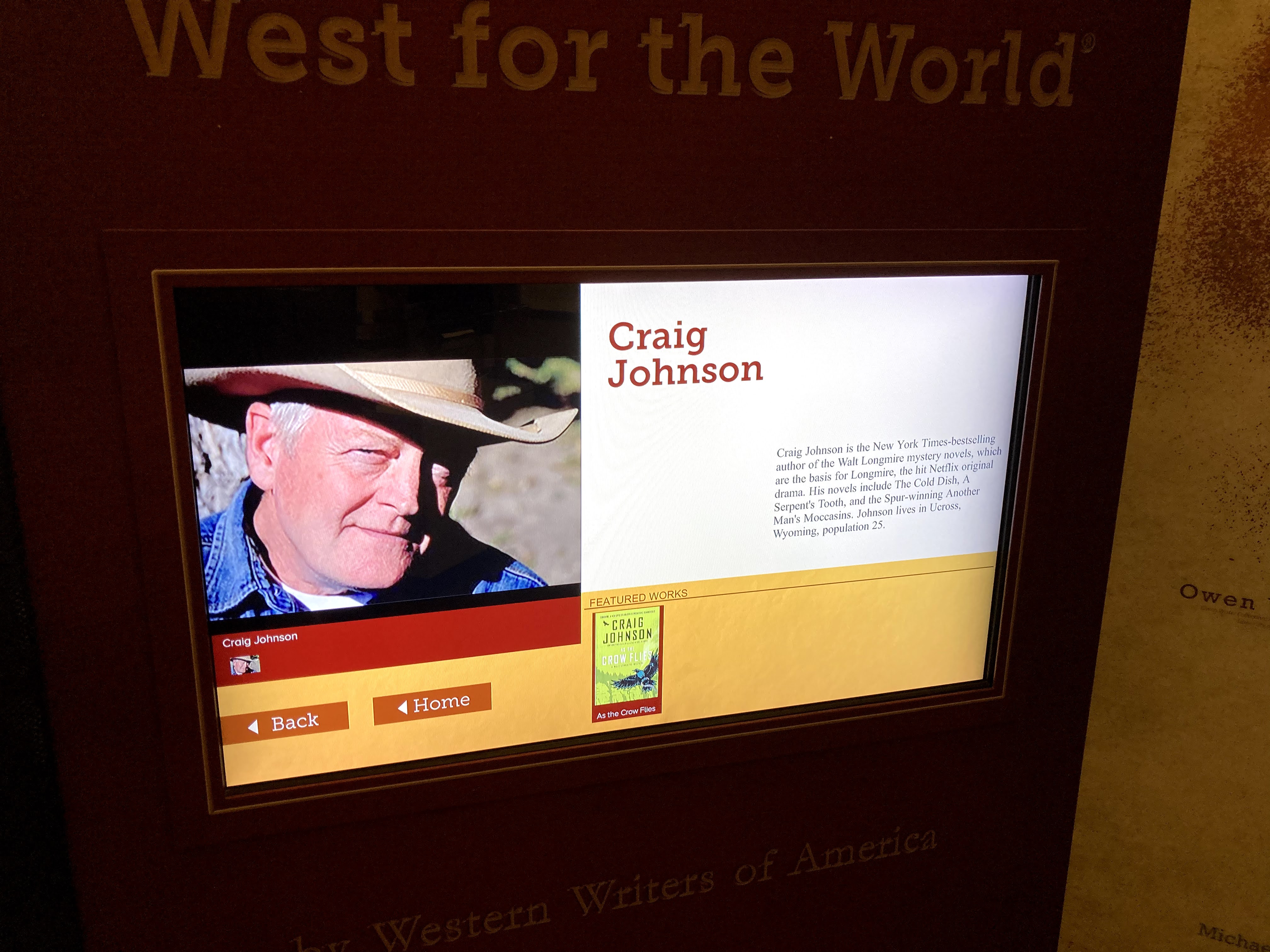
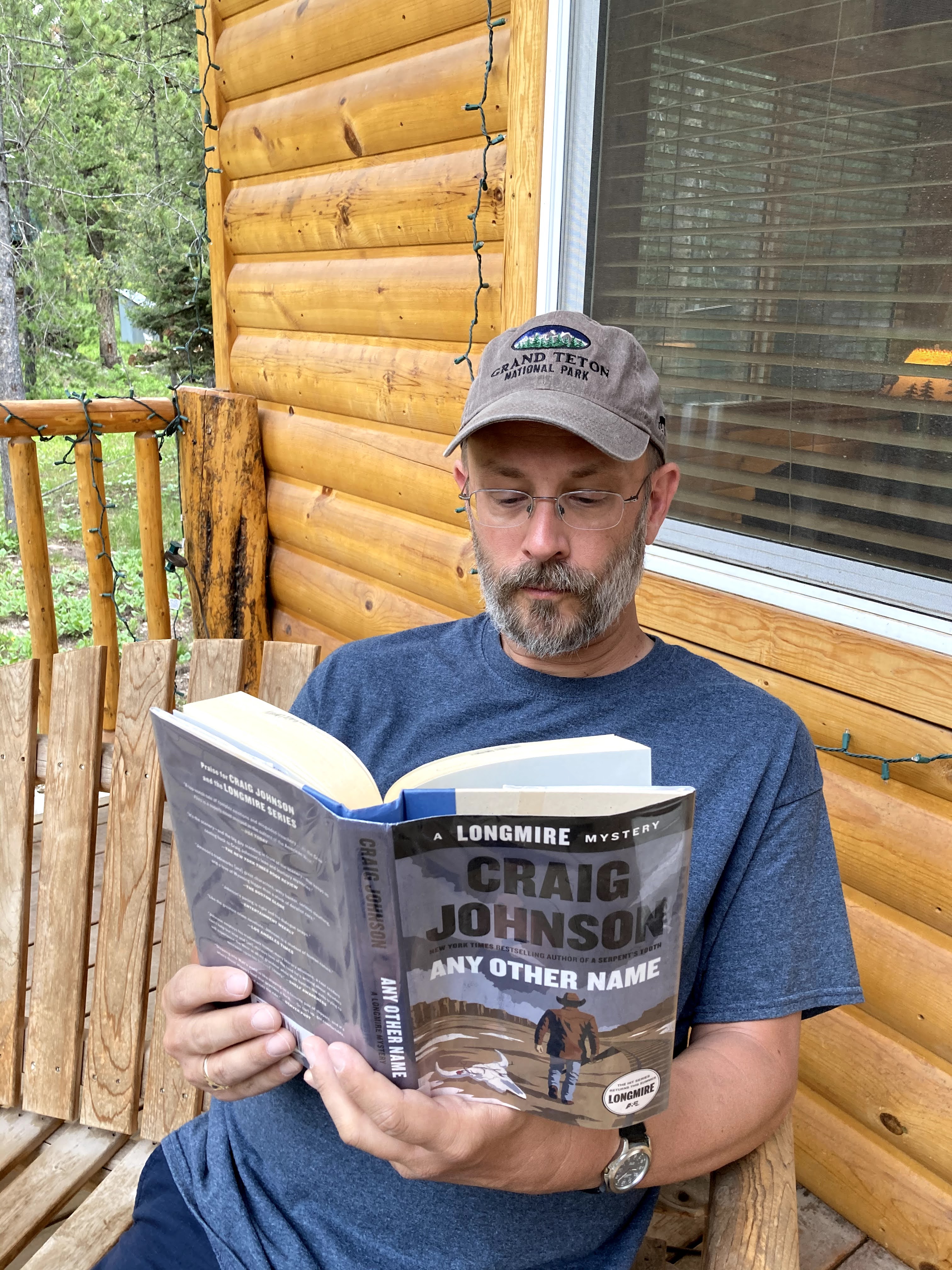
I am a huge fan of the Longmire novels by Craig Johnson, so when we prepared for our trip to the West, I packed one of them.  As a side note, serious readers spend more time deciding which books to pack for a vacation than they do clothes.  I have been re-reading the Longmire series in order and was in the middle of Any Other Name, so that went into my bag along with a few other books.  Craig Johnson is an award-winning author who is featured in the The Buffalo Bill Center of the West in Cody, Wyoming.  For another side note, this is an amazing site that is home to five separate museums:  The Buffalo Bill Museum, The Plains Indians Museum, The Cody Firearms Museum, The Draper Natural History Museum, and The Whitney Western Art Museum.


Craig crafts stories that invite readers into another world and make them long to return once the last page has been turned.  His characters are carefully and exquisitely crafted, and the settings he describes rightfully hold a place as participants every bit as vivid as the human players.  How, then, does one whose inner child has not been lost enter into such tales?


For starters, I wanted to read one of these novels while in the places near where they are set.  I read while we stayed at Airbnbs in Driggs and Island Park, Idaho, and in the Wyoming cities of Cheyenne and Cody.  In the liner notes to John Cougar Mellencamp's 1985 album Scarecrow, we find this.  "The highway between John's house and the studio where these songs were recorded cuts through a stretch of Indiana where the land is fertile and full of growth.  It is from this land and its people that these songs are born, and though it is not necessary to know this to enjoy and appreciate them, it does lend a certain understanding for those who care to think about such things."  Serious readers care to think about such things, and it was one way for me to enter into the stories that Craig has created by reading them in the West.  But wait, as the informercials say.  There's more.


The Busy Bee Café often provides nourishment for main protagonist Sheriff Walt Longmire, and though in the books it sits in the fictitious town of Durant, Wyoming, in reality it exists in Buffalo, where we made a stop just to get this picture.  Actually, we would have eaten there, but the Bee is closed on Sundays.  Had it been open, I would have ordered Walt's usual, but to find out what that is you will need to read the books.


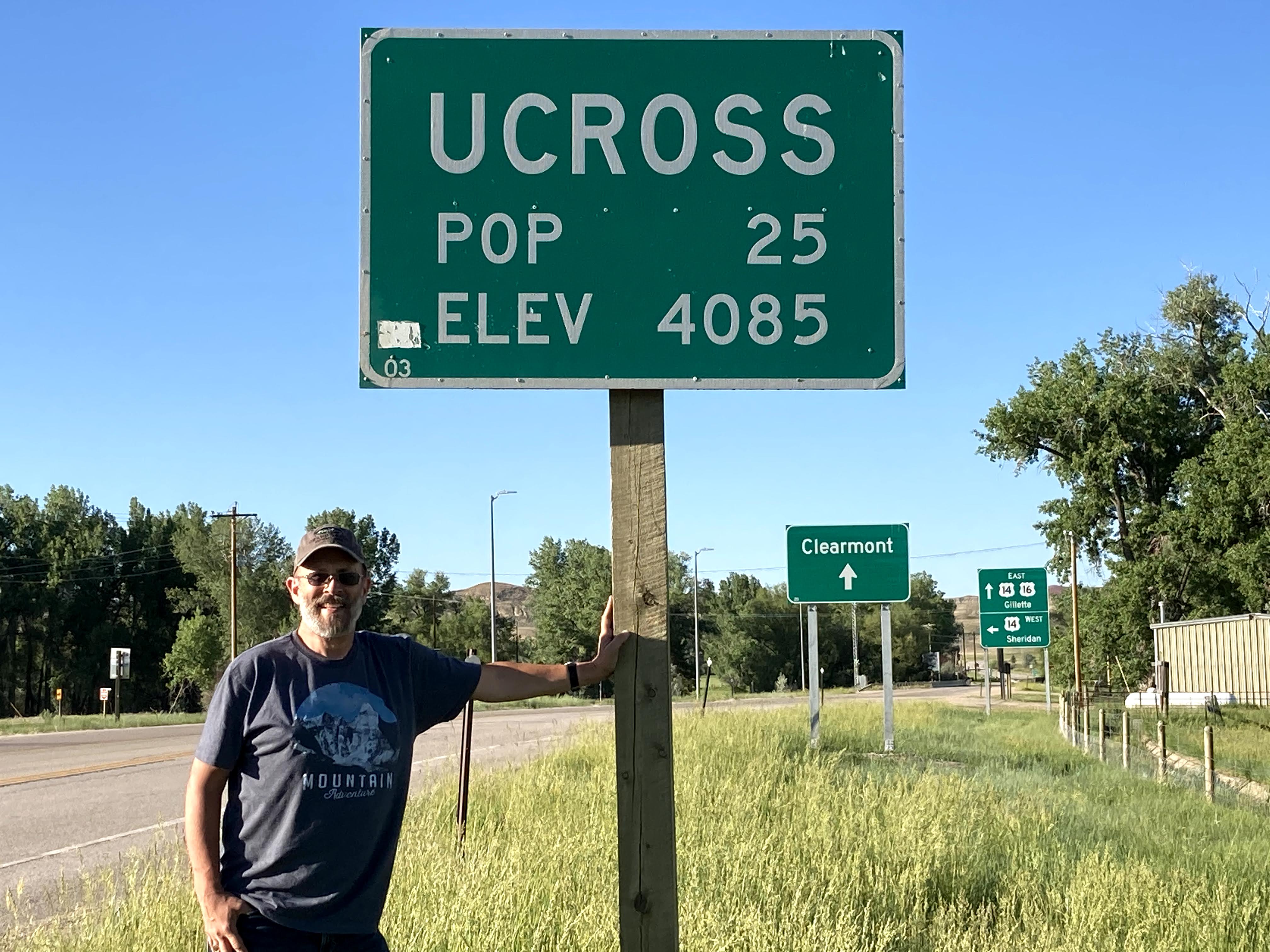
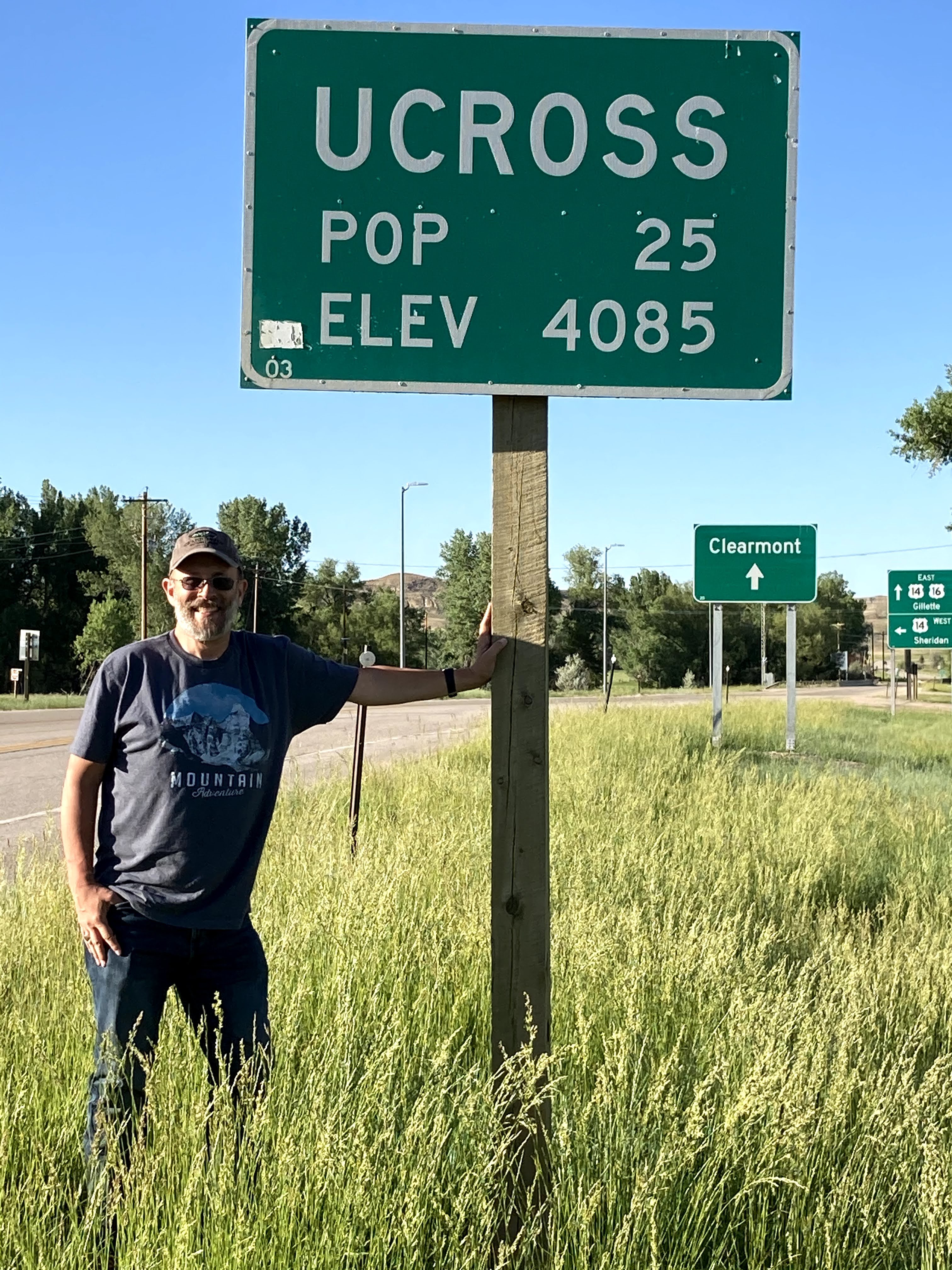
Yet the picture I was most excited to take was with the road sign for Ucross, Wyoming, population 25.  That is the home of author Craig Johnson, a fact of which he is so proud that he made it his Twitter handle, @ucrosspop25.

Now, before you start thinking this is all a bit much, I will have you know that thousands (no exaggeration) of people liked these pictures in the various Longmire fan groups on Facebook.  I would also point out that you probably own some apparel dedicated to your favorite sports figures or musicians, and this leads us back to the point of this post.  We like to enter into other stories.  It is part of the human nature.  Why do you think Homer's Iliad has been so popular for nearly three thousand years?  We thrill to the adventures of Achilles and Hector and if only for a short time are transported to places we can only imagine, gaining new perspectives on life as we go.

Thus ends the literary portion of this post, and thus begins the educational.  Teachers have an opportunity as no one else does to help young people enter into other stories.  In fact, although it may not be written in their job description, it is one of the most important things they do.  From Kindergarten through twelfth grade, a child's understanding is quite limited.  Children simply have not lived much life, yet they can grow far beyond the constraints of time and space through entering into the grand stories of history, science, literature, and the arts.  Their teachers, however, must be guides who have not lost their own love of entering into stories.  A dry, crabbed person is not a fit companion for adventure.

And as the educational section of this comes to a close, I invite those who are interested to consider a theological one as well.  God entered created the most dynamic, breathtaking, and adventurous of stories when He spoke reality into existence and formed us in His image.  He then entered that story in the person of Jesus Christ so that we could in turn enter more fully into His story, which is the story of life.  The story of God and His people is not one solely or even primarily of rules and regulations and spectacular punishments.  It is a story of shared life made possible by the death and resurrection of Jesus, Who entered the story of each and every person, whether someone accepts it or not.

What are the stories that have shaped you?  Which stories have you tried to enter and how?  I would love to hear from you in the comments!

Thursday, May 6, 2021

On Not Going Gentle

Authentic teaching is a vocation.  It is a calling.

George Steiner, Lessons of the Masters, 16


I have no idea how to express what I feel as I plan to leave the school where I have taught for nearly a quarter century, the vast majority of my thirty-year career.  There is no one I can ask to advise me on how to put these feelings into words.  I could sooner get an answer to Rodgers's and Hammerstein's seemingly whimsical question, "How do you hold a moonbeam in your hand?"  Then again, there is Pascal.  "Le coeur a ses raisons que la raison ne connaît point," (Pensées, 423/277).  "The heart has its reasons that reason knows not of."  And so, while Prufrock may have wondered whether to eat a peach, I will not inquire how to convey emotion verbally.  There is no Lucretian swerve powerful enough to combine the alphabetic atoms into prose or poetry worthy of the task.  Instead, let us consider why there should be such profound emotion connected with something as simple as retirement.

For thirty years I have taught Latin at either the middle school, high school, or undergraduate level.  The most recent twenty-three have been at North Central High School in Indianapolis, Indiana.  Brilliant colleagues with whom I conversed regularly about philosophy, art, language, science, world affairs, and politics made it a scholar's dream, yet it was the students, the insightful, intellectually curious, creative, and boundlessly energetic students who made this so much more than a mere job, and therein lies the first clue to why so much emotion has been caught up in my leaving.

"Authentic teaching is a vocation.  It is a calling."  This observation from George Steiner's Lessons of the Masters, which is perhaps my favorite sustained treatise on education, starts us in the right direction.  There are many forgeries in education, just as there are in any area of life.  The cheap knockoffs display the trappings of teaching but are driven by formulas and fads and are given value only by inept instruments of testing.  These are not our concern here.  Our interest is in authentic teaching, and of this Steiner goes on to say, "The teacher is aware of the magnitude and, if you will, mystery of his profession, of that which he has professed in an unspoken Hippocratic oath.  He has taken vows," (p. 17).

There is a religious cast to this, seen in words like "mystery," "oath," and "vows," and this is right.  Matters of faith and religion connect the human with the transcendent, and a teacher, no less than a priest, is a pontiff, which, as the Latin root pontifex reveals, is a bridge builder.  Teachers help to connect students with ideas, with others, with themselves, and at times even with what lies beyond it all.  How could a teacher not be aware of the magnitude of the profession, another word with religious undertones?  Such work is sacred work, and just as one does not loudly and vulgarly stampede from a cathedral, one does not simply walk away from the place and people with whom he has engaged in such work.

I was stunned at the beginning of my career, as I am now, that I am paid to do what I do, and although I certainly support higher salaries for teachers, there is something a bit odd about being paid at all.  Steiner asks, "How can vocation be put on a payroll?  How is it possible to price revelation?  Why have I been remunerated, given money, for what is my oxygen and raison d'être?  By what oversight or vulgarization should I have been paid to become what I am?" (p. 19).

Stay with this for a moment.  Yes, teachers must live and maintain a living, but when you consider the magnitude and mystery of what is really taking place when one teaches and another learns, does that truly seem something about which you can establish a monetary value?

Some will say that both Steiner and I are getting a bit above ourselves.  After all, what we call teaching covers some rather mundane things, like teaching a child the alphabet or basic math facts, but I would counter that the authentic teacher never merely teaches discrete pieces of knowledge.  As Steiner puts it, "The choice...is between 'life' and the disinterested...pursuit of pure thought," (p. 70).

Now we are getting somewhere.  This is all about life.  Education is a distinctly, indeed supremely, human endeavor.  It is a shared journey of discovery.  This is why Steiner can say that teaching is his "oxygen and raison d'être," as it has been mine.  These students and I, we are all fearfully and wonderfully made, and even in discussing the most simple or trivial of points, it is we, we human beings, who are doing the discussing.  I should confess here that I would have been a failure as an administrator.  Administrators are required by local statutes and state laws to evaluate teachers and students by criteria that, if not entirely meaningless, have less meaning for me.  Yes, of course, students must leave a class knowing certain things, but the true evaluation of what has taken place in that class, which is to say the measure of the value that comes out of it, is life.  Has what transpired, i.e. been breathed across, in the classroom given birth to or fostered the growth of life?  And how would one know if it had?  Ask yourself how you determine the life in anything.  You see signs of it.  In the life-bringing, life-giving classroom, you will find love, joy, happiness, curiosity, smiles, laughter, and the desire to discover and create.  Such things do not fit well in a spreadsheet, and once again we are back to the manual capture of moonbeams.

In the annals of those teachers who have breathed forth life in and with their students, we typically recall the great figures of history or a dear teacher of our own.  Rarely do we look to mythology and literature, and this is a sad consequence of how so much of our literature is taught today.  We mine it for rhetorical features and agendas and ignore the role that story has always played, to teach and to edify, to warn and to model.  Yet Steiner, for whom almost no literature was unfamiliar, finds the exemplary teacher in the centaur Chiron.  "Half beast, half man, Chiron embodies wisdom when it is energy, the natural order when it branches, in dangerous beauty, into the human.  He is the 'noble Pedagogue' par excellence.  His pupils form a constellation like no other:  Chiron has taught Orpheus, Jason and the Argonauts, Hercules, Asclepius, begetter of medicine.  He has borne the child Achilles on his back.  Chiron has educated 'for its glory a Heldenvolk,' 'a nation of heroes.'  What scholastic 'Magnificence' can be set beside the Centaur's?" (p. 72).

Have you ever thought of teaching as the natural order branching in dangerous beauty into the human?  Such a view sees teaching as far more than instructional strategies.  Once again we see life.  There it is in nature and branching, which, as opposed to mere static branches, suggests growth.

Steiner cites the following as a creed of 19th century French philosopher and teacher Jules Lagneau.  [T]he only thing which can be fruitful is a living instruction, a teaching by and of the entire soul, of the whole person, of life," (p. 105).

Given that, can you wonder that my departure from such a long period of teaching among a particular group of people should cause me sorrow?  Yet, it is time.  I am retiring from North Central High School.  Another will teach Latin here and, hopefully, strive to attain to some of the vision of teaching that Steiner describes.  That teacher will succeed in some areas and will fail in others, just as I have, but as Robert Browning reminds us, "a man's reach should exceed his grasp/Or what's a heaven for?"

Friday, December 18, 2020

Atomic Language


In her book Proust and The Squid: The Story and Science of the Reading Brain, Maryanne Wolf writes about the power of an alphabet.  In particular she focuses on the ancient Greek alphabet and observes, "Young Greek pupils were given an almost perfect alphabet with almost perfect rules of grapheme-phoneme correspondence.  As a result, these pupils could gain fluency in literacy far sooner than their Sumerian, Akkadian, or Egyptian counterparts." (p. 68)

Put another way, there is incredible power in an alphabet, which allows for unending combinations, as opposed to a pictographic language in which whole ideas are represented by images.  Even today, you can communicate with greater sophistication, greater depth, and greater novelty with a 26-letter alphabet than you can with a hundred emojis.

The Roman poet Lucretius noted this as well in his work De Rerum Natura, or On the Nature of Things, the first century B.C. didactic poem that explored the world of atoms.  In Book 2 we find the following.

quin etiam refert nostris in versibus ipsis
cum quibus et quali sint ordine quaeque locata;

namque eadem caelum mare terras flumina solem     1015
significant, eadem fruges arbusta animantis;
si non omnia sunt, at multo maxima pars est
consimilis; verum positura discrepitant res.
  (DRN 2.1013-1018)

Why, it even matters in our very own verses
With what and in what order the elements have been placed;
For the same letters indicate the sky, the sea, the lands, the rivers
The sun, and the same indicate grains, trees, and living things.
If not entirely, they are for the very most part very
Similar, but they distinguish things by their position.


Lucretius was pointing out the atomic nature of an alphabetic language, for just as atoms combine in endless arrangements to create new things, so the letters of a language function in a similar way.  If we combine three English letters we get "tap," if we combine them in a different order we get "apt," and if we rearrange them yet again we get "pat."

When I taught classes called Critical Thinking and Theory of Knowledge, my students would often discuss an episode of Star Trek: The Next Generation called "Darmok."  In that episode, Captain Picard interacts with a being whose people only speak in allegories that reference their own mytho-historical past.  One question that inevitably came up was how such a race could have engineered the space ships that they used.  It seemed that their allegory-based language was ill-suited to the kind of scientific specificity that could only be expressed through an infinitely flexible, alphabetic language.


Yes, we language teachers teach people how to speak and write in other languages and how to understand the written and spoken word.  Yet it is worth the pause every once in a while to marvel at the beauty, the power, and even the limitations of human languages, for with words we speak ideas into existence.


Monday, December 7, 2020

George Strait, Cicero, and Citing Your Sources

A friend of mine shared that an educator in her child's district had sent the following to parents as part of a district-wide communication.  "Reality is created by the mind.  We can change our reality by changing our mind."  This quotation was attributed to Plato.

My immediate reaction was that Plato could not have written that statement.  As I texted my friend, that statement is closer to what the pre-Socratic philosopher Protragoras said in his famous dictum, "Man is the measure of all things," which Plato utterly destroyed in his dialogue Theaetetus.  I added that according to his theory of forms laid out in Book 7 of Republic, Plato suggests that reality is not the physical objects around us, but rather transcendent forms accessible only to the mind.  This in no way suggests reality is subjective and created by the mind, as the quotation sent to the parents does, but rather the exact opposite.

All this reminds me of a scene from The West Wing (S04, E04) in which Deputy Chief of Staff Josh Lyman (Bradley Whitford) asks his assistant Donna Moss (Janel Maloney) to attend a self-help seminar hosted by someone who is advising their opponent in the upcoming presidential election.  The scene that follows depicts what happens when she returns to the office.

Not only does proper citation of sources matter so that others can follow the same research and so that we do not misattribute facts and quotations, but it matters because it usually indicates a broader, deeper acquaintance with primary sources and the bases of research.  Few people actually want the cheap, knock-off perfume or jewelry.  They want what is genuine, although many are happy to pass off their work as authentic when in fact it is a pale imitation.

The Roman orator Cicero (106-43 B.C.) was known to end sections of his speeches with certain rhythms.  One in particular followed the pattern DUM dum dum DUM dum, which was easily achieved by putting the present infinitive of the verb "to be" next to a 3rd person singular present passive subjunctive from a second conjugation verb.  Esse videatur was a common example, so common in fact that people who wanted to imitate Ciceronian style thought it was good enough just to tack that wording onto the ends of sentences.  Needless to say, DUM dum dum DUM dum does not an orator make.

The song that captures this best for me is George Strait's "The Real Thing," which is from his 2001 album The Road Less Traveled.  He sings of discovering rock and roll in the '50s and realizing there was more to music than just what he had heard on the radio.  As he sings in the chorus line, "I don't want you under my roof with your 86 proof watered down 'til it tastes like tea.  You're gonna pull my string, make it the real thing for me."


I couldn't agree more.  It is important to use and cite primary sources, to take the extra step to do the research, and to express your ideas, not with imitated eloquence, but with the force and beauty that can come for dealing with the real thing.


Wednesday, November 25, 2020

Any Road Out of Town

There's an old saying that if you don't know where you're going, any road out of town will do.  So it is when it comes to pedagogy.  For example, one Latin textbook series begins introducing war vocabulary in the first year to prepare students to read Caesar's De Bello Gallico in the second.  My favorite elementary Greek text introduces the vocabulary of Xenophon so students will be able to read his Anabasis.  


A friend shared with me a recent article, "Classical Schools Aren't Really Classical" by Jonathan Roberts that contrasts grammar-based methods of teaching Latin with comprehensible input.  It begins with a passage from Surprised By Joy by C.S. Lewis in which Lewis describes the thrill of being able to read extended passages of Homer's Iliad in Greek.  Roberts goes on to suggest that the human brain will come to understand a language without being taught explicitly to analyze its architecture as is common in the grammar-translation methods.

From there Roberts discusses the Classical education movement, inspired largely by an essay from Dorothy Sayers and put into practice by a growing number of Christian schools and homeschool communities.  He cites examples of why the grammar-translation method is hailed in such schools and then refutes the arguments for such pedagogy.

The title of his article is partly correct and partly incorrect.  It is true that ancient Roman children did not learn their own language, at least initially, through grammatical analysis.  St. Augustine famously talks about this in Book I of his Confessions.

cur ergo graecam etiam grammaticam oderam talia cantantem? nam et Homerus peritus texere tales fabellas et dulcissime vanus est, mihi tamen amarus erat puero. credo etiam graecis pueris Vergilius ita sit, cum eum sic discere coguntur ut ego illum. videlicet difficultas, difficultas omnino ediscendae linguae peregrinae, quasi felle aspergebat omnes suavitates graecas fabulosarum narrationum. nulla enim verba illa noveram, et saevis terroribus ac poenis ut nossem instabatur mihi vehementer. nam et latina aliquando infans utique nulla noveram, et tamen advertendo didici sine ullo metu atque cruciatu, inter etiam blandimenta nutricum et ioca adridentium et laetitias adludentium. didici vero illa sine poenali onere urgentium....

Why, therefore, did I hate Greek grammar singing also such things?  For Homer is skilled at weaving such tales and is sweetly entertaining, but to me as a boy he was bitter.  I believe Vergil is the same for Greek boys when they are forced to learn him in this way as I was Homer.  Indeed there is a difficulty, entirely the difficulty of learning a foreign language as if someone spread bitterness over all the Greek sweetness of those fabulous tales.  For when I was an infant, I knew no Latin, but nevertheless I learned it by paying attention and without any fear or punishment, among the coaxing of my nurses and the jokes of those who laughed with me and the happiness of those who played with me.  Truly, I learned it without the burdensome penalty of people forcing me....

Yet Augustine also makes it clear that a grammar-based approach was precisely what he had experienced when it came to learning Greek.  One could then argue both ways, that it is and that it is not Classical to teach with this pedagogy.

The question, of course, is not merely what did the ancients do, but what is best for our children.  Roberts cites arguments for the grammar-based approach that are easily refuted, as he indeed does, but there is more to consider here, and that is the question at the beginning of this post.  Where are you going?  Once you know that, you can pick the best road to travel.

If your goal is to read Homer and Vergil with the speed and facility with which you read a contemporary author, then comprehensible input will likely get you there more quickly.  If, however, your goal is something else, one Roberts does not consider, then the grammar-translation approach will serve you better.  This goal is developing an appreciation for beauty, in this case linguistic beauty, that will nourish the spirt and inspire further reading and study, whether in translation or in the original languages.  For more on this, see my article "Difficile est transferre hanc sententiam Latinam in Anglicam: The Depth and Charm of Latin Translation," The Classical Outlook, Volume 84, Number 1, Fall 2006.

Consider now the tale of two students.  One completes a four year high school program in Latin using the grammar-translation method, and the other does the same but with comprehensible input.  They both then pursue an undergraduate degree in Classics.  At the end of eight years of study, they will be indistinguishable.  They will both be able to read fluently and to appreciate the nuances of composition that make the works of Homer and Vergil true works of art.

Yet how many will pursue those additional four years of an undergraduate degree in Classics?  Most high school Latin students will not, and at the end of their high school careers, our two hypothetical students could not look more different.  The one, presumably, would have a deep appreciation for, in Poe's words, "the glory that was Greece and the grandeur that was Rome" as expressed in Classical literature.  The other would have the skill and pleasure of reading that literature with ease and rapidity.

"Knowing how way leads on to way," to quote Frost, I doubt that many of those who can read Classical languages fluently at eighteen will continue to do so.  Notice that I said I doubt many will do so.  Some may, but most, I imagine, will not.  On the other hand, I have had a great number of my former students continue their Classical interest and studies, whether through an undergraduate minor, additional Classics courses, or merely personal reading, and they have all experienced the grammar-based instruction of my classroom.  Notice again that I did not say all of my students have done this.  At the end of the day, however, I still champion and use the grammar-translation approach, not for the rigor of analysis it supposedly instills in students comparable to the study of geometry or physics, and certainly not for linguistic gains in word study and derivatives.  I use it it for the following reasons.

First, it quickly gets students into the language.  Second, it allows them to explore more deeply the beauties and intricacies of truly great authors.  Third, our English discussions allow us to go deeper and more quickly into the heart of the works themselves.  Fourth and finally, thirty years of teaching have shown that students who are exposed to this particular pedagogy have multiple roads to take toward whichever destination they choose, whether it be fluency, enjoyment, further study, or anything else to which they have been inspired.  Since giving my students multiple options is where I want to go, the grammar-translation road is the one I choose.

Sunday, October 18, 2020

My Friend, Yosef Cohen


"God don't make them any better.  And that's a fact."  So said Brigadier General Lewis Armistead of Major General Winfield Hancock in the film Gettysburg.  Of all the words in all the literature I have read, these are the ones that come to mind upon the passing of my friend, Yosef Cohen.  They come to mind quickly in association with him, for I have said them often over the years when speaking of him to others.

In 2012, Yosef, or Yossi as so many knew him, was honored by the Bureau of Jewish Education.  If you consider yourself my friend, take fewer than five minutes to watch this video about him on the occasion of that most deserved recognition.

In that video you get a sense of who he was as an educator, and but as his colleague who for many years taught in the room next to his at North Central High School in Indianapolis, I was blessed by something more, but let us start with educator.

As a teacher of Latin and occasionally Greek, I sometimes had questions about Hebrew, for that ancient language so often was intertwined with those of my discipline, Classics.  The moment I even began to ask him a question, Yosef would suggest that we meet over lunch.  We each brought out our lexicons, and the richest, headiest of conversations would begin, allowing me in a small way to count myself as one of his students.

He was also my interlocutor on matters of politics, the economy, education, world issues, and history.  Our conversations during passing periods made me want to be late for my own classes so the discussions with Yosef could continue.  He thought deeply and broadly, and this allowed him to bring civility to our conversations the like of which many would think was no longer possible.  With his passing, it very well may not be.

He played a paternal role for me as well, often pointing to his grey hair and my lack of it, perhaps being willfully blind to the increasing salt in the pepper of my beard.  He cared for my wife and my children, asking about them after we returned from every school break and especially after summer vacation, and was genuinely concerned about my future.  His advice was always sage, and it always, always aligned exactly with whatever my wife would say.  I sometimes wondered if they talked behind my back so their counsel would agree.

His humor was legendary, and I rarely took my leave of him without hearing a new joke from his seemingly endless treasury.  He lightened our department meetings with that humor and reminded us all that as important as teaching was, the business of schooling...well, not so much.

Children often have their heroes, real or imagined, that they delight in imitating, but it is rare for an adult to have, or at least to admit to having, such a model.  My wife can testify that I have said many times over the years that I would like to be more like Yosef Cohen when I grow up, and in this I know I am far from alone.

Tuesday, October 13, 2020

Making a Teacher Cry

Any number of things can make me cry while teaching, although I try to hide it the best I can.  More often than not, it is the depth of insight from one of my students that so unsettles me.  It is rather like snapping one's head to look at brilliant work of art or to hear a bit of sublime music while walking through the humdrum of the day, lost in a sea of less important details.  This time it happened during the last period of the day.

It was my A.P. Latin class, and before you make assumptions about my students or our school, you should know that ours is a large, midwestern, public high school with an enrollment between three and four thousand students.  This particular class is evenly split between boys and girls and is ethnically diverse.  As you read the rest of this story, I don't want you to assume it is set in an ivory tower.

Class started with us talking about accents, what connotations are associated with them and whether those same connotations exist for all people.  Do the flowing vowel sounds of Italian or the sharp consonants of German produce the same effects in you as they do in me?  Do they conjure the same feelings in other non-Italian- or non-German-speaking people as they do in many English speakers?

We are still in all-virtual instruction, and one of the benefits of Zoom is the private chat function.  Not a day passes when at least one student in nearly every class messages me privately a question or comment that I can then address with the whole class without revealing that student's name.  It is a help like no other for quiet students and those who like to process more deeply before they speak.

In this particular A.P. Latin class during the last period of the day, one of my students texted the following in response to our discussion about accents.  "The best way to tell the beauty of an accent is if it enthralls you, even if you don't understand a word."  This time I did a horrible job of hiding my tears.  When I shared the comment aloud, others in class commented that we had a true wordsmith or even a Shakespeare among us.  

Just as I had no time to ponder the depth of that comment or the beauty of its expression in the moment, I will leave you no time to do so, but will move on to what happened next.  As you read, let these powerful moments build up and wash over you.  Quick warning, however.  This next part gets a bit deep, but hang in there.

From there, we dove into our text, starting at Aeneid I.561.  As we read the line "Tum breviter Dido vultum demissa profatur," I had to stop to share with them something that had occurred earlier in the day during Latin III.  That class had been reading Sallust's Bellum Catilinae and were at the part where Catiline, the infamous conspirator of the late first century B.C., prepared to address the senate demisso voltu.  Even people without Latin can pick out the two similar phrases, vultum demissa in Vergil and demisso voltu in Sallust.  I pointed that both expressions contain the same words and mean the same thing, "with a downcast expression," but that they used different grammatical structures.  Vergil opted for a purely adjectival function of the participle demissa and an accusative form of vultum expressing respect.  She was literally downcast with respect to her face.  Sallust, on the other hand, had put both words in the ablative case, using an incredibly common construction known as the ablative absolute.

One of my students asked what, if anything, was being conveyed by Vergil's grammatical choice, and I pointed out that it was in clear imitation of Greek, for Greek likes to use the accusative of respect.  My student pressed on to ask why he would do that, and this led us to a brief discussion of the King James translation of the Bible.  One of the notable features of that translation, itself drawing heavily on previous English versions, was its casting into English certain Hebraisms.  For example, where English might more readily say, "God's son," the King James translators used "son of God," for the pattern "X of Y" is common in Hebrew.  In a similar way, I explained, Vergil clearly imitated Homer without slavishly aping him, and this connected his new epic with the Homeric works from a millennium prior.

Still without time to pause, I had to end that session with my Latin IV students and switch over to a breakout room in Zoom where my Latin V students deciding what they wanted to study next.  Latin V at our school provides a rare opportunity for students to explore topics of interest, and as we were starting a new quarter, it was time to see where they wanted to go.  One student began by saying she had been reading recently about rhetorical and logical fallacies.  I nearly stumbled going to the board to write her ideas and asked if she were reading such things for a class.  She said she was not, but had been inspired by other classes to look into the topics.  She thought she might want to pursue something with logic, rhetoric, or philosophy in her next Latin V project.  Another said she wanted to revisit some medieval studies we had pursued in Latin III, and another talked of pursuing medical topics, including mental health issues and quality of life for women in ancient Rome.

Now you can pause to consider what you have just read.  These are utterly extraordinary, ordinary students.  They are perfectly ordinary in that they, like the rest of their peers, follow fashion trends and enjoy popular entertainment.  They care about their friends and about what people think of them.  They are simultaneously excited and apprehensive about college, and they love to goof around.  Yet they are extraordinary in the depth of their curiosity and willingness to pursue it.  Because they are ordinary, however, I would argue that what makes them extraordinary could well be experienced by many more their age.  Depth, breadth, curiosity, eloquence...these are not the things of the rare few, but are the gems common to the human treasury, and when my students hold them up to the light, the sparkle quite often brings a tear to my eyes.

Monday, September 21, 2020

Words That Take You Back


On a short break between classes, I wandered over to one of the book cases in my classroom and pulled off the Loeb edition of Plato's Republic.  As I scanned the opening words,  

I went down yesterday to Piraeus with Glaucon, the son of Ariston...

I was transported to another time and place.  No, it was not to ancient Athens or the port of Piraeus, but to high school during my senior year.  Before getting to that, however, I should note that it was the word "Piraeus" itself that did the trick, or rather, my sudden remembrance that the word "Piraeus" was coming up.

In the last quarter of the school year in Latin II, I have for a long time taught a unit on ancient Greek language and culture that includes readings from Plato's Republic and another of his dialogues, Theaetetus.  It had been longer than I realized and nearly longer than I could remember since I had last read Republic from the beginning, and so it was that as the first words started to form in brain as my eyes picked them from the page that I realized one of the upcoming words would be "Piraeus," which is the port city for Athens.  Suddenly there rushed upon my memory the image of Socrates, the main character in the dialogue, and his friend Glaucon walking toward the city, but it was the image that the English translation by Jowett had first formed in my mind when I was in high school.

My senior English teacher, John Richardson, had brought Plato up in class, and I must have been intrigued enough to want to read the philosopher for myself.  I remember the thrill of finding the Modern Library edition with the classic translation by Benjamin Jowett at Hawley-Cooke Booksellers across the Ohio River in Louisville, Kentucky.  That copy resides in my classroom even now.


This slender volume was my introduction to philosophy and reading the great works on my own.  We had not been assigned to read it, but I was interested and gave it a whirl.  There I was, sitting in the living room of my home in southern Indiana, reading Plato, and it was a heady experience indeed.  It was also above me in many places, and I cannot say I made it all the way through to the end.  Yet it pierced me with an arrow of passion for philosophy that has continued to burn.

Jowett himself had this to say about the importance of translation in his own English rendering of Thucydides.  It is a necessary thing, he argued, in order "once more [to] present that old life, with its great ideas and great actions, its creations in politics and in art, like the distant remembrance of youth, before the delighted eyes of mankind."

It was that distant remembrance of youth that came flooding back to my mind today as I recalled Jowett's Republic, let loose by recalling one word, Piraeus.  What words take you back to another time and place?  What whole works serve you that way?  When they evoke distant memories, they can usher a very bright spot into your day indeed.