Showing posts with label Rocky Balboa. Show all posts

Monday, January 6, 2025

Like Rocky and Neo

I blogged very little in 2024 in part because I was working on the publication of my latest book, The Golden Waffle Principle:  Finding Meaning In Teaching.  Now that it is set to come out later this month (see my website for more information), I look forward to blogging on a more regular basis. 


In 2006, Rocky Balboa came out of retirement.  After sixteen years since the previous film in the Rocky franchise, Sylvester Stallone explored the challenges facing an aging athlete who wanted to see whether he still had what it took to go the distance.  Seven years before Rocky climbed back into the ring, a computer programmer who thought his name was Thomas Anderson discovered that he was actually Neo, The One long awaited to free captive minds from The Matrix.  Taken together, both of these films, along with a poem from 1842 based on an event from Roman antiquity, have something to tell us about facing the challenges of daily life.


Getting Hit


In Rocky Balboa, the sixth film of the award-winning boxing franchise, the former heavyweight champ talks straight with his son, now a young businessman.

Rocky:  [W]hen things got hard, you started looking for something to blame, like a big shadow.  Let me tell you something you already know.  The world ain't all sunshine and rainbows.  It's a very mean and nasty place, and I don't care how tough you are, it will beat you to your knees and keep you there permanently if you let it.  You, me, or nobody is gonna hit as hard as life.  But it ain't how hard you hit.  It's about how hard you can get hit, and keep moving forward.  How much can you take and keep moving forward.  That's how winning is done!  But you gotta be willing to take the hits, and not pointing fingers, saying you ain't where you wanna be because of him or her or anybody!  Cowards do that, and that ain't you!  You're better than that!


We all know this, but, like Rocky's son, we need to be reminded from time to time, yet that is not the point of this post.  I want to look at the kinds of punches life throws.  There are times when it seems as if life is trying to take us out with one knockout punch, perhaps through a devastating loss or a betrayal or catastrophic news.  More often, however, we seem to be the victim of a rain of body blows, those jabs to the torso that do not K.O. boxers, but that weaken them to the point they cannot continue.  But if a boxing metaphor is not to your taste, consider a hailstorm of bullets.


Neo Against the Agents


In the philosophical/theological/sci-fi film The Matrix, Thomas Anderson (Keanu Reeves) is the target of malevolent programs personified as Agents.  After one of them kills him, a character named Trinity (Carrie-Anne Moss) expresses to him her love, by which he is resurrected as Neo, the savior for whom many have been waiting.  Multiple Agents then discharge their weapons toward him, but now he merely looks curiously at the bullets as they freeze in the air and then fall to the ground.  When his chief nemesis Agent Smith rushes to attack him, Neo fights him almost casually, more fascinated by watching his own hands move than by any threat from Smith.


I want to be like Neo.  When I think about the hits that life dishes out, they seem to me more like body blows than a singular, knockout punch.  They are the small bullets of annoyance and frustration and burden rather than a nuclear bomb of devastating power.  Yet how does one do what Neo did?  How does one face enemies with strength rather than with stress?  In his case, it came from knowing who he truly was.  Once the love of Trinity restored him to life, and the biblical parallel here is unmistakable, his clear and grounded identity as The One allowed him to see threats for what they really were, and when it came to their source, Agent Smith, he did not so much as deign to look at him.


Ignoring the Craven Ranks


In 1842 Thomas Babington Macaulay published a book of poems titled Lays of Ancient Rome, the most famous of which is "Horatius."  It tells in rousing verse the story of Horatius Cocles, the Roman hero who, with two friends, defended the bridge into Rome against an invading army in the late 6th century B.C.  As the three warriors hold the far side, those on the Roman end work to hew down the bridge, and as it totters above the boiling tide, two of them run back before the boards crash into the waves.  The invading king invites Horatius to surrender, for he is now trapped on the bank with no way back to Rome.  Horatius, however, as with Neo, pays his enemy no regard.  In the words of Macaulay,

Round turned he, as not deigning
    Those craven ranks to see,

and dove into the river, still wearing his armor and bleeding from the fight, and swam across to the cheering welcome of his countrymen.

Horatius, Bernardo Strozzi (1581-1644)

I, for one, want to do just that.  I want to turn round and not so much as deign to look upon the craven ranks of stress, anxiety, worry, fear, pressure, and all the pretended fierceness of the things that would distract me from that to which God calls me each day.  This is only possible when I operate from an unshakably grounded knowledge that I am a friend of Jesus Christ and along with Him a beloved child of God.  It was in His unshakable identity as the Son of God, which had just been proclaimed for all to hear, that Jesus with cool strength and disregard for His enemy stood against Satan in the desert.

In one of the most stirring parts of the poem "Horatius," the titular hero calls out to his fellow Romans,

Now who will stand on either hand,
    And keep the bridge with me?

As we enter the new year, I want to stand in the strength of my identity in Christ against all the attacks of life.  Jesus Himself shows it can be done, and we have such rousing examples in our literature and dramatic tales.  Will you be one of those to stand with me?

Tuesday, March 21, 2023

Pomodoro, Jesus, and Rocky


How on earth could a timer that looks like a tomato, Jesus Christ, and the fictional southpaw boxer from Philadelphia named Rocky Balboa find their way into the same blog post?  A recent professional development session at my school had me pondering this very thing.


The Pomodoro Technique


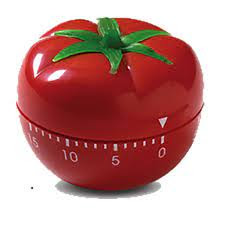
The Pomodoro Technique is a strategy for time management that has been around since the 1980s.  The basic idea is that you set a timer, which may or may not be in the shape of a pomodoro (Italian for "tomato"), work on your task for that amount of time, take a break, and then set the timer again for your next task.


This is a great strategy and one that the learning coach at our school, Jeff Buckner, presented to us during one of our faculty Teaching & Learning sessions.  Many of our students struggle with time management, and this is an easy strategy for them to implement.  Of course, this isn't just for students, and as I began thinking about how this could play out in my own life, my thoughts turned to Jesus and Rocky Balboa.


Our Favorite Characters


Ezra Pound recalled the following anecdote, apparently a favorite of William Butler Yeats.

"A plain sailor man took a notion to study Latin, and his teacher tried him with Virgil; after many leassons he asked him something about the hero.

"Said the sailor:  'What hero?'

"Said the teacher:  'What hero, why, Aeneas, the hero.'

"Said the sailor:  'Ach, a hero, him a hero?  Bigob, I t'ought he was a priest.'"  (Homer:  A Collection of Critical Essays, ed. George Steiner and Robert Fagles, 1962, pp. 17-18)

This anecdote well expresses the reaction many people have had to the characters of Achilles in the Iliad and Aeneas in the Aeneid.  If you prefer your heroes to be sword-wielding, spear-throwing warriors, the kind that yell out that their commander is a "bloated drunk with a dog's eyes and a rabbit's heart" and fight a river...yes, a river...then Achilles is your guy.  If, on the other hand, you want your hero to be the kind of person who suppresses his own feelings of pain as he inspires his troops and will do whatever it takes to fulfill his duty to gods, country, and family, then you want Aeneas.

For years, I was an Achilles kind of guy, and for that reason I did not enjoy all that much teaching Vergil's Aeneid.  At some point that changed, but I still gravitate to characters that leave it all out on the field, even if doing so does not lead to victory.  In addition to Achilles, I absolute love Diomedes in Book 5 of the Iliad.

Thus toiled the chiefs, in different parts engaged,
In every quarter fierce Tydides raged,
Amid the Greek, amid the Trojan train,
Rapt through the ranks, he thunders o'er the plain;
Now here, now there, he darts from place to place,
Pours on the rear, or lightens in their face.
Thus from high hills the torrents swift and strong
Deluge whole fields, and sweep the trees along;
Through ruined moles the rushing wave resounds,
O'erwhelms the bridge, and bursts the lofty bounds;
The yellow harvests of the ripened year,
And flatted vineyards, one sad waste appear,
While Jove descends in sluicy sheets of rain,
And all the labours of mankind are vain.
So raged Tydides, boundless in his ire,
Drove armies back, and made all Troy retire.  (Iliad 5.110-125, Alexander Pope translation)

I love Rocky Balboa, giving it all, even when he loses to Apollo Creed in the first movie, and my favorite opponent of his is probably Clubber Lang, whose grit and determination, even though he loses, are simply brutal.  Yet I sometimes wonder.  Are these the models that should inspire me the most?


Front-running


Prefontaine and Bowerman


In the 1998 film Without Limits, University of Oregon track coach Bill Bowerman (Donald Sutherland) is having a planning session with long-distance phenom Steve Prefontaine (Billy Crudup), who does not agree with his coach's philosophy of running.  After stating flatly that running any other way than all out and leading for the entire race is little more than the excrement of chickens, Pre explains.

Pre:  What else do you call laying back for two and a half miles then stealing a race in the last two hundred yards?
Bowerman:  Winning!

There is a great part of me that thinks as Steve Prefontaine did.  I am a highly driven person, and like Achilles or Diomedes or Rocky or Pre, I want to hit hard and give it my all.  And then there's Jesus.


Pomodoro Paul?


Jesus took time away from the demands of ministry to pray.  He got up early and separated Himself from the hustle and bustle of life to spend time with His Father.  He was never in a hurry and even stopped to address the needs of an unknown woman who had suffered from bleeding for twelve years while on His way to heal the son of the synagogue leader.  He famously taught His friend Martha not to be stressed out over things of lesser importance and to focus on what truly mattered.  And despite His seemingly slow and deliberate pace, He accomplished all He was sent to do.

What, then, is my takeaway from the Teaching and Learning session at our school?  I know myself well enough to acknowledge that I am wired for action.  I will probably still declare those lines about Diomedes translated by Pope when I am in my golden years and with as much thrill and excitement as I read them today.  Yet I want to reach that time and fulfill all that God has called me to do, and therefore it's not so much the action-adventure heroes that are my models for how to live, however much I may enjoy reading and watching their exploits, but Paul.  Paul was a hard-driven sort of person, shown first in his zeal for his faith searching out Christians to have them punished.  Yet once his life was transformed by his encounter with Jesus on the road to Damascus, he approached life a bit differently.  Still passionate, although for a different mission, he would say go on to say, "I press on toward the goal for the prize of the upward call of God in Christ Jesus."  (Philippians 3:14, ESV)

Passion and drive are good, but they must be balanced with rest and restoration.  Fulfilling the call of God is more important than the thrill of any high adventure moment along the way.  I imagine that if tomato-shaped timers had existed in his day, Paul might have found value in the Pomodoro Technique.