Thursday, October 21, 2021

Contagious Faith


I am always looking for ways to connect people with other people, with ideas, with opportunities, with experiences, and most importantly with Jesus, and for this reason I had been excited for many months about my friend Mark Mittelberg's new book Contagious Faith.  Mark is a best-selling author and speaker who has spent his life doing two things, helping people come to salvation through Jesus and equipping people to help their friends and family do the same.  He is also the executive director for the Lee Strobel Center for Evangelism and Applied Apologetics at Colorado Christian University, so it is safe to say that when he writes a book whose subtitle is Discover Your Natural Style for Sharing Jesus with Others, he knows what he is talking about.

I have been devouring this book about as fast as I can, which at times is not all that quickly since I am highlighting, making margin notes, and tweeting key lines.  In this post I will offer both a standard book review so you know what you are getting and a look at why this book needs to be in every church's bookstore, on every pastor's bookshelf, and in every Christian's arsenal for doing what God has called them to do.  To wrap it up, you will find a very personal reason why I am excited about all this.

The Review

The book is very well structured. After a foreward by Lee Strobel and two chapters that set out the why of evangelism, it moves into five "contagious faith styles," or approaches to personal evangelism.  Each style gets its own chapter that describes the style for sharing your faith, gives a biblical example to show how this style has been used, and backs that up with some personal stories from modern people.  It then gives practical tips related to that style that are useful for anyone, whether or not that particular style connects with you, and importantly offers some cautions about that style if it is pushed too far.  Too many books only present the positives of the author’s ideas, but Mittelberg is quick to show the pitfalls of each style so that they can be avoided.

Mittelberg identifies five styles for sharing your faith that he calls Friendship-Building, Selfless-Serving, Story-Sharing, Reason-Giving, and Truth-Telling.  I highlighted multiple passages in each style, even though the style that came back from my self assessment on the book's website was the Reason-Giving style.  In particular, I found myself enthusiastically highlighting, underlining, and writing "YES" with multiple exclamation marks in the Truth-Telling chapter.

The book then includes four chapters that go quite deep.  One discusses what the gospel actually is, and if you think you think it can be boiled down to just a quick prayer for salvation, think again.  Another explores what to do when your natural style doesn't seem to fit the situation, one explores the truly adventurous nature of sharing the good news of Jesus, and the final chapter takes a look at the evangelism explosion around the world and how your legacy can be caught up in it.

And if this were not enough, the book contains an exhaustive list of resources at the end, which in itself would be worth the price of the book.

The Why

Obviously, I am a fan of Contagious Faith, and although I would have loved to explore in depth each chapter, it is better that you just buy the book for yourself and jump in...unless, of course, you are not persuaded the idea of personal or lifestyle evangelism is all that important in the first place.  Let's be clear.  Mark Mittelberg has not paid me to write what you are about to read.  This is my own stance.  If you have a beef with it, take it up with me.

Church leaders, what could be more important than equipping our people to share the good news of Jesus Christ?  Addressing issues of sin and brokenness are important, as are the many acts of service that local churches provide, but nothing...nothing...is more important than someone's relationship with God, and if a person does not know Him or has chosen to reject His grace, that person's relationship will be defined by an eternity of separation from the living, loving God of the universe.  There's a name for that, by the way.  It's called hell.  Pastors, elders, youth leaders, Sunday school teachers, deacons, bishops, and choir directors...either you believe this or you don't.  If you don't, then I would suggest finding another line of work or at least stop using the word "Christian" on your business card.  If you do, then you understand what I'm saying and it will either encourage you in your evangelistic training efforts or it will light the fire that helps you start them.

And this leads us to Christians who would not consider themselves part of that list above.  These are the children and teens, moms and dads, grandmas and grandpas who fill our churches, worship faithfully, and try to live good lives, but who would never in a million years consider themselves evangelists.  Here's the thing.  Christians have understood since the time of Jesus that it was incumbent upon us to share the gospel.  From the beginning we have understood that Matthew 28:18-20 was speaking to all of us.

And Jesus came and said to them, "All authority in heaven and on earth has been given to me.  Go therefore and make disciples of all nations, baptizing them in the the name of the Father and of the Son and of the Holy Spirit, teaching them to observe all that I have commanded you.  And behold I am with you always, to the end of the age."  (ESV)

As Mittelberg makes clear, it is not enough just to be a nice person and hope people can guess what is going on and accept Jesus as their Lord.  How do we know?  The last chapter of the book talks about the flourishing of evangelism and the increasing numbers of people around the world who are turning to Jesus.  What is conspicuous by its absence is mention of the United States.  Do you really need me to link data that show a decline in our country of those who follow Jesus?  I could, of course, such as here, here, and here, but just look at your news and social media feeds.  Listen to the conversations you have with co-workers, friends, and family.  Those will make more than a sufficiently compelling case for evangelism.

We must help our children and teens, moms and dads, grandmas and grandpas, indeed everyone in our churches and Christian communities, know how to share the good news of God through Jesus Christ.  Mark Mittelberg's Contagious Faith is an excellent resource in this most important of works.

Mark, my son Austin, and me

The Personal Part

Part of my own journey with Jesus can be found starting on p. 239 of another of Mark Mittelberg's books, The Unexpected Adventure, which he co-authored with Lee Strobel.  It was Wednesday, August 9, 2000.  The pastor of our church and I had gone to a conference where Mark was speaking, and in his morning session on relational evangelism, he made frequent reference to the clear point at which a person came to saving faith in Jesus.  I had grown up in the church, had been baptized the summer before I turned 13, and had an active prayer and devotional life.  Jesus was always part of my life, so I could not put my finger on a specific, transitional moment in my life, a Damascene conversion, if you will.  The church we attended at the time did not speak of such things, either, but I was interested in helping our congregation develop evangelistically, so this seemed like something I should understand better.

At the mid-morning break, I stood in line to ask Mark about it, but when my turn came, I found the words coming out haltingly, and as he spoke, tears unexpectedly filled my eyes.  Mark knew something was up, and since the break was nearly over, asked if I wanted to grab lunch at the conclusion of the session.  I nodded and headed off to the men's room to compose myself.  Alone in that church's restroom, I heard the nearly audible voice of Jesus saying that after that day, I would never need to doubt my relationship with Him again.  I could hardly wait for lunch, and it wasn't from hunger!

We hopped into Mark's car as soon as the session was over and drove to a nearby deli.  There, in the parking lot, Mark unpacked the gospel.  It was not that I had never heard it before, but I needed to make it my own.  We prayed, I accepted Jesus as my Lord and Savior, and we grabbed lunch.  Something transpired in those moments that is best captured in Mark's telling of it in The Unexpected Adventure.

He [Steve] told me later that as I spoke, he kept praying, "Yes, Lord Jesus."  He said that "suddenly the word Lord took on a whole new meaning.  It was as if the four letters of that word radiated with red and blue and gold colors.  I kept saying, 'LORD Jesus -- just those two words, over and over.  I finally understood the word Lord and I laughed and cried."  (p. 242)

Mark did not miss an opportunity.  Yes, he was leading a conference session and needed to keep his mind on his presentation, but he was prepared for a divine appointment that day and met it.  I hope you read this latest book of his, Contagious Faith.  Perhaps there is someone just waiting to experience the Lordship of Jesus Christ because of a conversation with YOU!


Monday, September 27, 2021

We Don't Always Need To Teach


Edith Hamilton

"In Greece there are most lovely wild flowers.  They would be beautiful anywhere, but Greece is not a rich and fertile country of wide meadows and fruitful fields where flowers seem at home.  It is a land of rocky ways and stony hills and rugged mountains, and in such places the exquisite vivid bloom of wild flowers comes as a startling surprise."  (Mythology, Edith Hamilton, p. 111)

This is the passage that a high school junior who is the student of a friend of mine chose for a typical read-and-respond assignment.  What that student wrote regarding this quotation forms a powerful reminder, or perhaps a startlingly new idea, that all teachers would do well to bear in mind.

 "I personally enjoyed this quote because it was so vivid in details that I could visualize what was being described.  This quote struck me because it was not about something that could be taught or learned and applied to one's life.  It is simply a quote describing details of Greece.  I think it is important to also recognize quotes or passages like this one because sometimes in life we need the simpler things rather than always looking at quotes that are about how we should live our lives, passages that teach.  Yes, teaching and guidance quotes and passages are good but so are the descriptive ones, the ones that transport us into a space in our minds that is purely creative and imaginative.  Quotes like this one ...make whatever the reader is reading far more interesting because quotes like this allow that reader to imagine what ancient Greece or any other place from the past would have been like.  This may be a simple quote, but I see something deeper in this quote that is very important....  It brings out the creative and imaginative side of literature."

We sometimes think of lyric poetry in classical literature as being that which does not advance the plot.  It is personal and emotional.  It sets up mood and atmosphere and evokes feelings.  When, for example, the Roman poet Catullus in Carmen 5 asks of his beloved, "Give me a thousand kisses and then a hundred more/And then another thousand and a hundred like before/Then add another thousand and a hundred to the score," he could have more simply said, "Give me 3,300 kisses."  Yet, as Howard Nemerov so elegantly put it, there is a line between prose and poetry.  It is as indiscernible as the moment of transition from rain to snow, but it exists and it is the realm of lyric, and to be honest, would you not much rather have your lover propose passion in the lyrical way of Catullus than with a prosaic mathematical sum?

And this brings us back to what this high school student observed and that teachers should remember.  Education is not always about teaching and learning facts.  It is not always about producing something with those learned facts, whether on a test or through a project or presentation.  It is not, as it were, always about advancing the plot.  There is a necessarily lyrical aspect to education as well.

We seem to have lost sight of this, and there can be no more unfortunate or compelling proof than in the numbers of students who have told me over the years that they have lost their love of reading because of their English classes.  I enjoy spotting a Greco-Roman reference in literature as much as the next person and find a well crafted tricolon crescens an absolute delight, but no one looks at a Monet merely to count the brush strokes.  How often do we make a reading, especially in English or world language classes, merely a mining expedition for figures of speech, historical factoids, or salutary aphorisms?  Do we ever with our students simply read a poem, listen to a piece of music, or observe a work of nature or art and then do nothing more?

I can hear the objections rising even in my own mind as the presumed need for assessments and productivity claims the honor of precedence that we have yielded to it.  My colleague's student, however, was right.  In addition to all the pragmatic facets of education and the demonstrable proofs of their having been mastered, we need as well those facets that "transport us into a space in our minds that is purely creative and imaginative."  I hope to remember this as I plan future explorations for my own students into "the glories that were Greece and the grandeur that was Rome."


Wednesday, September 15, 2021

Collaboration and Communication


At a recent professional development meeting at our school, we talked about the importance of collaboration and communication among students.  It was one of those PD sessions that prompted me to think more after the meeting, and I began to realize why collaboration and communication are not just important but vital to students and what the prerequisites are for them to work well.

Christians know that God is eternally existent in three persons.  He is Father, Son, and Holy Spirit...three persons, one God.  It is one of the delightful mysteries of our faith.  This truth reveals, as has often been said, that community is at the heart of God, and since we were created in His image, it stands to reason that collaboration, a word whose Latin roots literally mean "to work together," should be part of our nature.  We were created for collaboration with God Himself and with others.

We also should expect to be highly communicative creatures, for, as we read in the first chapter of Genesis, God spoke reality into existence, and in the first chapter of the Gospel of John, we read, "In the beginning was the word."  Think about it.  The God in Whose image we are made spoke, and subatomic particles began to exist.  He uttered a word and the number 17 came into being, to say nothing of planets and rabbits and gravity and us.  Our God is a supremely communicative being, and as creatures made in His image, so are we.

Collaboration and communication, while natural to humans, must also be developed, just as our abilities to run and jump, paint and do math, and all other things must be, and just as we would no more expect a person who had never touched a football to show up for practice and run a complex offense, so we should not expect to shape high school students into master collaborators and communicators without some foundation having been laid.

When it comes to collaboration, docility is a key requirement.  Unfortunately, too many people think docility refers to a nearly catatonic state.  Again, the Latin root helps us here by showing that docility simply means the quality of being able to be taught, and folded into that quality are the abilities to respect others, to listen, and to exhibit self control.  Students who lack these abilities cannot suddenly be turned loose to work in small groups, at least not unless the teacher is looking for chaos to ensue.  Ideally, these abilities will have been nurtured by families and by earlier levels of schooling.  If they are present, then the high school teacher can build on them, helping students grow in their natural calling to collaboration.  If not, then these prerequisites must be established.

As for communication, there is no better preparation for the mature development of all this entails than early childhood reading.  A quick Google search will produce more evidence for this than you can possibly process, so a good place to start may be the work of Maryanne Wolf, a child literacy expert with a background in cognitive science and psycholinguistics.  Children who have experienced books, both by having them read to them from an early age and by reading on their own, not only gain linguistic fluency that helps them with the massively complex tasks of mature written, read, and oral communication, but they also gain exposure to and awareness of a vastly broader world of ideas and emotions and experiences than they could have simply through their direct, physical relationships.  Seeing how characters respond to situations, both good and bad, in stories, develops in them a rich palette from which to draw in their own responses to the world.

As a Christian who is an educator, I want to help my students become who God has called them to be, and this clearly involves helping them develop their skills in collaboration and communication.  I invite all those who work with younger children, especially parents and other family members, to help prepare their children for the levels of mature development that will come as they grow older.


Saturday, September 11, 2021

Ad Astra Per Aspera


On Wednesday, September 15, 2021, the first all-civilian trip to space will launch from Kennedy Space Center in Cape Canaveral, Florida.  Inspiration4 is the next step in a journey humans have followed for thousands of years.

I have written twice about my experience as an educator taking part in International Space Camp at the U.S. Space and Rocket Center in Huntsville, Alabama (here and here).  In those posts, I wrote a bit about why a Latin teacher would have any interest in a science program such as Space Camp, and now I want to go a bit further.


Pythagoras, who lived from c. 570-c. 495 B.C., is credited with being the first person to posit the idea that the earth is round.  He also developed the idea that has come to be known as the "music of the spheres," a theory about mathematical relationships among the heavenly bodies.  Plato (c. 428-c. 348 B.C.) touched on this in Republic VII, as did Aristotle (384-322 B.C.) in On The Heavens, II.9.  The Roman statesman and philosopher Cicero (106-43 B.C.) wrote of astronomical things in Book VII of his On the Republic, which has come to be known by its own title, "The Dream of Scipio."  There he wrote,

Ex quo omnia mihi contemplanti praeclara cetera et mirabilia videbantur.  Erant autem eae stellae, quas numquam ex hoc loco vidimus, et eae magnitudines omnium, quas esse numquam suspicati sumus.  (De Re Publica, VI.16)

"As I gazed at them from this point, all the other heavenly bodies seemed brilliant and amazing.  And there were stars that we have never seen from earth, and the sheer numbers of them all were such as we have never imagined."

The Roman poet Vergil (70-19 B.C.) has the title character of the Aeneid meet his father in the underworld, and the old man tells Aeneas of what is to come, going so far as to note that there will be those who,

...caelique meatus/describent radio et surgentia sidera dicent  (Aeneis, VI.849-850)

"will mark out the movements of the sky with a rod and will tell of the rising stars."

Even science fiction found its start in the ancient world with Lucian of Samosata (c. 125-c. 180 A.D.), whose True History contains scenes of outer space travel, aliens, and war between planets.

What will hopefully happen on the 15th of September in the twenty-first year of the twenty-first century since the birth of Christ, is the next step on a journey going back at least as far as Pythagoras.  It is why I was proud to join educators from across the United States and around the world at Space Camp and why I will be talking about space exploration with my Latin classes on Wednesday.  I think the ancients would be pleased.


Thursday, September 9, 2021

The End of Education


Terminus, Roman god of boundaries

Terminus is the Latin word for boundaries as well as of the Roman god of them.  A terminus stone marked the end of one person's property and the beginning of another, and a related idea is that of imperium, which is the authority of someone over a particular sphere.  Violations of imperium were quite serious, especially in the realm of the Roman gods, where one deity frequently usurped the authority of another.  In Book 1 of Vergil's Aeneid, for example, Juno, the queen of the gods, wants to persuade the god of the winds, Aeolus, to do her bidding.  She begins by acknowledging that he has the power, given him by Jupiter, to stir up storms and then promises him a proper marriage to a beautiful nymph, something she is entitled to do as the goddess of marriage.  A few lines later, however, Neptune, the god of the sea, becomes enraged when his waters have been churned to a tumult.  Aeolus may indeed have authority over wind, but he does not, as the angered sea deity makes quite clear, possess it over the ocean.

On September 8, 2021, a senseless act of violence took place at the high school where I spent twenty-three years of my career.  North Central High School in Indianapolis, Indiana, is a large, public high school of nearly 3,800 students, all of whom were sent home early yesterday because one student stabbed another in a fight.  You can see news coverage of what happened here.

Let us return to the idea of boundaries.  In 1970, The Five Man Electrical Band released a B-side song that the following year became an A-side hit, "Signs."

It reflected the growing spirit of freedom in that era, one that pushed back against boundaries that restricted people from living to their full potential.  In a country built on the idea of vast freedom and freedoms, this was a good thing.  Yet with most good things, the eradication of all boundaries is a step too far.  We need certain boundaries in society.  They provide definition and clarity.  There was a time when we dressed and behaved a certain way at church and then differently when we returned home Sunday afternoon.  We knew that certain types of talk were appropriate in the business place and others at the football game.  There was a common understanding, reinforced by parents and educators alike, of what was acceptable at school and what was not, and although fighting among children and teenagers has never been approved by adults, there was at least the sense among young people that should it occur, it must not take place in a school, for there would be swift and serious consequences.  As Ecclesiastes 3:1 puts it, "For everything there is a season, and a time for every matter under heaven."  It is why Jesus cast the moneychangers out of the temple, a reference I made in another post discussing the difference between the sacred and the profane and what difference that makes in education.

We may never know what led these young men to think that the appropriate next activity in their lives would be to fight inside North Central High School.  We may never know why one of them did not see it as inappropriate to stab his classmate in the halls of his school.  We must, however, work to reinforce with our children proper boundaries in their lives.  School is a place where people learn and grow.  It is place to try, to fail, and to try again.  It is a place to create and produce something new from what has been learned, and because this is true, there are certain behaviors and language that are appropriate within its walls.  Stabbing someone is not among them.

Monday, September 6, 2021

Sacred and Profane

Jesus Casting Out The Moneychangers At The Temple
Carl Bloch, 1800s

The English word "profane" is derived from two Latin words that mean "outside the temple."  In the most literal sense of the word, my typing these words is a profane activity to be distinguished from singing a hymn in church or celebrating holy communion.  Jesus took issue with the profane invading the sacred when He threw the moneychangers out of the temple.  It was not that there was something wrong with buying and selling, but rather that it had no place in the temple.

The distinction between the profane and the sacred has also had a much wider reach in society.  In most places and times there has been a sense that certain language, certain behavior, even certain dress was appropriate in one area of life but not in another.  Entering a conversation at a sporting event and, in an effort to gain clarity, asking, "How 'bout dem Colts?" is perfectly acceptable.  In another situation, "What do you think about those horses?" may be more fitting.  As one of my English teachers once said, "You wouldn't wear a tuxedo to clean the gutters."

Increasingly, however, the line between sacred and profane is being blurred, as are many of the other lines that give definition and character to our society.  Several years ago I wrote about the unfortunate need in one school district to tell teachers to be sober before reporting to work.  No, I am not making that up.  You can read about it here.  Based on what I saw a teacher recently post on social media, it would seem that another round of much and sadly needed training is required for some of our educators.

This teacher had shared a meme contrasting the national anthem of the United States with a pop song.  The former was described as being as old as s***, written by an unknown a**, boring as hell, and played at lame a** sporting events.  The latter apparently f***ing slaps and is played at lit a** parties.

I am not interested in writing a jingoistic post lauding "The Star Spangled Banner" above all songs, but I am concerned when a teacher has no qualms about sharing such a meme on social media.  A teacher who finds this appropriate has a far different understanding of what it means to be a teacher than can be found in the description of the high calling that most societies have attributed to those who lead children and that I recently wrote about here.

Not every thought that passes through our minds must be shared.  No matter how witty or cute or humorous we think something is, it may not need to be expressed through social media, and that is true whether or not someone is a follower of Jesus Christ.  Those who are, however, have further obligations.  As Paul says in 1 Corinthians 10:23, "'All things are lawful,' but not all things are helpful.  'All things are lawful,' but not all things build up."  In other words, just because we can does not mean we should.  Christians in particular must be careful of what they say and do not because their words and deeds are earning them salvation, but because those words and deeds will either enhance or detract from their witness to the gospel of Jesus Christ, and nothing, no matter how amusing it may seem, should ever stand in the way of that.


Monday, August 9, 2021

Infinite Space


"I could be bounded in a nutshell, and count myself a king of infinite space...."  Hamlet, II.ii

The picture above is from my new classroom at Guerin Catholic High School, where I will begin my thirty-first year of teaching this fall.  This room is significantly smaller than the one I inhabited for the past seventeen years or the one six before that at the public high school where I taught for the most recent 23 years of my three-decade career.  In fact, it is so small that I will only teach there the IB students, the smallest of my classes, teaching all the rest in other rooms.  Yes, for the first time in my career, I will be a traveling teacher.  When I first learned of this arrangement, the line from Hamlet above blazed through my mind, for this is no way a downgrade, but rather the most blessed of opportunities.

I had felt the call to be a teacher, which basically meant following in the family business, long before the day during my junior year at New Albany High School when Latin teacher Miss Alice Ranck made the offhand comment that Antioch was the first place where people were called Christians.  Without citing chapter and verse, she was referencing Acts 11:26, and I heard Jesus say as if He were sitting next to me, "You can teach this subject and be a Christian presence in public schools."  And so I did for thirty years.  In a middle school in Kansas City, Missouri; at a high school, community college, and university in Austin, Texas; and at a high school and university in Indianapolis, Indiana, I have taught Latin and Classics for three decades.

Eric Leveque and I after our Latin II classes lost in a war with the French classes

After retiring from public education in May of 2021, I now find myself employed once again, but in an openly Christian environment, replacing one of my former student teachers, Eric Leveque, who left his teaching position to pursue a law degree.  There are perhaps those who would question a move from a large, flourishing program in a building with space to hold a personal library of thousands of books, and so would I, although I suspect my question arises from a different motivation.  My question is simply, "Why, O Lord, would You allow me the privilege of teaching in a place where Your name is glorified?"

Why does that matter?  Isn't the teaching of Latin or any other subject merely the transmission of knowledge from someone who knows it to someone who does not?  This view of education, narrow to the point of inaccuracy, unfortunately holds sway in too much of our society, from the common conception of what a school should be to departments of education in our universities, yet those who follow Jesus Christ, Who claimed to be truth itself, know that there is much more to education.  John 1:3 observes, "All things were made through him, and without him was not any thing made that was made."  In ways we may not fully understand, all truth, all goodness, all beauty have their foundation in Jesus, and so it can only be in a Christian context that anything approaching the full knowledge of math or history or literature or art or any other subject can be approached.

Years ago Isaiah 50:4 struck me profoundly.  The Latin text of the Vulgate translation reads, "Dominus dedit mihi linguam eruditam ut sciam sustentare eum qui lassus est verboErigit mane, mane erigit mihi aurem, ut audiam quasi magistrum."  A literal rendering into English would be, "The Lord has given me an educated tongue so that I may know how to sustain with a word the one who is weary.  He rouses early, early he rouses my ear, so that I may listen as if to a teacher."  Nothing could better capture what I have always tried to live out in answer to the calling I heard in my own Latin classroom so many years ago.  

God has shown me much over the past few months, drawing me ever closer to Him and guiding me as I empty myself so that there is ever that much more space in me in which He may dwell.  To that I end, the following verses of Scripture, slightly modified in places to reflect a first person perspective, give shape and structure to this next stage in my service to Jesus through teaching.

In ipso condita sunt universa in caelis et in terra.  Omnia per ipsum et in ipsum creata sunt, et ipse est ante omnia, et omnia in ipso constant, in quo sunt omnes thesauri sapientiae et scientiae absconditi.  Deus Pater eripuit nos de potestate tenebrarum et transtulit in regnum Filii dilectionis suae, in quo habemus redemptionem, remissionem peccatorum, quia in ipso complacuit omnem plenitudinem inhabitare et per eum reconciliare omnia in ipsum, pacificans per sanguinem crucis eius, sive quae in terris sive quae in caelis sunt.  Ergo doceo omnem hominem in omni sapientia, ut exhibeam omnem hominem perfectum in Christo, in quo et laboro certando secundum operationem eius, quae operatur in me in virtute, permanens in fide fundatus et stabilis et immobilis a spe evangelii.

In Him all things in the heavens and on earth have been established.  All things have been created through Him and for Him, and He Himself is before all things, and all things hold together in Him, in Whom all the storehouses of wisdom and knowledge have been hidden.  God the Father snatched us from the power of darkness and bore us into the kingdom of His beloved Son, in Whom we have redemption, the remission of sins, because it pleased God for all His fullness to dwell in Him and through Him to reconcile all things, whatever is on earth or in the heavens, to Himself, making peace through the blood of His cross.  Therefore I teach every person in all wisdom, so that I may present every person complete in Christ, for which I also labor by struggling according to the work which is at work in me in power, remaining rooted and established in faith and unmovable from the hope of the good news.


In ipso...constant/In Him...hold together in Him Colossians 1:16-17

in quo...absconditi/in whom...hidden Colossians 2:3

eripuit...peccatorum/snatched...sins Colossians 1:13-14

quia...sunt/because...cross Colossians 1:19-20

omnem...virtute/every...power Colossians 1:28-29

in fide...evangelii/remaining...news Colossians 1:23

Monday, June 21, 2021

Be True To Your School

To celebrate our 30th wedding anniversary, my wife and I took a trip with our children and some of our friends to the Grand Tetons and Yellowstone.  Our first stop, however, was in Kansas City, Missouri, and while we did take in a Royals baseball game, the real purpose was to visit the first school where my wife and I taught.

In 1991 it was the Martin Luther King, Jr. Latin Grammar Magnet Middle School, and although it closed in 2009, the building still stands at 4301 Indiana.  If the name of the schools seems a bit long, that is because it was changed when the school was restructured as a magnet school as part of the city's desegregation in the 1980s.  An article in 2020 describes the long history of school segregation in Kansas City, and the following paragraph details the environment that would become the first teaching experience for my wife and me.

The hope in the 1980s was to build one of the best school districts in the nation.  Fifteen brand-new buildings were constructed while 54 old ones were remodeled.  They created nearly five dozen magnet schools which concentrated on subjects such as computer science, foreign languages, and classical Greek athletics.  James Shortridge explains, "If the quality of instruction was high, the buildings modern, and the programs innovative, students from all over the region would want to attend."

It was sad to see the front doors closed, and I could still remember walking through them to interview with Mrs. Juanita Hempstead, the principal.  I learned so much as an educator in the two years we spent at King from Latin teachers like Leo Kerwin, Joe Gehrer, and Donna Jacobson, math teacher Phyllis Kopp, social studies teacher Richard Cayce, English teacher Winston Valin, and many others*, yet, as it remained for the next thirty years of my career, it was the students who made the difference.

I wish I had kept records from those days of all my eighth grade Latin students.  Many names linger in my mind along with many more faces.  Included among them are Torium Johnson, Anneatricia Hicks, Nicholas Brager, Fanetta Williams, Sheena Clay, Bennie Terrell, Anthony Merritt, Hollywood Austin, Azure'd Canty, William Workcuff, Antwan Lytle, James King, Randon Jones, Simone Kirkwood, Anissa Tiger, Donte Bonds, Alexis Cadenhead, and Maurice Booker.


The picture above is from the back of the school where we parked each day in our black Geo Storm.  I remember my eyes filling with hot tears as we walked out the doors behind us for the last time in 1993 as prepared to move to Texas for me to attend graduate school.  I loved the students of King Middle School, and although I was a raw teacher fresh from college, I wanted to give them all I had.  In fact, I remember administering a state-mandated exam during the spring of our first year, and as the students worked on it, I walked around the room and started considering what I would do differently and what I would retain the following year.  That practice of reflection and the striving to do better has remained with me for thirty years, and I trace its origins to my time at King.

What a thrill it was for my wife and me to return and to show our children and our friends where we started.  King Middle will always hold a special place in my heart.


*The colleagues whose names I can remember.

Latin
Carla Brown
Donna Jacobson
Joe Gehrer
Leo Kerwin
Peter Dodington

Math
Phyllis Kopp
Rev. Buie

Science
Barbara Webb
Franz Nelson
Mrs. Shurn
Larry Grinstead

Social Studies
Ruth Whertvine
Richard Cayce
Ransom Ward

English
Winston Valin, III
Mrs. Wheeler
Arlene Penner
Sandy Clifton

Special Ed
Dr. Rozelle Boyd

Principal
Juanita Hempstead

Assistant Principals
Lonnie Jackson
Ulrica Seals
Mike Schepis


Thursday, June 17, 2021

Entering A Story


While visiting the Grand Tetons and Yellowstone recently, we saw a young tyke wearing a Batman costume.  Most people give little thought to children dressing up as superheroes.  It is common for young ones to pretend to be their favorite characters from books and movies or people who seem larger than life like firefighters and astronauts, yet I would suggest this is not province of children alone.  Adults, too, enjoy entering into larger stories.

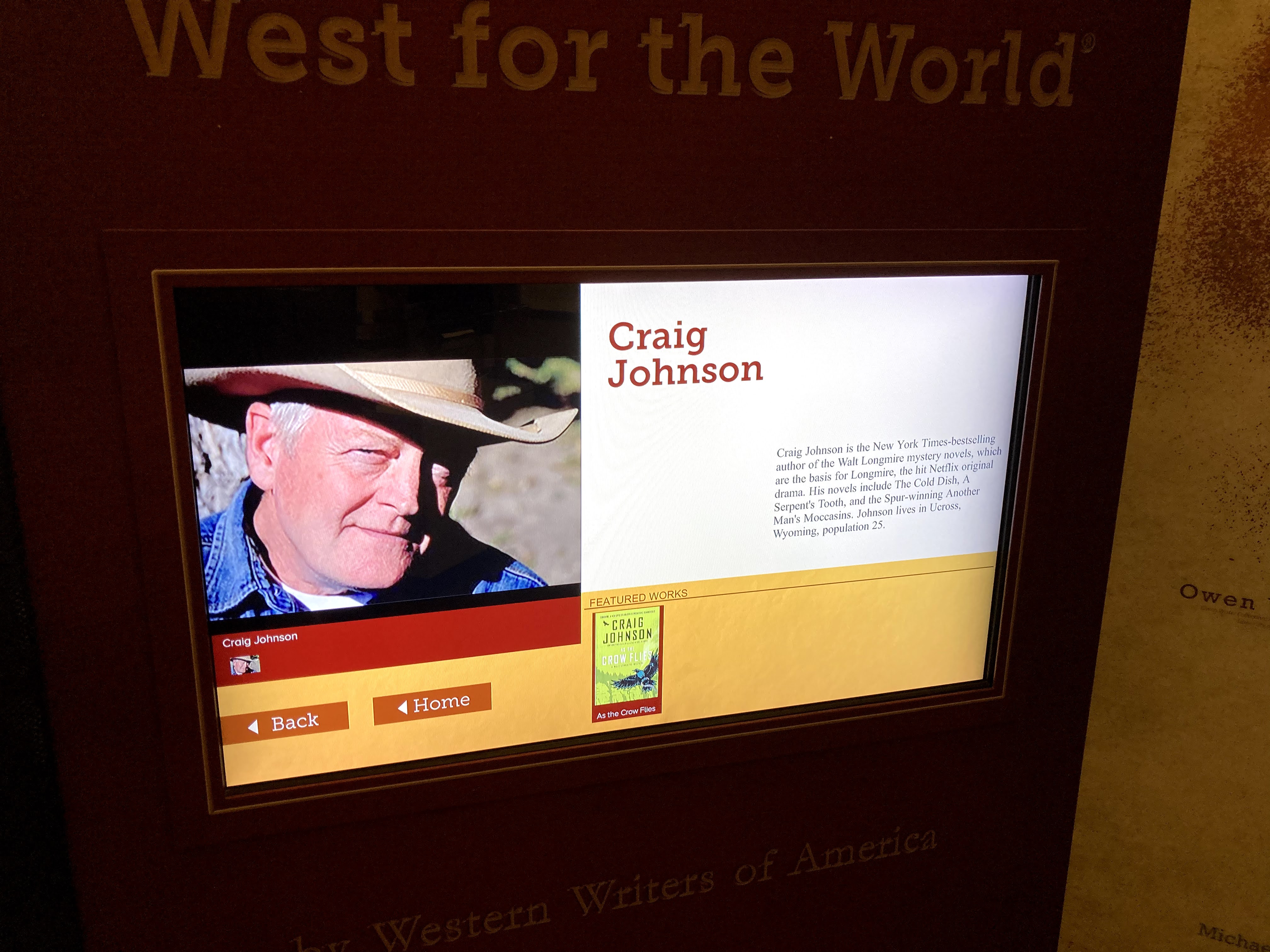
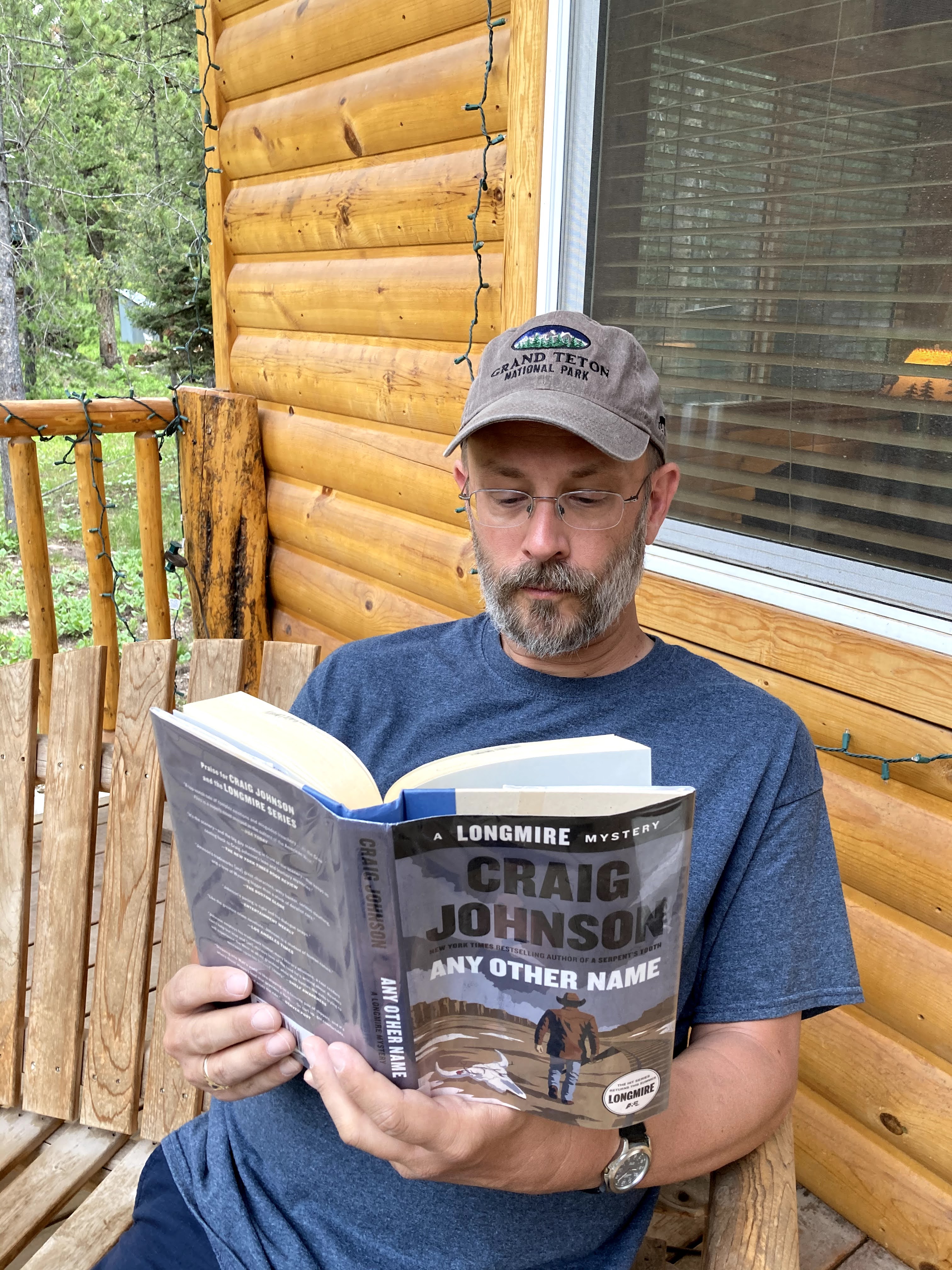
I am a huge fan of the Longmire novels by Craig Johnson, so when we prepared for our trip to the West, I packed one of them.  As a side note, serious readers spend more time deciding which books to pack for a vacation than they do clothes.  I have been re-reading the Longmire series in order and was in the middle of Any Other Name, so that went into my bag along with a few other books.  Craig Johnson is an award-winning author who is featured in the The Buffalo Bill Center of the West in Cody, Wyoming.  For another side note, this is an amazing site that is home to five separate museums:  The Buffalo Bill Museum, The Plains Indians Museum, The Cody Firearms Museum, The Draper Natural History Museum, and The Whitney Western Art Museum.


Craig crafts stories that invite readers into another world and make them long to return once the last page has been turned.  His characters are carefully and exquisitely crafted, and the settings he describes rightfully hold a place as participants every bit as vivid as the human players.  How, then, does one whose inner child has not been lost enter into such tales?


For starters, I wanted to read one of these novels while in the places near where they are set.  I read while we stayed at Airbnbs in Driggs and Island Park, Idaho, and in the Wyoming cities of Cheyenne and Cody.  In the liner notes to John Cougar Mellencamp's 1985 album Scarecrow, we find this.  "The highway between John's house and the studio where these songs were recorded cuts through a stretch of Indiana where the land is fertile and full of growth.  It is from this land and its people that these songs are born, and though it is not necessary to know this to enjoy and appreciate them, it does lend a certain understanding for those who care to think about such things."  Serious readers care to think about such things, and it was one way for me to enter into the stories that Craig has created by reading them in the West.  But wait, as the informercials say.  There's more.


The Busy Bee Café often provides nourishment for main protagonist Sheriff Walt Longmire, and though in the books it sits in the fictitious town of Durant, Wyoming, in reality it exists in Buffalo, where we made a stop just to get this picture.  Actually, we would have eaten there, but the Bee is closed on Sundays.  Had it been open, I would have ordered Walt's usual, but to find out what that is you will need to read the books.


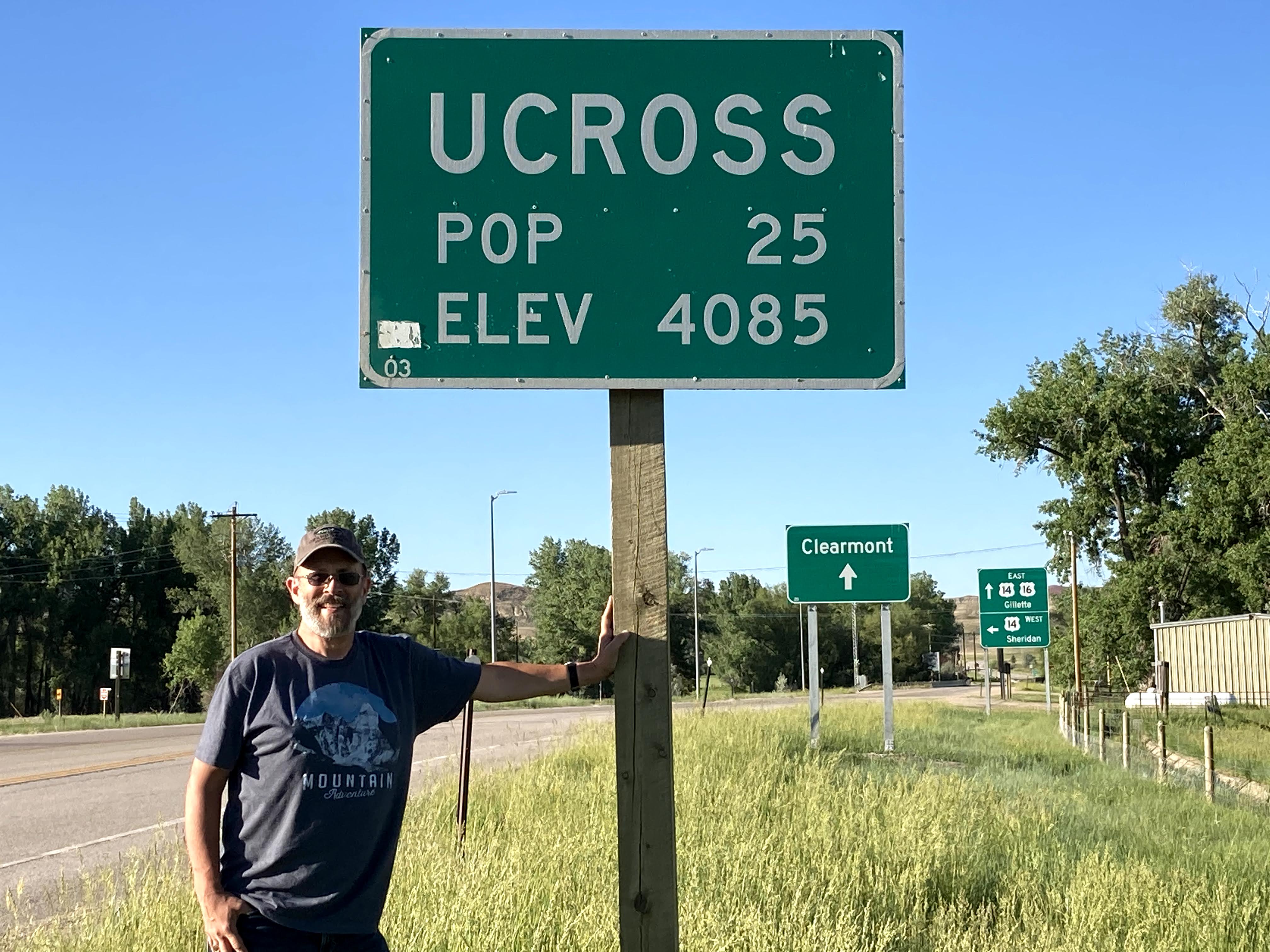
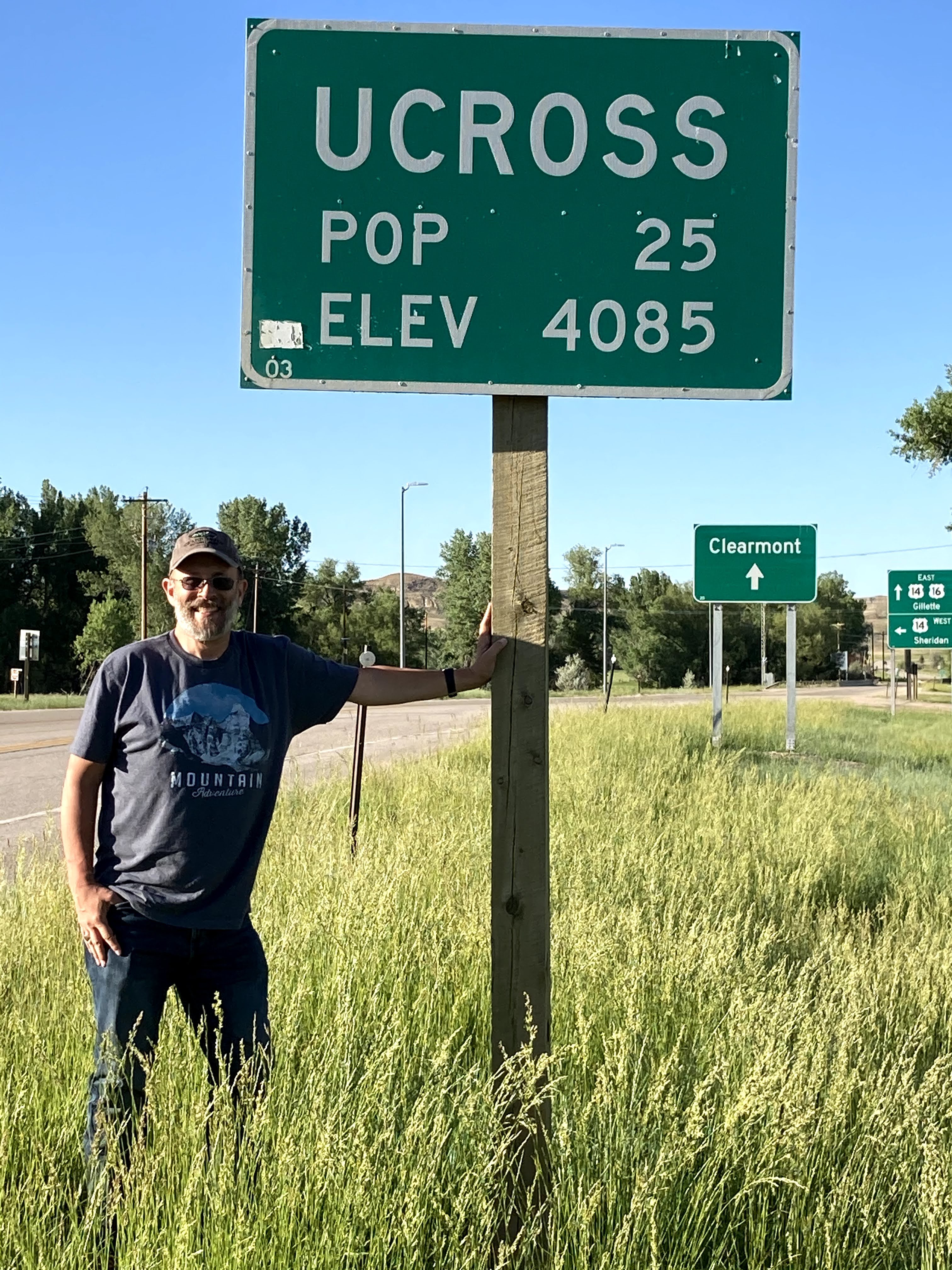
Yet the picture I was most excited to take was with the road sign for Ucross, Wyoming, population 25.  That is the home of author Craig Johnson, a fact of which he is so proud that he made it his Twitter handle, @ucrosspop25.

Now, before you start thinking this is all a bit much, I will have you know that thousands (no exaggeration) of people liked these pictures in the various Longmire fan groups on Facebook.  I would also point out that you probably own some apparel dedicated to your favorite sports figures or musicians, and this leads us back to the point of this post.  We like to enter into other stories.  It is part of the human nature.  Why do you think Homer's Iliad has been so popular for nearly three thousand years?  We thrill to the adventures of Achilles and Hector and if only for a short time are transported to places we can only imagine, gaining new perspectives on life as we go.

Thus ends the literary portion of this post, and thus begins the educational.  Teachers have an opportunity as no one else does to help young people enter into other stories.  In fact, although it may not be written in their job description, it is one of the most important things they do.  From Kindergarten through twelfth grade, a child's understanding is quite limited.  Children simply have not lived much life, yet they can grow far beyond the constraints of time and space through entering into the grand stories of history, science, literature, and the arts.  Their teachers, however, must be guides who have not lost their own love of entering into stories.  A dry, crabbed person is not a fit companion for adventure.

And as the educational section of this comes to a close, I invite those who are interested to consider a theological one as well.  God entered created the most dynamic, breathtaking, and adventurous of stories when He spoke reality into existence and formed us in His image.  He then entered that story in the person of Jesus Christ so that we could in turn enter more fully into His story, which is the story of life.  The story of God and His people is not one solely or even primarily of rules and regulations and spectacular punishments.  It is a story of shared life made possible by the death and resurrection of Jesus, Who entered the story of each and every person, whether someone accepts it or not.

What are the stories that have shaped you?  Which stories have you tried to enter and how?  I would love to hear from you in the comments!

Thursday, May 6, 2021

On Not Going Gentle

Authentic teaching is a vocation.  It is a calling.

George Steiner, Lessons of the Masters, 16


I have no idea how to express what I feel as I plan to leave the school where I have taught for nearly a quarter century, the vast majority of my thirty-year career.  There is no one I can ask to advise me on how to put these feelings into words.  I could sooner get an answer to Rodgers's and Hammerstein's seemingly whimsical question, "How do you hold a moonbeam in your hand?"  Then again, there is Pascal.  "Le coeur a ses raisons que la raison ne connaît point," (Pensées, 423/277).  "The heart has its reasons that reason knows not of."  And so, while Prufrock may have wondered whether to eat a peach, I will not inquire how to convey emotion verbally.  There is no Lucretian swerve powerful enough to combine the alphabetic atoms into prose or poetry worthy of the task.  Instead, let us consider why there should be such profound emotion connected with something as simple as retirement.

For thirty years I have taught Latin at either the middle school, high school, or undergraduate level.  The most recent twenty-three have been at North Central High School in Indianapolis, Indiana.  Brilliant colleagues with whom I conversed regularly about philosophy, art, language, science, world affairs, and politics made it a scholar's dream, yet it was the students, the insightful, intellectually curious, creative, and boundlessly energetic students who made this so much more than a mere job, and therein lies the first clue to why so much emotion has been caught up in my leaving.

"Authentic teaching is a vocation.  It is a calling."  This observation from George Steiner's Lessons of the Masters, which is perhaps my favorite sustained treatise on education, starts us in the right direction.  There are many forgeries in education, just as there are in any area of life.  The cheap knockoffs display the trappings of teaching but are driven by formulas and fads and are given value only by inept instruments of testing.  These are not our concern here.  Our interest is in authentic teaching, and of this Steiner goes on to say, "The teacher is aware of the magnitude and, if you will, mystery of his profession, of that which he has professed in an unspoken Hippocratic oath.  He has taken vows," (p. 17).

There is a religious cast to this, seen in words like "mystery," "oath," and "vows," and this is right.  Matters of faith and religion connect the human with the transcendent, and a teacher, no less than a priest, is a pontiff, which, as the Latin root pontifex reveals, is a bridge builder.  Teachers help to connect students with ideas, with others, with themselves, and at times even with what lies beyond it all.  How could a teacher not be aware of the magnitude of the profession, another word with religious undertones?  Such work is sacred work, and just as one does not loudly and vulgarly stampede from a cathedral, one does not simply walk away from the place and people with whom he has engaged in such work.

I was stunned at the beginning of my career, as I am now, that I am paid to do what I do, and although I certainly support higher salaries for teachers, there is something a bit odd about being paid at all.  Steiner asks, "How can vocation be put on a payroll?  How is it possible to price revelation?  Why have I been remunerated, given money, for what is my oxygen and raison d'être?  By what oversight or vulgarization should I have been paid to become what I am?" (p. 19).

Stay with this for a moment.  Yes, teachers must live and maintain a living, but when you consider the magnitude and mystery of what is really taking place when one teaches and another learns, does that truly seem something about which you can establish a monetary value?

Some will say that both Steiner and I are getting a bit above ourselves.  After all, what we call teaching covers some rather mundane things, like teaching a child the alphabet or basic math facts, but I would counter that the authentic teacher never merely teaches discrete pieces of knowledge.  As Steiner puts it, "The choice...is between 'life' and the disinterested...pursuit of pure thought," (p. 70).

Now we are getting somewhere.  This is all about life.  Education is a distinctly, indeed supremely, human endeavor.  It is a shared journey of discovery.  This is why Steiner can say that teaching is his "oxygen and raison d'être," as it has been mine.  These students and I, we are all fearfully and wonderfully made, and even in discussing the most simple or trivial of points, it is we, we human beings, who are doing the discussing.  I should confess here that I would have been a failure as an administrator.  Administrators are required by local statutes and state laws to evaluate teachers and students by criteria that, if not entirely meaningless, have less meaning for me.  Yes, of course, students must leave a class knowing certain things, but the true evaluation of what has taken place in that class, which is to say the measure of the value that comes out of it, is life.  Has what transpired, i.e. been breathed across, in the classroom given birth to or fostered the growth of life?  And how would one know if it had?  Ask yourself how you determine the life in anything.  You see signs of it.  In the life-bringing, life-giving classroom, you will find love, joy, happiness, curiosity, smiles, laughter, and the desire to discover and create.  Such things do not fit well in a spreadsheet, and once again we are back to the manual capture of moonbeams.

In the annals of those teachers who have breathed forth life in and with their students, we typically recall the great figures of history or a dear teacher of our own.  Rarely do we look to mythology and literature, and this is a sad consequence of how so much of our literature is taught today.  We mine it for rhetorical features and agendas and ignore the role that story has always played, to teach and to edify, to warn and to model.  Yet Steiner, for whom almost no literature was unfamiliar, finds the exemplary teacher in the centaur Chiron.  "Half beast, half man, Chiron embodies wisdom when it is energy, the natural order when it branches, in dangerous beauty, into the human.  He is the 'noble Pedagogue' par excellence.  His pupils form a constellation like no other:  Chiron has taught Orpheus, Jason and the Argonauts, Hercules, Asclepius, begetter of medicine.  He has borne the child Achilles on his back.  Chiron has educated 'for its glory a Heldenvolk,' 'a nation of heroes.'  What scholastic 'Magnificence' can be set beside the Centaur's?" (p. 72).

Have you ever thought of teaching as the natural order branching in dangerous beauty into the human?  Such a view sees teaching as far more than instructional strategies.  Once again we see life.  There it is in nature and branching, which, as opposed to mere static branches, suggests growth.

Steiner cites the following as a creed of 19th century French philosopher and teacher Jules Lagneau.  [T]he only thing which can be fruitful is a living instruction, a teaching by and of the entire soul, of the whole person, of life," (p. 105).

Given that, can you wonder that my departure from such a long period of teaching among a particular group of people should cause me sorrow?  Yet, it is time.  I am retiring from North Central High School.  Another will teach Latin here and, hopefully, strive to attain to some of the vision of teaching that Steiner describes.  That teacher will succeed in some areas and will fail in others, just as I have, but as Robert Browning reminds us, "a man's reach should exceed his grasp/Or what's a heaven for?"